
What does uterine artery Doppler reflect in late pregnancy? Insights from angiogenic, hemodynamic, and vascular markers in preeclampsia
Listen to this summary
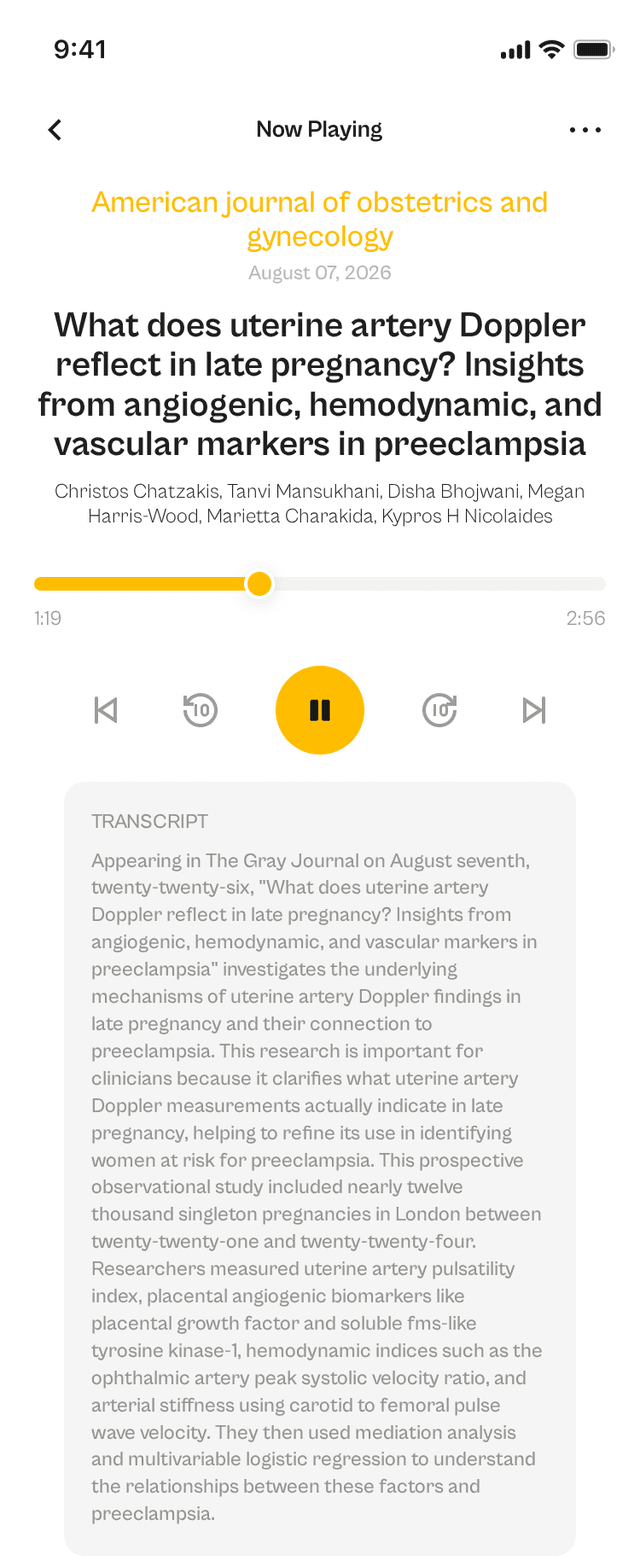
The authors aimed to clarify the relationship between uterine artery Doppler findings at 35-36 weeks of gestation and the occurrence of preeclampsia by examining the contributions of placental angiogenic, hemodynamic, and vascular factors. Their findings indicate that while uterine artery Doppler reflects biological processes related to placental dysfunction, it does not independently predict preeclampsia when accounting for other angiogenic and hemodynamic markers. Specifically, an imbalance in placental angiogenic factors, particularly higher levels of sFlt-1 and lower levels of PlGF, was found to be significantly associated with increased preeclampsia risk.
This is one of 33,000+ journals available on OSLR. Try it free for 14 days.
Free 14-day trial. 33,000+ journals. Cancel anytime.
More from American journal of obstetrics and gynecology
View all →Aug 4, 2026 · American journal of obstetrics and gynecology
Ultrasound-guided robotic myomectomy using a drop-in probe
Jul 31, 2026 · American journal of obstetrics and gynecology
Antidepressant Continuation in Pregnancy and Postpartum Depression Risk Across Racial and Ethnic Groups
Jul 30, 2026 · American journal of obstetrics and gynecology
Abnormal serum sFlt-1 and PlGF as markers of occult placental dysfunction and fetal risk in pregestational diabetes: A Prospective Masked Cohort Study
Jul 30, 2026 · American journal of obstetrics and gynecology
Coping Together: A Qualitative Exploration of Challenges Identified by Couples Living with Endometriosis
Jul 30, 2026 · American journal of obstetrics and gynecology
Antenatal magnesium sulfate prior to very preterm birth in routine care is associated with increased survival without cerebral palsy
Jul 23, 2026 · American journal of obstetrics and gynecology
Liquid Biopsy Cell-free RNA-based Machine Learning Enables Preoperative Risk-Stratification of Uterine Leiomyosarcoma
More in Obstetrics & Gynecology
View all →Aug 9, 2026 · Journal of minimally invasive gynecology
Letter to the Editor Regarding "Bowel Injuries Reported After NovaSure Endometrial Ablation: A 10-Year Review of FDA MAUDE Data." Title: "Bowel Injury Following Endometrial Ablation: A Plausible Mechanism and Prevention Strategy."
Aug 9, 2026 · Human reproduction (Oxford, England)
Preconception 1-hour blood glucose as an early indicator of gestational diabetes mellitus risk in PMOS/PCOS women undergoing IVF treatment: a multi-centre cohort study
Aug 9, 2026 · Journal of minimally invasive gynecology
Beyond the Mass Effect: Decoupling Endometrioma Size and Bilaterality from Ovarian Reserve Depletion
Aug 9, 2026 · Journal of ultrasound in medicine : official journal of the American Institute of Ultrasound in Medicine
High-Frequency Ultrasound Assessment of Female Genital Rejuvenation
Aug 9, 2026 · Journal of ultrasound in medicine : official journal of the American Institute of Ultrasound in Medicine
From ACR O-RADS 2022 to Explainable Deep Learning: Comparative Performance of Expert Radiologists, Convolutional Neural Networks, Vision Transformers, and Fusion Models for Ultrasound-Based Risk Stratification of Ovarian Masses
Aug 8, 2026 · Gynecologic oncology reports
Rescuing a refractory Leiomyosarcoma: ALK-DCTN1 fusion as a gateway to long-term control with Ceritinib
"Oslr has become part of my weekly routine on my day off. The clinical relevance of the summaries is outstanding — I'd rate it 9/10. Being able to consume research hands-free is a huge advantage for busy physicians."

Dr. Jennifer Thompson
Portland, OR
Stay current without falling behind
33,000+ journals. 3-minute audio summaries. Free for 14 days.