
Management of Patients with Medetomidine Withdrawal During Interfacility Transfer
Listen to this summary
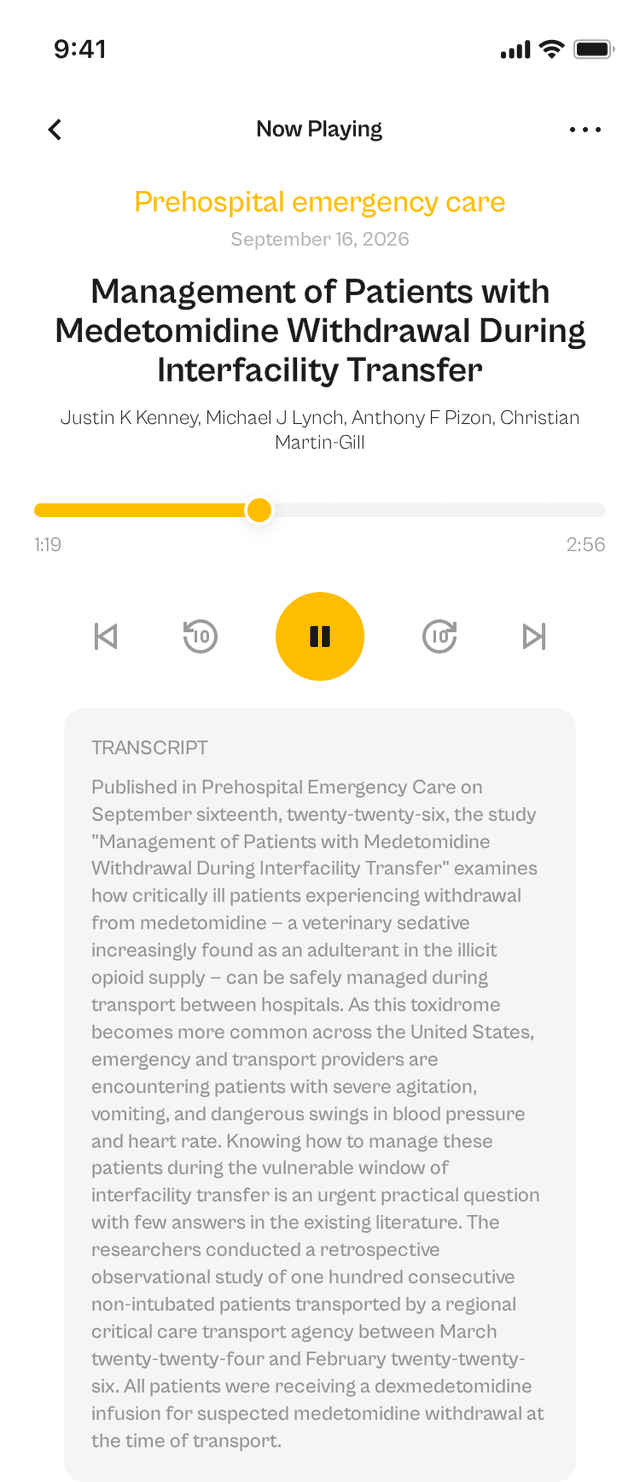
The authors aimed to evaluate the management and outcomes of patients experiencing medetomidine withdrawal during interfacility transport while receiving dexmedetomidine infusion. Their study found that while many patients exhibited significant withdrawal symptoms, such as hypertension and tachycardia, most remained stable on dexmedetomidine without requiring additional sedative infusions or advanced airway management. The findings suggest that early recognition of symptoms and continued pharmacologic support are crucial for safe transport of these patients.
This is one of 33,000+ journals available on OSLR. Try it free for 14 days.
Free 14-day trial. 33,000+ journals. Cancel anytime.
More from Prehospital emergency care
View all →Sep 23, 2026 · Prehospital emergency care
Repeat 9-1-1 Calls and Clinical Outcomes of Children After Non-Transport by Emergency Medical Services
Sep 21, 2026 · Prehospital emergency care
Enhancing Far-Forward Resuscitation: A Quantitative Laboratory Analysis of Blood Warmer Devices Used in Austere Environments
Sep 18, 2026 · Prehospital emergency care
A Causal Model for Prehospital Blood Transfusion and Mortality in Traumatic Hemorrhagic Shock
Sep 17, 2026 · Prehospital emergency care
Redesigning 9-1-1 Paramedic Pathways: Evaluation of the IMPACC Model of Care
Sep 17, 2026 · Prehospital emergency care
Practice Patterns and Performance of Pediatric Air Medical Tracheal Intubation: A National Multisite Cohort Study
Sep 17, 2026 · Prehospital emergency care
Differences in EMS Calls, Delays, and Payer Types in U.S. Southern Border Counties and Non-Border Counties
More in Emergency Medicine
View all →Sep 22, 2026 · The American journal of emergency medicine
Contrast agent substitution or corticosteroid premedication: association with emergency department throughput
Sep 22, 2026 · The American journal of emergency medicine
Acute kidney injury secondary to Djenkol bean ingestion
Sep 21, 2026 · The American journal of emergency medicine
The 2026 Surviving Sepsis Campaign Guidelines: The dissenting opinion
Sep 18, 2026 · The American journal of emergency medicine
Bedside predictors of left ventricular systolic dysfunction in children with suspected infection undergoing cardiac ultrasound
Sep 18, 2026 · The American journal of emergency medicine
Severe atomoxetine overdose presenting with status epilepticus and wide-complex ventricular tachycardia
Sep 18, 2026 · Emergency medicine journal : EMJ
Quantifying the impact of prehospital arterial line insertion on scene time
"Oslr has become part of my weekly routine on my day off. The clinical relevance of the summaries is outstanding — I'd rate it 9/10. Being able to consume research hands-free is a huge advantage for busy physicians."

Dr. Jennifer Thompson
Portland, OR
Stay current without falling behind
33,000+ journals. 3-minute audio summaries. Free for 14 days.