
Feasibility of Neurological Prognostication After Pediatric Cardiac Arrest with a Reduced Number of EEG Electrodes
Listen to this summary
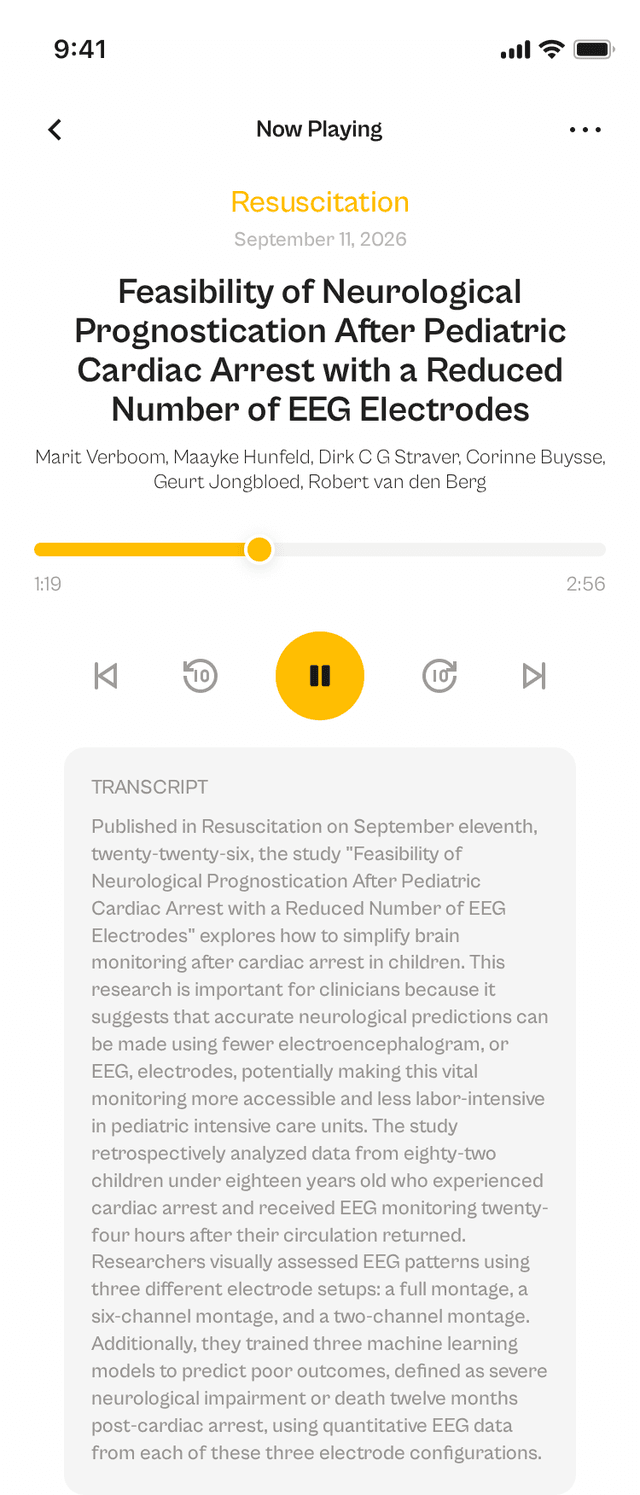
The authors aimed to determine whether reducing the number of EEG electrodes used for neurological prognostication after pediatric cardiac arrest (pCA) would affect the accuracy of visual assessments and machine learning models for predicting patient outcomes. Their study found that both visual classification and machine learning predictions of outcomes were comparable between full and reduced electrode montages, suggesting that fewer electrodes could be sufficient for effective monitoring without compromising prognostic accuracy.
This is one of 33,000+ journals available on OSLR. Try it free for 14 days.
Free 14-day trial. 33,000+ journals. Cancel anytime.
More from Resuscitation
View all →Sep 14, 2026 · Resuscitation
Out‑of‑Hospital Cardiac Arrest from Foreign Body Airway Obstruction: A Population‑Based Study in Victoria, Australia
Sep 14, 2026 · Resuscitation
Structured diagnostic strategies for psychological problems in cardiac arrest survivors: an important knowledge gap
Sep 11, 2026 · Resuscitation
Intravenous or Intraosseous Vascular Access in Cardiac Arrest: An Individual Participant Data Meta-Analysis
Sep 11, 2026 · Resuscitation
The impact of the World Restart a Heart (WRAH) initiative - inspiring regions, countries and people all over the world
Sep 11, 2026 · Resuscitation
Association of hypotension burden calculated from intermittently documented blood pressures and outcome after pediatric cardiac arrest
Sep 11, 2026 · Resuscitation
Association between the first post-resuscitation partial pressure of arterial carbon dioxide and neurologic outcomes in children with out-of-hospital cardiac arrest: a multicenter retrospective cohort study
More in Emergency Medicine
View all →Sep 23, 2026 · Prehospital emergency care
Repeat 9-1-1 Calls and Clinical Outcomes of Children After Non-Transport by Emergency Medical Services
Sep 22, 2026 · The American journal of emergency medicine
Contrast agent substitution or corticosteroid premedication: association with emergency department throughput
Sep 22, 2026 · The American journal of emergency medicine
Acute kidney injury secondary to Djenkol bean ingestion
Sep 21, 2026 · The American journal of emergency medicine
The 2026 Surviving Sepsis Campaign Guidelines: The dissenting opinion
Sep 21, 2026 · Prehospital emergency care
Enhancing Far-Forward Resuscitation: A Quantitative Laboratory Analysis of Blood Warmer Devices Used in Austere Environments
Sep 18, 2026 · The American journal of emergency medicine
Severe atomoxetine overdose presenting with status epilepticus and wide-complex ventricular tachycardia
"Oslr has become part of my weekly routine on my day off. The clinical relevance of the summaries is outstanding — I'd rate it 9/10. Being able to consume research hands-free is a huge advantage for busy physicians."

Dr. Jennifer Thompson
Portland, OR
Stay current without falling behind
33,000+ journals. 3-minute audio summaries. Free for 14 days.