
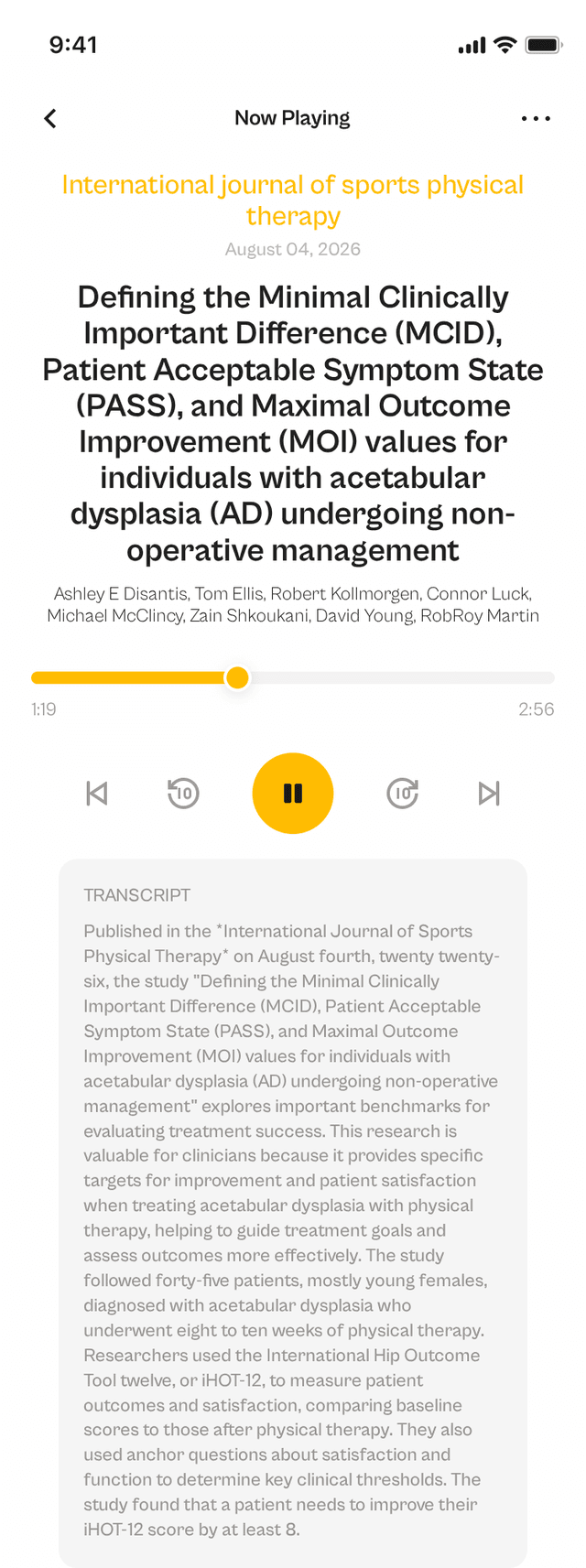
Defining the Minimal Clinically Important Difference (MCID), Patient Acceptable Symptom State (PASS), and Maximal Outcome Improvement (MOI) values for individuals with acetabular dysplasia (AD) undergoing non-operative management
Listen to this summary
The authors aimed to define key clinically important outcome values for the International Hip Outcome Tool 12 (iHOT-12) in individuals with acetabular dysplasia undergoing physiotherapy. They established the minimal clinically important difference (MCID) as 8.5 points, a patient acceptable symptom state (PASS) change score of 15.2, an absolute PASS threshold score of 62, and a maximal outcome improvement (MOI) threshold of 22.9%. Despite reporting symptom improvement, only half of the participants expressed satisfaction with their functional status after treatment.
This is one of 33,000+ journals available on OSLR. Try it free for 14 days.
Free 14-day trial. 33,000+ journals. Cancel anytime.
More from International journal of sports physical therapy
View all →Aug 5, 2026 · International journal of sports physical therapy
Diagnostic Dilemma: Testing to Differentiate UCL Sprains From Flexor-Pronator Elbow Strains in the Overhead Athlete
Aug 4, 2026 · International journal of sports physical therapy
A Novel Way of Testing Hip Extension and Flexion Strength, and Strength Ratio in the Clinical Setting: Is it Reliable?
Aug 4, 2026 · International journal of sports physical therapy
Does Medial Knee Position Reflect Dynamic Knee Valgus? Comparing Kinematic Timing and Magnitude During a Three-Task Movement Screen
Aug 4, 2026 · International journal of sports physical therapy
Mixed-Nerve Silent Period Characteristics During Muscle Output Regulation in Healthy Athletes: Preliminary Findings and Comparison with a Single Postoperative Case
Aug 4, 2026 · International journal of sports physical therapy
Infrared Kinesiology Tape Increases Skin Temperature and Red Blood Cell Flux at Rest
Aug 4, 2026 · International journal of sports physical therapy
Rapid Re-activation of Functionally Inhibited Hamstring Muscles via Real-Time EMG Visual Feedback in an Asymptomatic Masters Sprinter: A Case Report
More in Physical Therapist
View all →Aug 9, 2026 · Orthopaedic journal of sports medicine
Modified Postoperative Rehabilitation Including Dynamic Posterior Cruciate Ligament Brace to Reduce Recurrence of Posterior Tibial Translation After Posterior Cruciate Ligament Reconstruction: A Retrospective Comparative Cohort Study
Aug 9, 2026 · Orthopaedic journal of sports medicine
Comparison of Patellofemoral Degeneration After Three Types of High Tibial Osteotomy: Retrotuberosity Biplane Open-Wedge, Supratuberosity Biplane Open-Wedge, and Closed-Wedge Techniques
Aug 9, 2026 · Orthopaedic journal of sports medicine
The Impact of Preoperative Anxiety on the Incidence of Arthrogenic Muscle Inhibition After Anterior Cruciate Ligament Reconstruction
Aug 9, 2026 · Orthopaedic journal of sports medicine
Litigation Against Physicians Caring for Collegiate Athletes in the United States
Aug 9, 2026 · Orthopaedic journal of sports medicine
Prevalence of Capitellar Osteochondritis Dissecans and Medial Epicondylar Abnormalities in Female Youth Baseball Players: A Large-Scale Ultrasonographic Screening Study
Aug 9, 2026 · Orthopaedic journal of sports medicine
Association of Mental Health, Quality of Life, and Sport Specialization Using the Wisconsin Sport Specialization Questionnaire Among Adolescent Athletes
"Oslr has become part of my weekly routine on my day off. The clinical relevance of the summaries is outstanding — I'd rate it 9/10. Being able to consume research hands-free is a huge advantage for busy physicians."

Dr. Jennifer Thompson
Portland, OR
Stay current without falling behind
33,000+ journals. 3-minute audio summaries. Free for 14 days.