
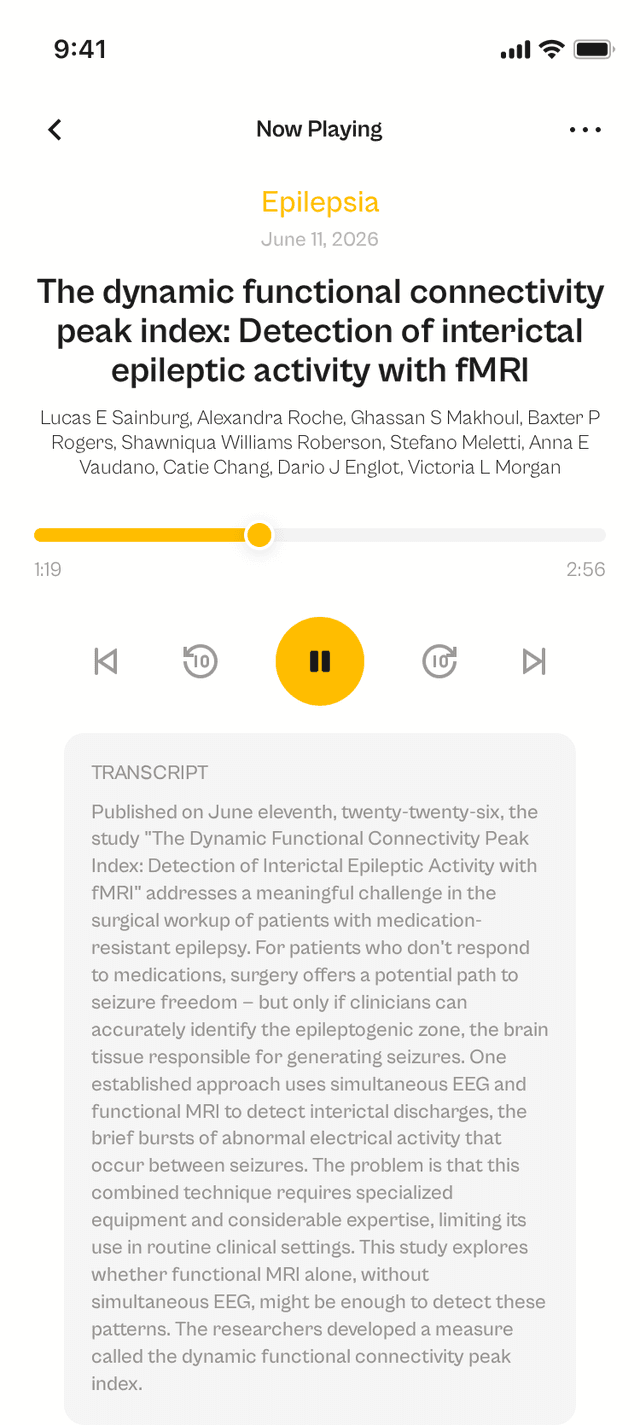
The dynamic functional connectivity peak index: Detection of interictal epileptic activity with fMRI
Listen to this summary
The authors aim to develop a method for localizing the epileptogenic zone (EZ) in patients with medication-resistant epilepsy using dynamic functional connectivity (dFC) measured by fMRI, without the need for simultaneous EEG. They hypothesize that the dFC peak index, which quantifies negative connectivity peaks following interictal discharges, will be elevated in epileptic tissue, particularly in temporal lobe epilepsy (TLE) patients. Their findings support this hypothesis, showing that elevated dFC peak index values correlate with better surgical outcomes, indicating its potential utility in guiding epilepsy surgery.
This is one of 33,000+ journals available on OSLR. Try it free for 14 days.
Free 14-day trial. 33,000+ journals. Cancel anytime.
More from Epilepsia
View all →More in Psychiatry & Neurology
View all →Sep 23, 2026 · The New England journal of medicine
Etuvetidigene Autotemcel for the Treatment of Wiskott-Aldrich Syndrome
Sep 23, 2026 · The New England journal of medicine
Clinical Uses of Common Genetic Variants Associated with Common Diseases
Sep 23, 2026 · The New England journal of medicine
Phase 1 Study of Anito-cel, a d-Domain BCMA CAR T Cell for Refractory or Recurrent Myeloma
Sep 23, 2026 · The New England journal of medicine
Effect of Screening with Multicancer Early-Detection Test on Late-Stage Cancer Diagnosis
Sep 23, 2026 · The American journal of psychiatry
Age-Associated Cognitive Deviations in Early-Onset Psychosis Patients and Their Siblings
Sep 22, 2026 · The American journal of sports medicine
Lateral Tibial Posterior Slope Induces Anterior Tibial Translation While Lateral-Medial Slope Difference Induces Internal Rotation: A Cadaveric Biomechanical Study
"Oslr has become part of my weekly routine on my day off. The clinical relevance of the summaries is outstanding — I'd rate it 9/10. Being able to consume research hands-free is a huge advantage for busy physicians."

Dr. Jennifer Thompson
Portland, OR
Stay current without falling behind
33,000+ journals. 3-minute audio summaries. Free for 14 days.