
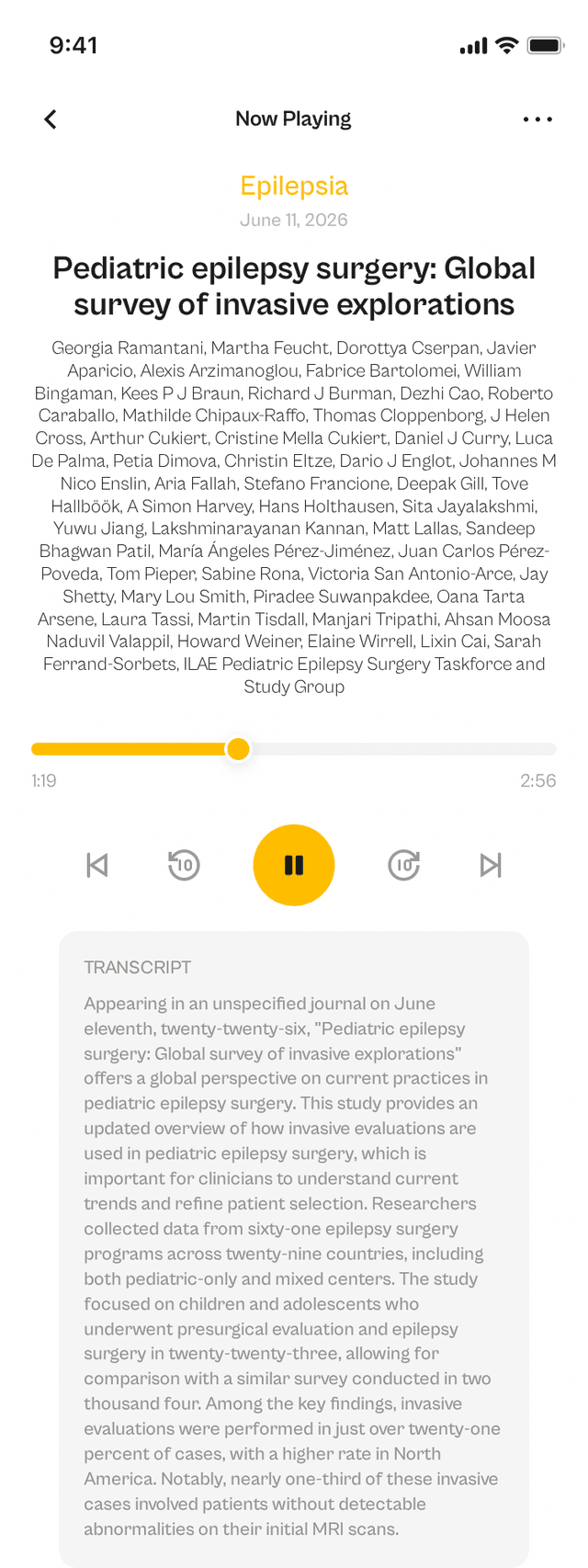
Pediatric epilepsy surgery: Global survey of invasive explorations
Listen to this summary
This study aims to provide an updated global overview of invasive evaluation practices in pediatric epilepsy surgery, particularly in MRI-negative cases. The authors found that invasive evaluations were performed in 21.1% of cases, with stereoelectroencephalography (SEEG) being the predominant technique. The findings highlight the complexity of surgical candidates, including a significant proportion of patients who did not proceed to surgical intervention, emphasizing the need for improved selection strategies.
This is one of 33,000+ journals available on OSLR. Try it free for 14 days.
Free 14-day trial. 33,000+ journals. Cancel anytime.
More from Epilepsia
View all →Jun 11, 2026 · Epilepsia
The dynamic functional connectivity peak index: Detection of interictal epileptic activity with fMRI
Jun 11, 2026 · Epilepsia
Diagnosis and management guidelines for infantile epileptic spasms syndrome around the world: A scoping review and comparative study of international approaches
More in Psychiatry & Neurology
View all →Sep 23, 2026 · The New England journal of medicine
Etuvetidigene Autotemcel for the Treatment of Wiskott-Aldrich Syndrome
Sep 23, 2026 · The New England journal of medicine
Clinical Uses of Common Genetic Variants Associated with Common Diseases
Sep 23, 2026 · The New England journal of medicine
Phase 1 Study of Anito-cel, a d-Domain BCMA CAR T Cell for Refractory or Recurrent Myeloma
Sep 23, 2026 · The New England journal of medicine
Effect of Screening with Multicancer Early-Detection Test on Late-Stage Cancer Diagnosis
Sep 23, 2026 · The American journal of psychiatry
Age-Associated Cognitive Deviations in Early-Onset Psychosis Patients and Their Siblings
Sep 22, 2026 · The American journal of sports medicine
Lateral Tibial Posterior Slope Induces Anterior Tibial Translation While Lateral-Medial Slope Difference Induces Internal Rotation: A Cadaveric Biomechanical Study
"Oslr has become part of my weekly routine on my day off. The clinical relevance of the summaries is outstanding — I'd rate it 9/10. Being able to consume research hands-free is a huge advantage for busy physicians."

Dr. Jennifer Thompson
Portland, OR
Stay current without falling behind
33,000+ journals. 3-minute audio summaries. Free for 14 days.