
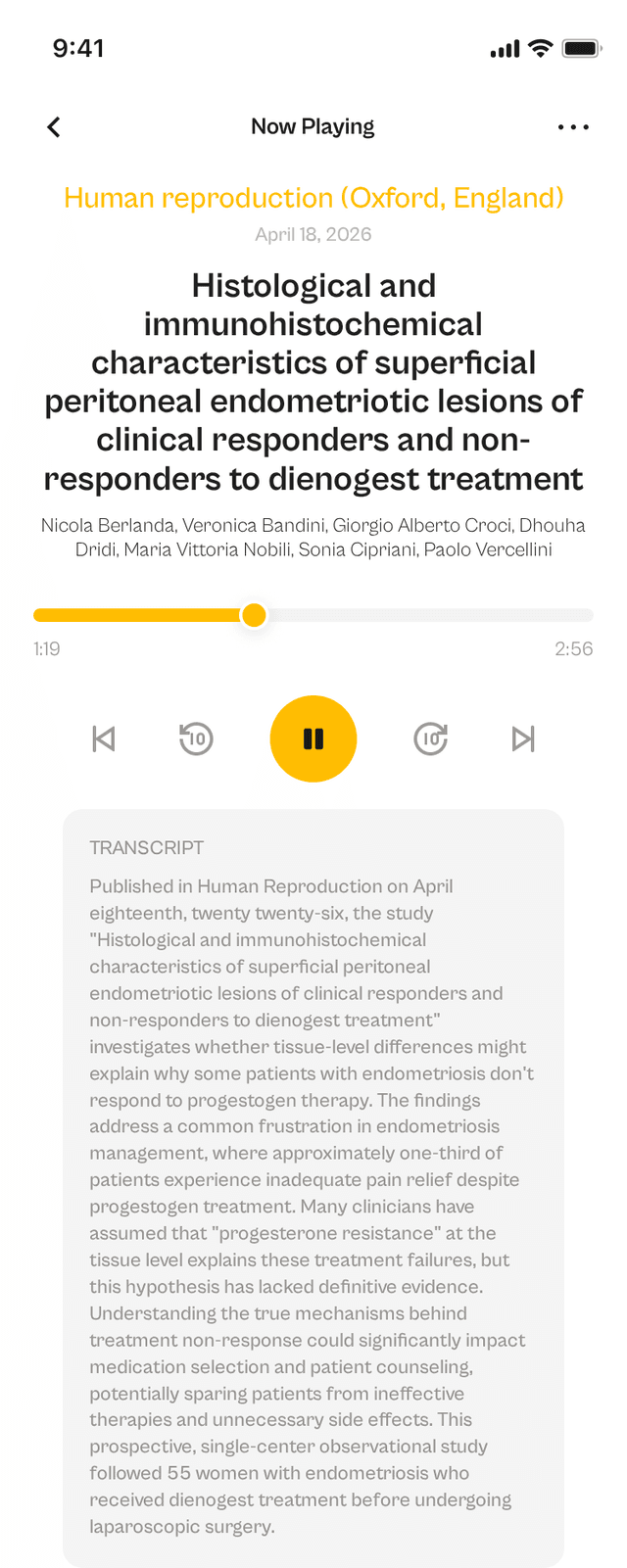
Histological and immunohistochemical characteristics of superficial peritoneal endometriotic lesions of clinical responders and non-responders to dienogest treatment
Listen to this summary
The authors aimed to investigate whether there are distinct histological and immunohistochemical characteristics in superficial peritoneal endometriotic lesions that could differentiate clinical responders from non-responders to dienogest treatment, potentially indicating progesterone resistance. Their findings revealed no significant differences in these characteristics between the two groups, suggesting that intrinsic progesterone resistance may not be the primary reason for treatment non-response in women with endometriosis. However, the study noted that the severity of specific symptoms like deep dyspareunia and dyschezia may be influenced by the expression of estrogen and progesterone receptors in the lesions.
This is one of 33,000+ journals available on OSLR. Try it free for 14 days.
Free 14-day trial. 33,000+ journals. Cancel anytime.
More from Human reproduction (Oxford, England)
View all →May 8, 2026 · Human reproduction (Oxford, England)
The International Glossary on Infertility and Fertility Care, 2025†
May 4, 2026 · Human reproduction (Oxford, England)
The impact of endometrial preparation on pregnancy loss in vitrified-warmed euploid blastocyst transfer cycles: a randomized controlled trial
Apr 30, 2026 · Human reproduction (Oxford, England)
Single-cell proteomics reveals cytoplasmic defects in Patl2-deficient oocytes rescued by spindle transfer
Apr 28, 2026 · Human reproduction (Oxford, England)
Sperm DNA fragmentation: how to test, when to test, and what to do with abnormal results-a pragmatic mini-review for clinical practice
Apr 28, 2026 · Human reproduction (Oxford, England)
A de novo C-terminal truncation mutation in NUP205 as a key factor in premature ovarian insufficiency
Apr 26, 2026 · Human reproduction (Oxford, England)
Once, twice, three times frozen: viability and post-transfer outcomes of fresh and vitrified-warmed mouse embryos
More in Obstetrics & Gynecology
View all →May 10, 2026 · American journal of obstetrics & gynecology MFM
Childhood maltreatment and pregnancy-related reproductive health in middle adulthood: A prospective investigation
May 10, 2026 · Prenatal diagnosis
Neuroimaging Findings and Risk Factors for Brain Injury in Foetuses Treated for Anaemia
May 10, 2026 · Prenatal diagnosis
Fetal Cranial Biometric Abnormalities: The Value of Routine Ultrasound for Early Diagnosis of Glutaric Acidemia Type 1
May 10, 2026 · Fertility and sterility
Transabdominal retrieval of oocytes when transvaginal access is not an option: mastering an egg-cellent technique
May 10, 2026 · American journal of obstetrics and gynecology
How Long Should Women Push? The Effect of Fetal Position, Parity, and Epidural Use on Spontaneous Delivery
May 10, 2026 · Contraception
Women's Attitudes Toward Over-the-Counter Oral Contraceptive Pills: A Cross-Sectional Survey
"Oslr has become part of my weekly routine on my day off. The clinical relevance of the summaries is outstanding — I'd rate it 9/10. Being able to consume research hands-free is a huge advantage for busy physicians."

Dr. Jennifer Thompson
Portland, OR
Stay current without falling behind
33,000+ journals. 3-minute audio summaries. Free for 14 days.