
How big is the time window for cell-free fetal DNA testing after pregnancy loss and which factors are associated with a successful result?
Listen to this summary
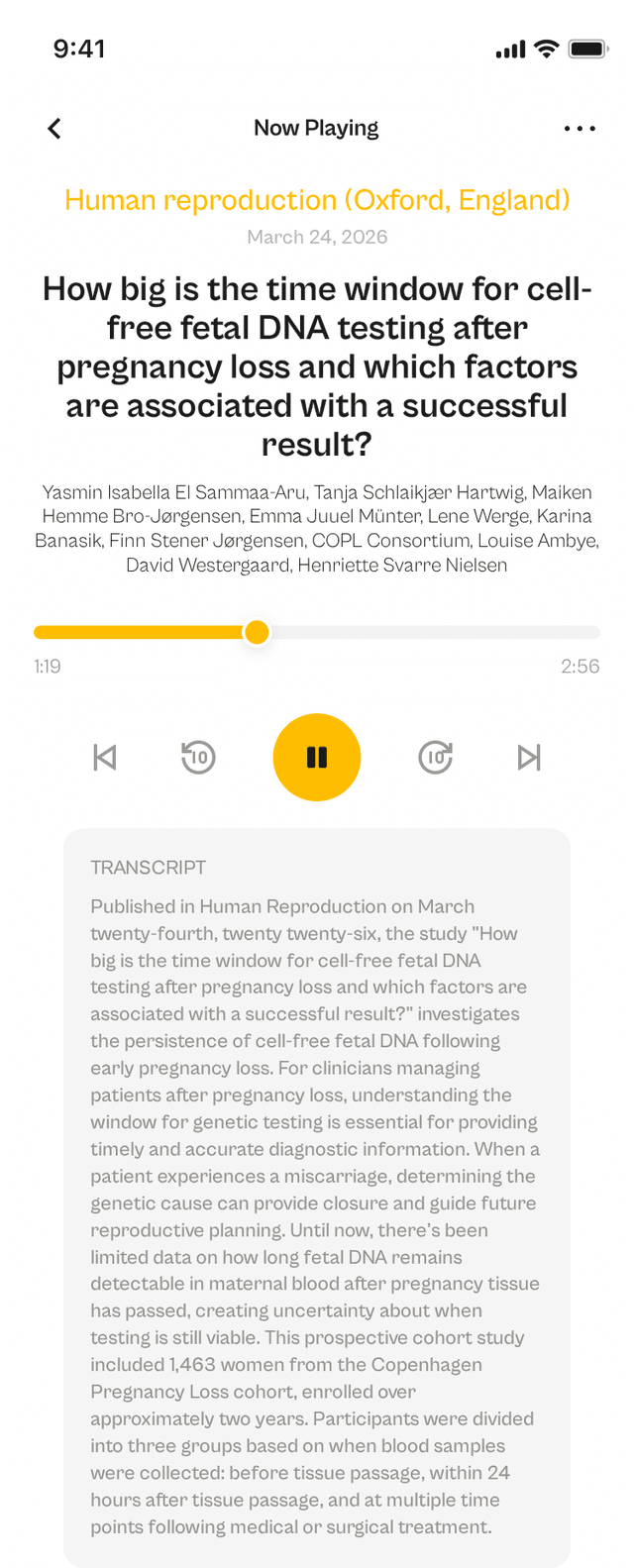
The authors investigate the decline of cell-free fetal DNA (cffDNA) following early pregnancy loss and the factors influencing its detectability. They find that cffDNA levels can remain detectable for up to three days post-tissue passage, with higher β-hCG levels correlating with increased odds of obtaining a conclusive test result. These findings suggest a need for refined cffDNA diagnostics to improve reproductive care and decision-making after pregnancy loss.
This is one of 33,000+ journals available on OSLR. Try it free for 14 days.
Free 14-day trial. 33,000+ journals. Cancel anytime.
More from Human reproduction (Oxford, England)
View all →Mar 24, 2026 · Human reproduction (Oxford, England)
Human stem cell-based embryo models: innovation, ethics, and policy
Mar 24, 2026 · Human reproduction (Oxford, England)
Early pregnancy concentrations of pregnancy-associated plasma protein-A (PAPP-A) and insulin-like growth factor-1 (IGF-1) following frozen embryo transfer: secondary analyses from a randomized controlled trial
Mar 24, 2026 · Human reproduction (Oxford, England)
Heat exposure during susceptible windows of spermatogenesis and sperm epigenetic age
Mar 23, 2026 · Human reproduction (Oxford, England)
Ovarian and reproductive hormone characteristics and risk of cycle cancellation in immediate versus postponed modified natural cycle frozen embryo transfer (mNC-FET) cycles
Mar 23, 2026 · Human reproduction (Oxford, England)
Periconceptional ultra-processed food consumption in women and men, fertility, and early embryonic development
Mar 23, 2026 · Human reproduction (Oxford, England)
Depression and anxiety among women going through medically assisted reproduction: a register-based cohort study
More in Obstetrics & Gynecology
View all →Mar 25, 2026 · The New England journal of medicine
A Placebo-Controlled Trial of the Oral PCSK9 Inhibitor Enlicitide
Mar 25, 2026 · Journal of minimally invasive gynecology
Pain severity and Magnetic Resonance Imaging as key factors in the management of accessory cavitated uterine malformation
Mar 25, 2026 · BJOG : an international journal of obstetrics and gynaecology
Effectiveness of Interventions to Improve Women's Experience of Pelvic Examinations: A Systematic Review and Meta-Analysis
Mar 25, 2026 · American journal of obstetrics & gynecology MFM
Factors associated with appropriate administration of magnesium sulfate for neuroprotection prior to early preterm birth
Mar 25, 2026 · Contraception
Reasons for contraceptive nonuse at two sites in Burkina Faso
Mar 24, 2026 · BJOG : an international journal of obstetrics and gynaecology
Impaired Hearing and Systolic Blood Pressure as Potential Markers of Cerebral Infarction After Eclampsia: A Cross-Sectional Study
"Oslr has become part of my weekly routine on my day off. The clinical relevance of the summaries is outstanding — I'd rate it 9/10. Being able to consume research hands-free is a huge advantage for busy physicians."

Dr. Jennifer Thompson
Portland, OR
Stay current without falling behind
33,000+ journals. 3-minute audio summaries. Free for 14 days.