
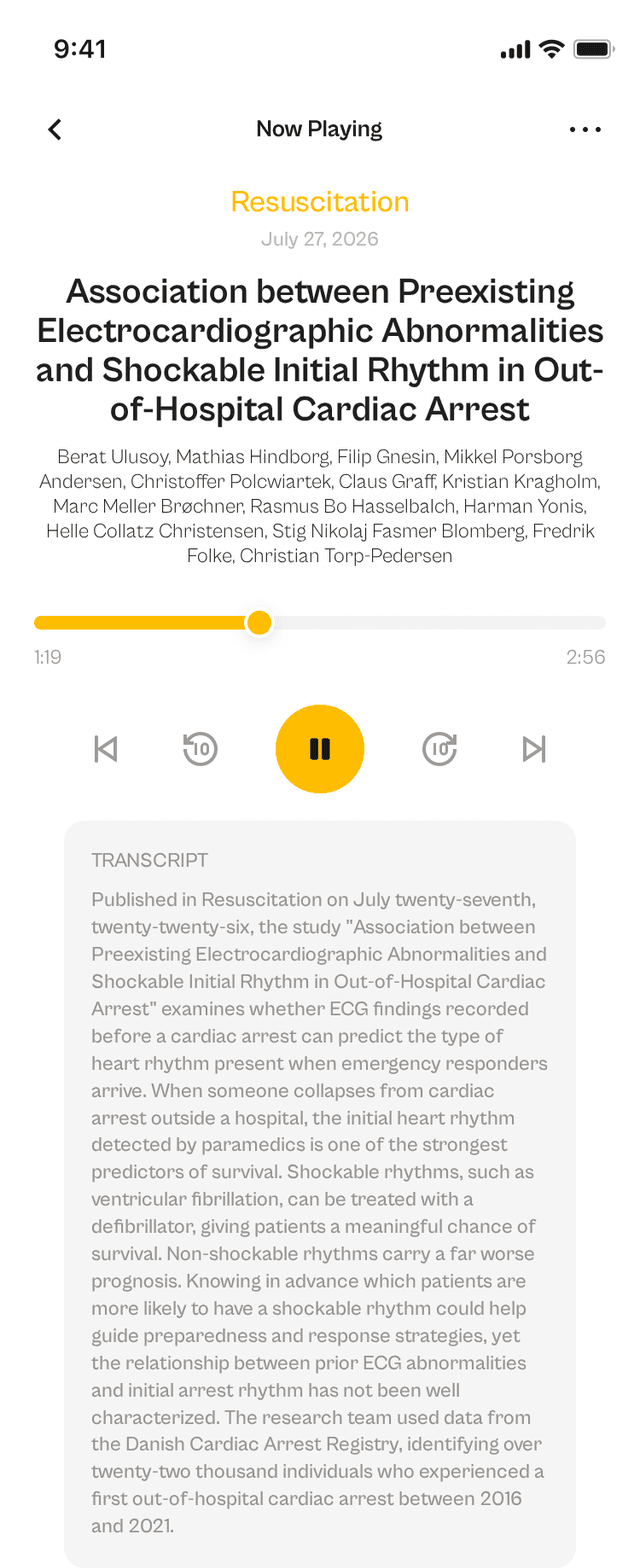
Association between Preexisting Electrocardiographic Abnormalities and Shockable Initial Rhythm in Out-of-Hospital Cardiac Arrest
Listen to this summary
This study investigates the relationship between preexisting electrocardiographic (ECG) abnormalities and the likelihood of a shockable initial rhythm in out-of-hospital cardiac arrest (OHCA). The authors found that specific ECG abnormalities, such as pathological Q-waves and left bundle branch block, were associated with higher odds of a shockable rhythm in bystander-witnessed arrests compared to individuals with normal ECGs. The findings suggest that prior ECGs may provide valuable prognostic information regarding the initial rhythm during OHCA events.
This is one of 33,000+ journals available on OSLR. Try it free for 14 days.
Free 14-day trial. 33,000+ journals. Cancel anytime.
More from Resuscitation
View all →Jul 27, 2026 · Resuscitation
Emergency response with lights and sirens to patients with a suspected out-of-hospital cardiac arrest and a do-not-attempt-resuscitation order in the hospital record: a one-year observational study
Jul 27, 2026 · Resuscitation
Incidence, outcomes, and temporal trends of pediatric in-hospital cardiac arrest in Japan: a nationwide study
Jul 27, 2026 · Resuscitation
Initial vascular access for neonatal resuscitation: a systematic review
Jul 23, 2026 · Resuscitation
Associations Between Pulsed Oxygen Saturation During Out-Of-Hospital Cardiopulmonary Resuscitation, Cardiopulmonary Resuscitation Quality and Return Of Spontaneous Circulation
Jul 23, 2026 · Resuscitation
Advanced Hemodynamic Monitoring During Post-Resuscitation Care After Out-of-Hospital Cardiac Arrest: A Scoping Review
Jul 23, 2026 · Resuscitation
Racial and Ethnic Differences in Bystander Cardiopulmonary Resuscitation for Opioid-Associated Out-of-Hospital Cardiac Arrests
More in Emergency Medicine
View all →Aug 8, 2026 · The American journal of emergency medicine
Paramedic perspectives on prehospital buprenorphine: A qualitative case study of implementation in emergency medical services
Aug 8, 2026 · The American journal of emergency medicine
Clinical selection of point-of-care EEG for seizure or altered mental status in a pediatric emergency department
Aug 7, 2026 · The American journal of emergency medicine
When dyspnea replaces chest pain: Age-dependent symptom profiles in ACS and non-ACS patients undergoing coronary angiography
Aug 6, 2026 · The American journal of emergency medicine
Concurrent cardiocerebral infarction in the emergency department: A case series from a tertiary care centre in South India
Aug 6, 2026 · The American journal of emergency medicine
Successful dispatcher-assisted CPR and outcomes after out-of-hospital cardiac arrest: an age-specific nationwide study
Aug 6, 2026 · The American journal of emergency medicine
Non-A, non-B aortic arch dissection with atypical presentation, ambiguous CTA findings, and therapeutic dilemma
"Oslr has become part of my weekly routine on my day off. The clinical relevance of the summaries is outstanding — I'd rate it 9/10. Being able to consume research hands-free is a huge advantage for busy physicians."

Dr. Jennifer Thompson
Portland, OR
Stay current without falling behind
33,000+ journals. 3-minute audio summaries. Free for 14 days.