
When dyspnea replaces chest pain: Age-dependent symptom profiles in ACS and non-ACS patients undergoing coronary angiography
Listen to this summary
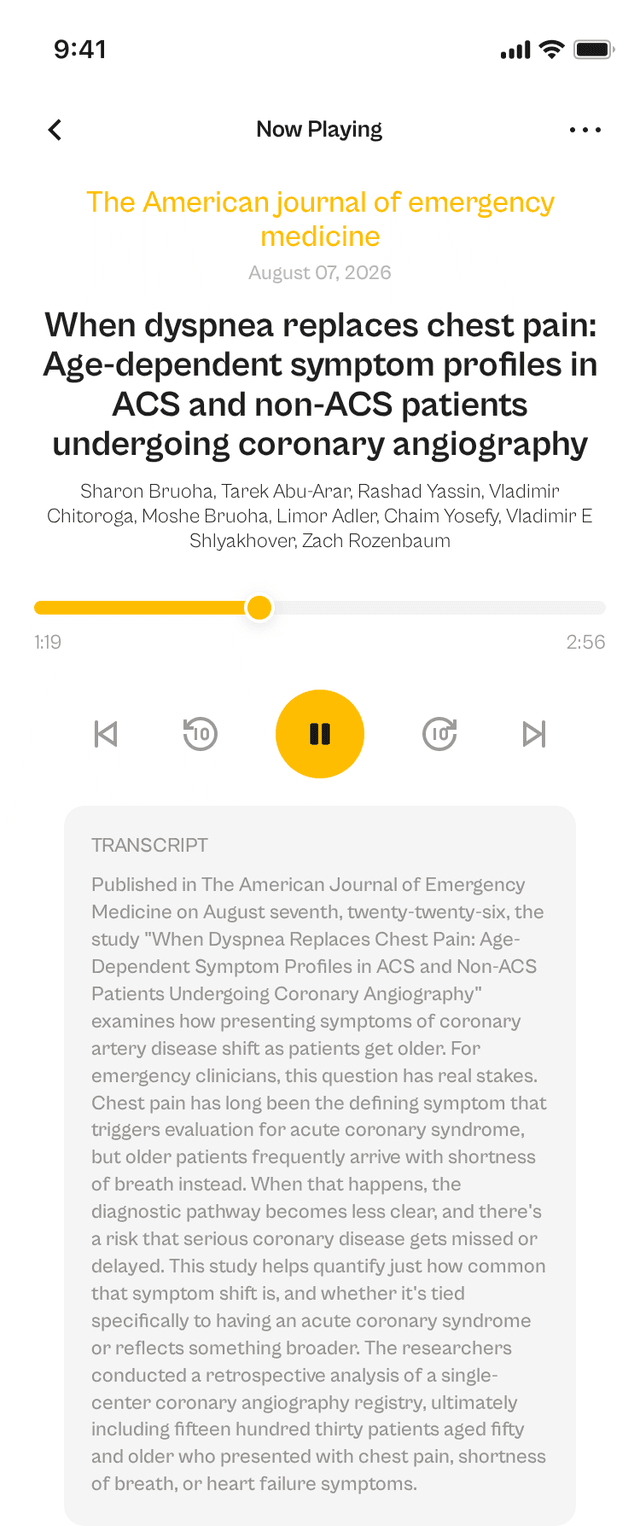
The authors investigated how age affects symptom presentation in patients undergoing coronary angiography, specifically whether older adults increasingly present with dyspnea instead of the typical chest pain associated with acute coronary syndrome (ACS). Their findings reveal a significant shift toward dyspnea-containing presentations with advancing age, occurring in both ACS and non-ACS patients, highlighting the need for careful evaluation of dyspnea as a high-risk symptom in older individuals. This suggests that dyspnea should be recognized as a critical indicator of potential coronary disease, rather than merely an atypical symptom in this demographic.
This is one of 33,000+ journals available on OSLR. Try it free for 14 days.
Free 14-day trial. 33,000+ journals. Cancel anytime.
More from The American journal of emergency medicine
View all →Aug 8, 2026 · The American journal of emergency medicine
Clinical selection of point-of-care EEG for seizure or altered mental status in a pediatric emergency department
Aug 8, 2026 · The American journal of emergency medicine
Paramedic perspectives on prehospital buprenorphine: A qualitative case study of implementation in emergency medical services
Aug 6, 2026 · The American journal of emergency medicine
Concurrent cardiocerebral infarction in the emergency department: A case series from a tertiary care centre in South India
Aug 6, 2026 · The American journal of emergency medicine
Successful dispatcher-assisted CPR and outcomes after out-of-hospital cardiac arrest: an age-specific nationwide study
Aug 6, 2026 · The American journal of emergency medicine
Non-A, non-B aortic arch dissection with atypical presentation, ambiguous CTA findings, and therapeutic dilemma
Aug 6, 2026 · The American journal of emergency medicine
Initial atropine dose of 0.5 mg versus 1 mg in unstable bradycardia: A propensity score-matched retrospective cohort study
More in Emergency Medicine
View all →Aug 4, 2026 · The western journal of emergency medicine
Comparison of Emergency Department Boarders Managed by a Critical Care Consult Service versus Standard Care
Aug 4, 2026 · The western journal of emergency medicine
Emergency Department-initiated Naltrexone for Alcohol Use Disorder: Association with Recidivism
Aug 4, 2026 · The western journal of emergency medicine
The Impact of Urinalysis Turnaround Times on Patient Disposition in the Emergency Department
Aug 4, 2026 · The western journal of emergency medicine
Potentially Avoidable Spine Transfers to a Level I Trauma Center: A Five-Year Retrospective Analysis
Aug 4, 2026 · The western journal of emergency medicine
Cultivating Environmentally Sustainable Emergency Departments with GreenED
Aug 4, 2026 · The western journal of emergency medicine
De-Labeling of Penicillin Allergy in the Emergency Department at a Veterans Affairs Hospital
"Oslr has become part of my weekly routine on my day off. The clinical relevance of the summaries is outstanding — I'd rate it 9/10. Being able to consume research hands-free is a huge advantage for busy physicians."

Dr. Jennifer Thompson
Portland, OR
Stay current without falling behind
33,000+ journals. 3-minute audio summaries. Free for 14 days.