
Emergency Department-initiated Naltrexone for Alcohol Use Disorder: Association with Recidivism
Listen to this summary
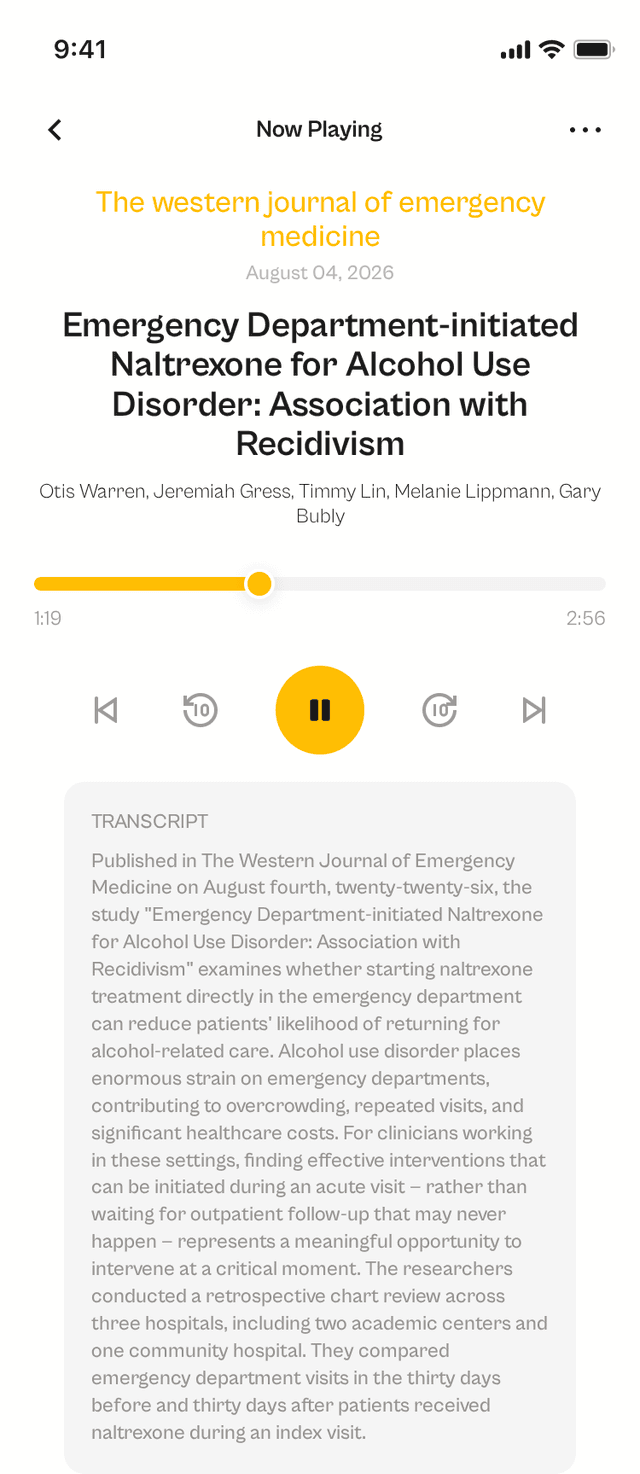
The authors aimed to determine whether administering naltrexone in the emergency department (ED) would reduce recidivism rates for alcohol use disorder (AUD) within 30 days post-treatment. While the overall study population showed no change in ED visit rates after naltrexone administration, frequent ED users (those with four or more visits in the preceding 90 days) experienced a significant reduction in visits following treatment. This suggests that naltrexone may be beneficial for high-frequency ED users with AUD.
This is one of 33,000+ journals available on OSLR. Try it free for 14 days.
Free 14-day trial. 33,000+ journals. Cancel anytime.
More from The western journal of emergency medicine
View all →Aug 4, 2026 · The western journal of emergency medicine
The Impact of Urinalysis Turnaround Times on Patient Disposition in the Emergency Department
Aug 4, 2026 · The western journal of emergency medicine
De-Labeling of Penicillin Allergy in the Emergency Department at a Veterans Affairs Hospital
Aug 4, 2026 · The western journal of emergency medicine
Potentially Avoidable Spine Transfers to a Level I Trauma Center: A Five-Year Retrospective Analysis
Aug 4, 2026 · The western journal of emergency medicine
Cultivating Environmentally Sustainable Emergency Departments with GreenED
Aug 4, 2026 · The western journal of emergency medicine
Comparison of Emergency Department Boarders Managed by a Critical Care Consult Service versus Standard Care
Aug 4, 2026 · The western journal of emergency medicine
Unveiling Unwritten Curricula: Enhancing Junior Faculty Development in Academic Emergency Medicine
More in Emergency Medicine
View all →Sep 23, 2026 · Prehospital emergency care
Repeat 9-1-1 Calls and Clinical Outcomes of Children After Non-Transport by Emergency Medical Services
Sep 22, 2026 · The American journal of emergency medicine
Acute kidney injury secondary to Djenkol bean ingestion
Sep 22, 2026 · The American journal of emergency medicine
Contrast agent substitution or corticosteroid premedication: association with emergency department throughput
Sep 21, 2026 · Prehospital emergency care
Enhancing Far-Forward Resuscitation: A Quantitative Laboratory Analysis of Blood Warmer Devices Used in Austere Environments
Sep 21, 2026 · The American journal of emergency medicine
The 2026 Surviving Sepsis Campaign Guidelines: The dissenting opinion
Sep 18, 2026 · The American journal of emergency medicine
Bedside predictors of left ventricular systolic dysfunction in children with suspected infection undergoing cardiac ultrasound
"Oslr has become part of my weekly routine on my day off. The clinical relevance of the summaries is outstanding — I'd rate it 9/10. Being able to consume research hands-free is a huge advantage for busy physicians."

Dr. Jennifer Thompson
Portland, OR
Stay current without falling behind
33,000+ journals. 3-minute audio summaries. Free for 14 days.