
Peri-aortic fat to assess cardiovascular aging using an AI-driven radiomic biomarker
Listen to this summary
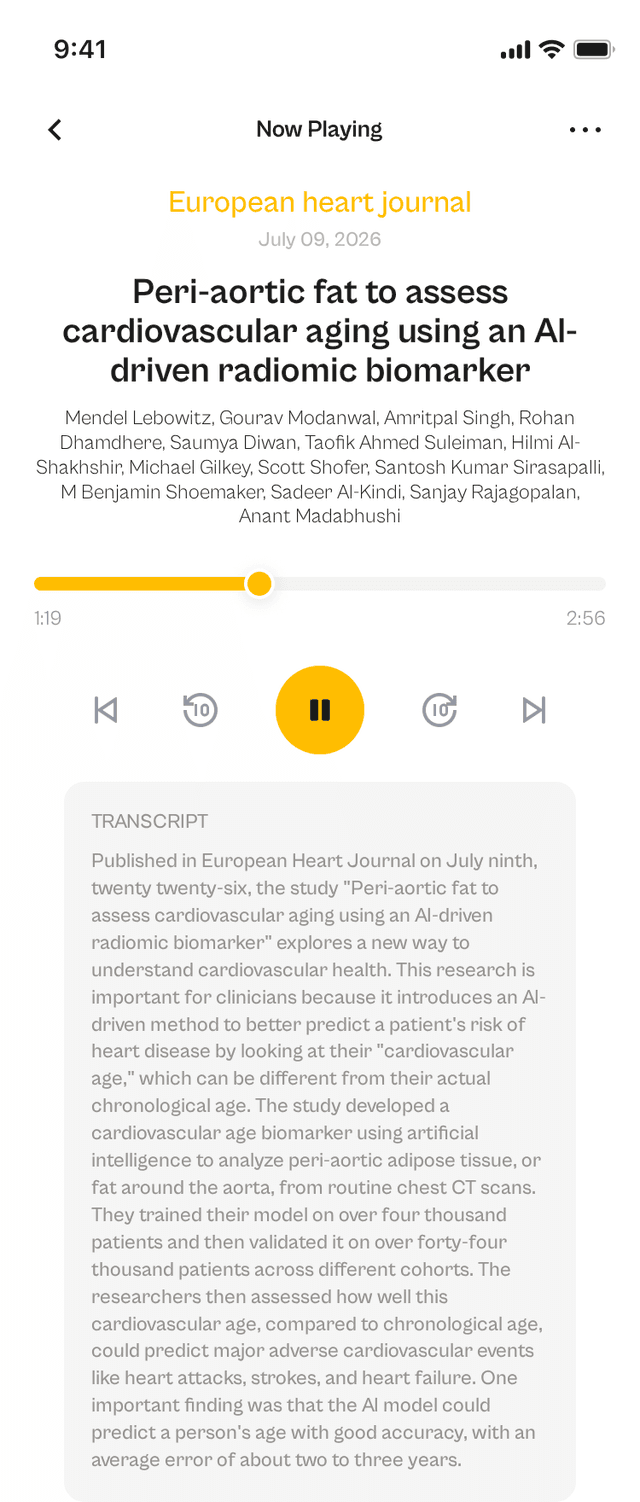
The authors aimed to develop a radiomic biomarker, termed cardiovascular age (CV-Age), based on peri-aortic adipose tissue (PAAT) from routine chest CT scans to better assess cardiovascular aging and its associated risks. They found that the PAAT-derived CV-Age, particularly the age gap (ΔAge) between CV-Age and chronological age, effectively stratified the risk of major adverse cardiovascular events (MACE) and improved risk classification compared to traditional age-based assessments. This study suggests that CV-Age can enhance the identification of individuals at higher cardiovascular risk who may otherwise be overlooked.
This is one of 33,000+ journals available on OSLR. Try it free for 14 days.
Free 14-day trial. 33,000+ journals. Cancel anytime.
More from European heart journal
View all →Jul 10, 2026 · European heart journal
Influenza vaccination, incident atrial fibrillation, and cardiovascular outcomes
Jul 9, 2026 · European heart journal
Transformer-based models for predicting cardiovascular risk in Chinese adults: development and validation
Jul 9, 2026 · European heart journal
Left ventricular recovery and outcomes in patients with a durable left ventricular assist device: the EUROMACS registry
Jul 9, 2026 · European heart journal
Standardized endpoint definitions for trials of transcatheter left atrial appendage closure: a consensus from the Left Atrial Appendage Academic Research Consortium†
Jul 9, 2026 · European heart journal
The dark genome in cardiovascular medicine
Jul 7, 2026 · European heart journal
Disrupted erythrocyte S1P-eNOS axis promotes hypoxia, hypertension and fibrosis in obstructive sleep apnoea-hypopnoea syndrome
More in Internal Medicine
View all →Jul 11, 2026 · Journal of addiction medicine
Multiple Substance Use Disorders From Adolescence to Midlife
Jul 11, 2026 · American heart journal
Antegrade dissection and re-entry versus retrograde strategy in chronic total occlusion percutaneous coronary intervention: Rationale and design of the ADRENALINE randomized study
Jul 11, 2026 · American heart journal
Integrative assessment of high-sensitivity C-reactive protein and lipid levels in predicting 20-year atherosclerotic cardiovascular disease risk, in a Mediterranean population: The ATTICA study (2002-2022)
Jul 11, 2026 · Journal of hepatology
Surveillance of patients at risk of liver cancer: Expert opinions
Jul 11, 2026 · American heart journal
Interpreting apparent differences among the major colchicine trials for cardiovascular prevention: a descriptive compatibility analysis
Jul 10, 2026 · JACC. Clinical electrophysiology
Comparison of Pacing Lead Design on Left Bundle Branch Pacing Outcomes: LEAD-LBBP Randomized Clinical Trial
"Oslr has become part of my weekly routine on my day off. The clinical relevance of the summaries is outstanding — I'd rate it 9/10. Being able to consume research hands-free is a huge advantage for busy physicians."

Dr. Jennifer Thompson
Portland, OR
Stay current without falling behind
33,000+ journals. 3-minute audio summaries. Free for 14 days.