
Association Between Time Spent in the Emergency Department and 30-Day Mortality: A Population-Level Observational Study in England
Listen to this summary
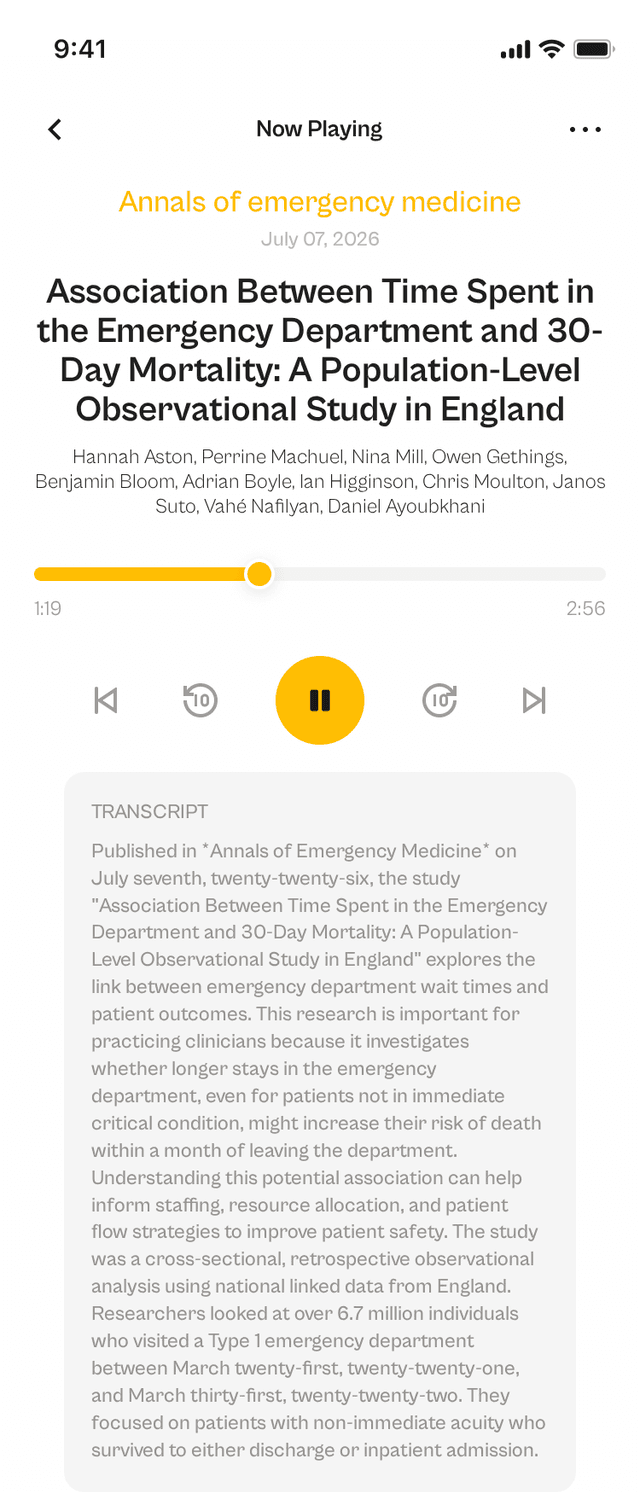
The authors aimed to investigate the relationship between the duration of stay in Type 1 emergency departments and the risk of all-cause mortality within 30 days after discharge or admission. Their analysis of over 6.7 million patients revealed that longer ED stays were associated with increased mortality risk, but the authors caution that this correlation may be influenced by confounding factors rather than a direct causal link, highlighting the need for further research to clarify these drivers.
This is one of 33,000+ journals available on OSLR. Try it free for 14 days.
Free 14-day trial. 33,000+ journals. Cancel anytime.
More from Annals of emergency medicine
View all →Sep 12, 2026 · Annals of emergency medicine
Implementation of Relative Value Unit-Based Physician Compensation in Emergency Physicians: Operational Evidence From a National Group
Sep 4, 2026 · Annals of emergency medicine
Childhood Mental Health-Related Visits and Emergency Department Pediatric Volume in the United States, 2016 to 2022
Sep 3, 2026 · Annals of emergency medicine
Will Artificial Intelligence Replace Me? Automation Susceptibility of Emergency Physician Tasks
Sep 1, 2026 · Annals of emergency medicine
Dexmedetomidine Continuous Infusion to Maintain Sedation in Severely Agitated Adolescents in the Emergency Department
Aug 19, 2026 · Annals of emergency medicine
Unscheduled Procedural Sedation Multidisciplinary Delphi Consensus Guidelines, Part 1: Principles, Oversight, and Quality Monitoring: Approved by the ACEP Board of Directors, April 29, 2026
Aug 19, 2026 · Annals of emergency medicine
Unscheduled Procedural Sedation Multidisciplinary Delphi Consensus Guidelines, Part 2: Clinical Practice: Approved by the ACEP Board of Directors, April 29, 2026
More in Emergency Medicine
View all →Sep 23, 2026 · Prehospital emergency care
Repeat 9-1-1 Calls and Clinical Outcomes of Children After Non-Transport by Emergency Medical Services
Sep 22, 2026 · The American journal of emergency medicine
Contrast agent substitution or corticosteroid premedication: association with emergency department throughput
Sep 22, 2026 · The American journal of emergency medicine
Acute kidney injury secondary to Djenkol bean ingestion
Sep 21, 2026 · The American journal of emergency medicine
The 2026 Surviving Sepsis Campaign Guidelines: The dissenting opinion
Sep 21, 2026 · Prehospital emergency care
Enhancing Far-Forward Resuscitation: A Quantitative Laboratory Analysis of Blood Warmer Devices Used in Austere Environments
Sep 18, 2026 · Prehospital emergency care
A Causal Model for Prehospital Blood Transfusion and Mortality in Traumatic Hemorrhagic Shock
"Oslr has become part of my weekly routine on my day off. The clinical relevance of the summaries is outstanding — I'd rate it 9/10. Being able to consume research hands-free is a huge advantage for busy physicians."

Dr. Jennifer Thompson
Portland, OR
Stay current without falling behind
33,000+ journals. 3-minute audio summaries. Free for 14 days.