
Neuroimaging and neurophysiology in infantile-onset epilepsy after neonatal stroke
Listen to this summary
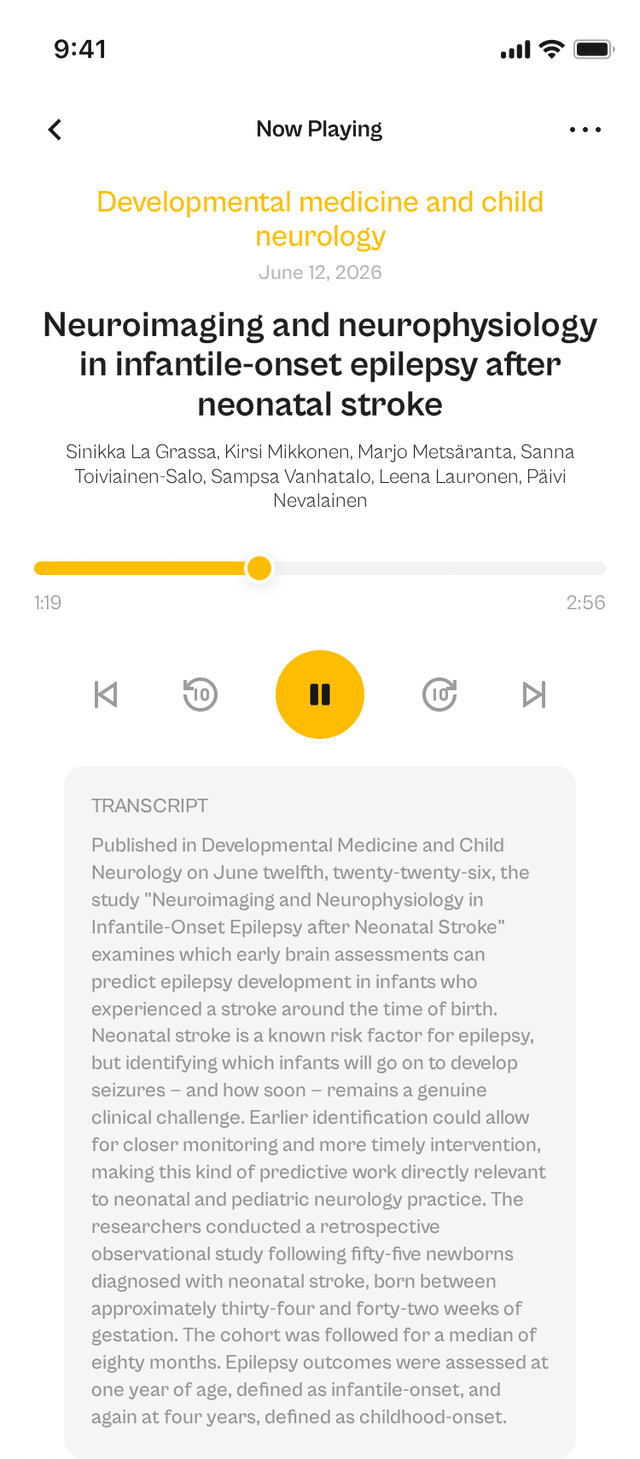
The authors aimed to identify neuroimaging and neurophysiological markers that could predict the onset of epilepsy in infants and children following neonatal stroke. Their study found that specific markers, such as proximal middle cerebral artery infarction and abnormal EEG patterns, were significantly associated with infantile-onset epilepsy, while asymmetry in neonatal EEG was linked to childhood-onset epilepsy. This research highlights the potential of neonatal neuroimaging and EEG findings in assessing the risk of epilepsy in affected children.
This is one of 33,000+ journals available on OSLR. Try it free for 14 days.
Free 14-day trial. 33,000+ journals. Cancel anytime.
More from Developmental medicine and child neurology
View all →Jun 12, 2026 · Developmental medicine and child neurology
Transition to adulthood: Perspectives from young people with cerebral palsy, parents, and health professionals
Jun 12, 2026 · Developmental medicine and child neurology
Musculoskeletal health among adults with cerebral palsy: A systematic review
Jun 1, 2026 · Developmental medicine and child neurology
Descripción actualizada de la parálisis cerebral
More in Pediatrics
View all →Sep 23, 2026 · The New England journal of medicine
Phase 1 Study of Anito-cel, a d-Domain BCMA CAR T Cell for Refractory or Recurrent Myeloma
Sep 23, 2026 · American journal of respiratory and critical care medicine
Combined results of the TETON-1 and TETON-2 Trials of Inhaled Treprostinil for Idiopathic Pulmonary Fibrosis
Sep 23, 2026 · American journal of respiratory and critical care medicine
Biologic outcomes in severe asthma patients by smoking status: evidence from SHARP
Sep 23, 2026 · The New England journal of medicine
Effect of Screening with Multicancer Early-Detection Test on Late-Stage Cancer Diagnosis
Sep 23, 2026 · Journal of clinical oncology : official journal of the American Society of Clinical Oncology
Five-Year Follow-Up of the Phase III ASCOT Trial of Adjuvant S-1 After Resection for Biliary Tract Cancer
Sep 23, 2026 · Pediatric nephrology (Berlin, Germany)
IPNA clinical practice recommendations for the management of aHUS and secondary TMA in children
"Oslr has become part of my weekly routine on my day off. The clinical relevance of the summaries is outstanding — I'd rate it 9/10. Being able to consume research hands-free is a huge advantage for busy physicians."

Dr. Jennifer Thompson
Portland, OR
Stay current without falling behind
33,000+ journals. 3-minute audio summaries. Free for 14 days.