
Comparison of Cerebral Hemodynamics among Hemodynamically Stable Preterm Small for Gestational Age and Appropriate for Gestational Age Neonates: A Prospective Cohort Study
Listen to this summary
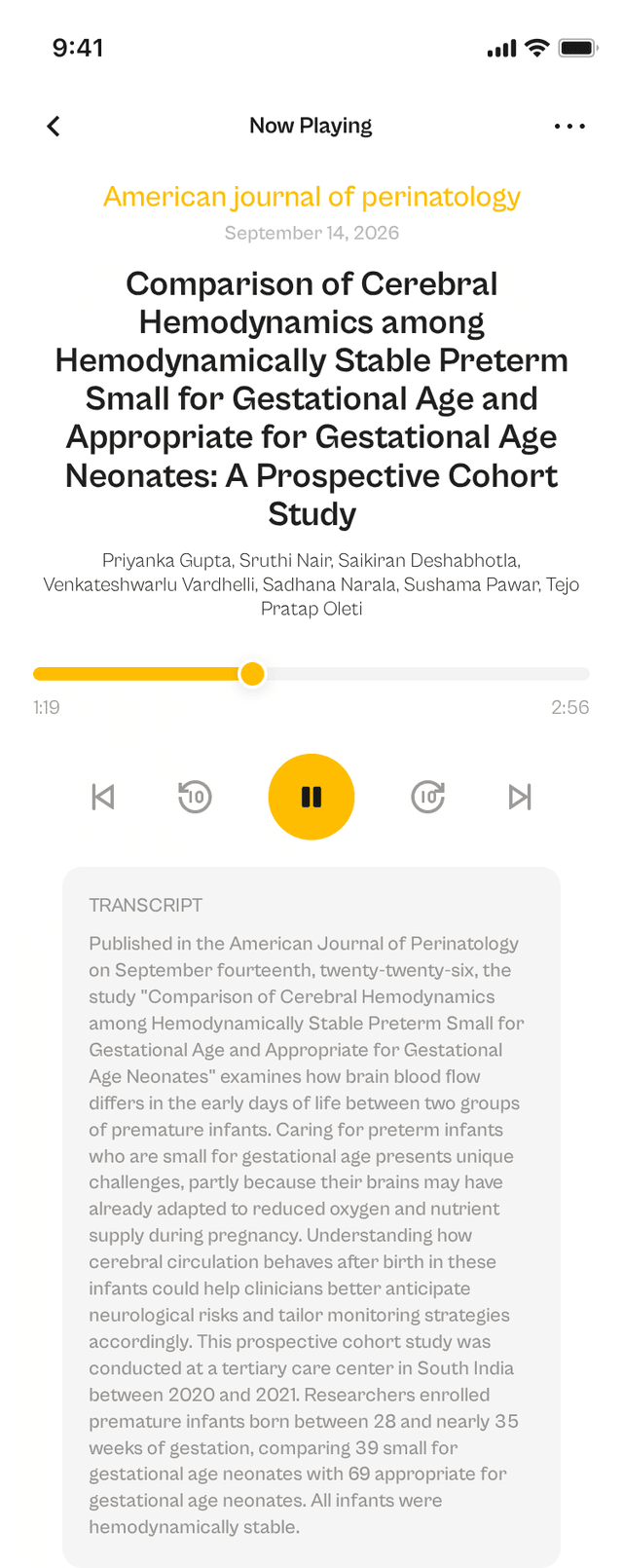
This study aimed to investigate the differences in cerebral hemodynamics between hemodynamically stable preterm small for gestational age (SGA) and appropriate for gestational age (AGA) neonates. The findings revealed that preterm SGA neonates exhibited significantly lower pulsatility index (PI) and resistive index (RI) in the middle cerebral artery, suggesting altered cerebral hemodynamics characterized by lower vascular impedance and cerebral vasodilation compared to AGA neonates. The authors highlight the need for further research to understand the long-term implications of these differences.
This is one of 33,000+ journals available on OSLR. Try it free for 14 days.
Free 14-day trial. 33,000+ journals. Cancel anytime.
More from American journal of perinatology
View all →Sep 21, 2026 · American journal of perinatology
Migraines in pregnancy: a prospective study of symptom patterns and obstetric outcomes
Sep 17, 2026 · American journal of perinatology
Perinatal Risk and Outcomes Among Individuals Insured by Medicare
Sep 16, 2026 · American journal of perinatology
Microbiology Trends among Postcesarean Surgical Site Infections at a Large Public Hospital
Sep 16, 2026 · American journal of perinatology
Reticulocyte Hemoglobin Use for Prediction of Iron Deficiency Anemia in Pregnancy
Sep 14, 2026 · American journal of perinatology
Association Between the Number of US Food and Drug Administration-Warned Anesthetic Exposures and Full-Scale Intelligence Quotient at Age 3 Years in Very Preterm Infants
Sep 12, 2026 · American journal of perinatology
Persistent adverse perinatal outcomes among pregnancies with gestational diabetes in the U.S
More in Obstetrics & Gynecology
View all →Sep 23, 2026 · International urogynecology journal
Comparison of Postoperative Functional Recovery and Anatomical Restoration in Patients with Pelvic Organ Prolapse Undergoing Three Types of Apical Suspension Techniques: A Retrospective Study
Sep 23, 2026 · Gynecologic oncology reports
Abscopal effect following palliative radiotherapy after cemiplimab in recurrent cervical cancer: a case report
Sep 23, 2026 · Human reproduction (Oxford, England)
Maternal TRIM28 safeguards bovine embryonic genome activation by regulating SAM-dependent methylation via lipid metabolism
Sep 23, 2026 · The New England journal of medicine
Effect of Screening with Multicancer Early-Detection Test on Late-Stage Cancer Diagnosis
Sep 23, 2026 · Gynecologic oncology reports
Fertility-sparing surgery for a patient with a pre-operative suspected diagnosis of a Uterine Smooth Muscle Tumor of Uncertain Malignant Potential (STUMP): A case report
Sep 23, 2026 · Gynecologic oncology reports
Trabectedin plus pegylated liposomal doxorubicin in recurrent ovarian carcinoma after poly-ADP-ribose polymerase inhibitors progression: A real-world single-center experience
"Oslr has become part of my weekly routine on my day off. The clinical relevance of the summaries is outstanding — I'd rate it 9/10. Being able to consume research hands-free is a huge advantage for busy physicians."

Dr. Jennifer Thompson
Portland, OR
Stay current without falling behind
33,000+ journals. 3-minute audio summaries. Free for 14 days.