
Ambient temperature reduces oocyte yield in assisted reproductive technology via a partially sex hormone-mediated pathway
Listen to this summary
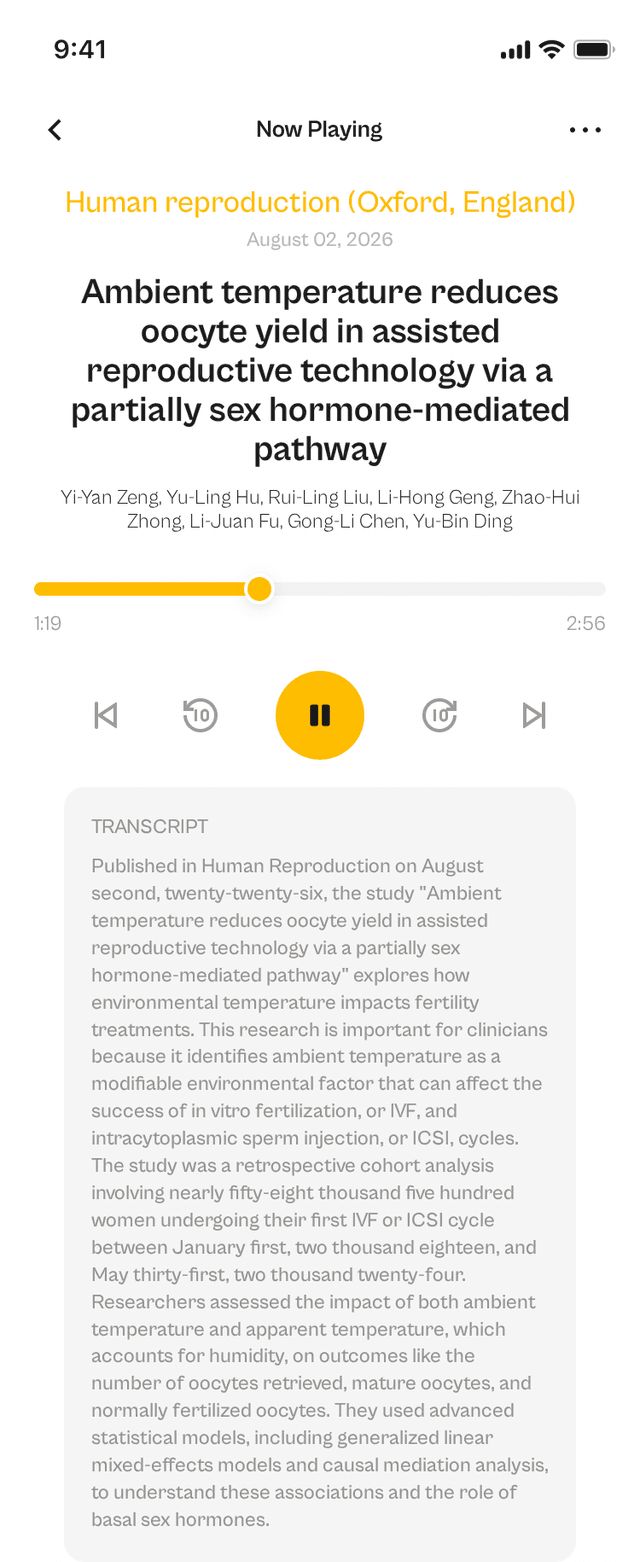
The study investigates whether higher ambient temperatures before oocyte retrieval negatively affect oocyte yield in women undergoing their first IVF or ICSI cycle. The findings indicate that each 1°C increase in apparent temperature is associated with a significant decrease in total and mature oocytes retrieved, with luteinizing hormone (LH) partially mediating this effect, while compensatory increases in follicle-stimulating hormone (FSH) and estradiol (E2) were also observed. These results highlight ambient temperature as a modifiable environmental risk factor for oocyte yield in assisted reproductive technology.
This is one of 33,000+ journals available on OSLR. Try it free for 14 days.
Free 14-day trial. 33,000+ journals. Cancel anytime.
More from Human reproduction (Oxford, England)
View all →Aug 9, 2026 · Human reproduction (Oxford, England)
Preconception 1-hour blood glucose as an early indicator of gestational diabetes mellitus risk in PMOS/PCOS women undergoing IVF treatment: a multi-centre cohort study
Aug 4, 2026 · Human reproduction (Oxford, England)
Mastering reproduction across the globe: the growing and sustained impact of master's degree programs in reproductive science and medicine
Aug 3, 2026 · Human reproduction (Oxford, England)
Mitochondria-targeted therapeutic strategies in assisted reproduction: challenges and potential solutions
Jul 31, 2026 · Human reproduction (Oxford, England)
Increased risk of congenital anomalies after fertility treatment is partially mediated by multiple birth: a population-based cohort study
Jul 29, 2026 · Human reproduction (Oxford, England)
Body fat percentage in relation to semen characteristics, testicular volume, and reproductive hormones: a cross-sectional study
Jul 28, 2026 · Human reproduction (Oxford, England)
Associations of anti-Müllerian hormone with primordial follicle density and in vitro maturation outcomes in girls with transfusion-dependent thalassemia undergoing fertility preservation
More in Obstetrics & Gynecology
View all →Aug 9, 2026 · Journal of ultrasound in medicine : official journal of the American Institute of Ultrasound in Medicine
High-Frequency Ultrasound Assessment of Female Genital Rejuvenation
Aug 9, 2026 · Journal of minimally invasive gynecology
Letter to the Editor Regarding "Bowel Injuries Reported After NovaSure Endometrial Ablation: A 10-Year Review of FDA MAUDE Data." Title: "Bowel Injury Following Endometrial Ablation: A Plausible Mechanism and Prevention Strategy."
Aug 9, 2026 · Journal of minimally invasive gynecology
Beyond the Mass Effect: Decoupling Endometrioma Size and Bilaterality from Ovarian Reserve Depletion
Aug 9, 2026 · Journal of ultrasound in medicine : official journal of the American Institute of Ultrasound in Medicine
From ACR O-RADS 2022 to Explainable Deep Learning: Comparative Performance of Expert Radiologists, Convolutional Neural Networks, Vision Transformers, and Fusion Models for Ultrasound-Based Risk Stratification of Ovarian Masses
Aug 8, 2026 · Gynecologic oncology reports
Interval debulking with HIPEC in patient with VP shunt
Aug 8, 2026 · Gynecologic oncology
Health-related quality of life after risk-reducing hysterectomy: a randomised vignette study
"Oslr has become part of my weekly routine on my day off. The clinical relevance of the summaries is outstanding — I'd rate it 9/10. Being able to consume research hands-free is a huge advantage for busy physicians."

Dr. Jennifer Thompson
Portland, OR
Stay current without falling behind
33,000+ journals. 3-minute audio summaries. Free for 14 days.