
Status Epilepticus Is Detected Earlier than Seizures on cEEG in Critically Ill Adults
Listen to this summary
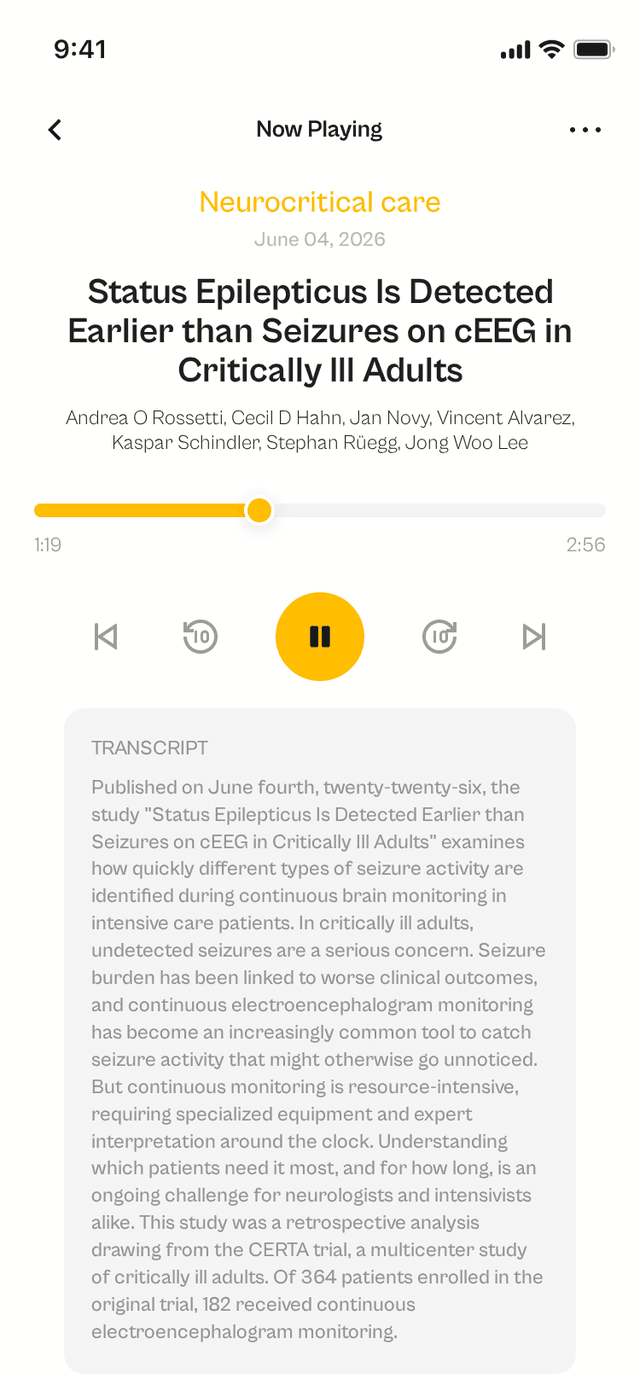
The authors investigate the detection latency of status epilepticus (SE) compared to short seizures in critically ill adults using continuous electroencephalogram (cEEG). Their findings reveal that SE is detected significantly earlier than short seizures, which may have implications for optimizing EEG resource allocation and improving patient outcomes. The study suggests that timely detection of seizures and SE could correlate with better prognosis, warranting further research in larger cohorts.
This is one of 33,000+ journals available on OSLR. Try it free for 14 days.
Free 14-day trial. 33,000+ journals. Cancel anytime.
More from Neurocritical care
View all →Jun 8, 2026 · Neurocritical care
Safety and Additive Efficacy of Dual CSF Drainage (Ventricular + Lumbar) in Severe Aneurysmal Subarachnoid Hemorrhage: A Secondary Analysis of the EARLYDRAIN Trial
Jun 5, 2026 · Neurocritical care
The Role of Microbiome-Associated Metabolites and Their Clinical Implications in Traumatic Brain Injury: A Scoping Review
More in Psychiatry & Neurology
View all →Nov 20, 2026 · Journal of pain and symptom management
ACCOMPANI: A Psychosocial Nurse Intervention for African American Families in Pediatric Oncology.
Nov 20, 2026 · Journal of pain and symptom management
Perceived Clinical Utility of a Routine Family Experience Feedback Loop in Pediatric Palliative Care.
Nov 20, 2026 · Journal of pain and symptom management
Predictors of Clinician Success, Quality, and Resilience in Outpatient Pediatric Palliative Care.
Nov 19, 2026 · Developmental medicine and child neurology
Definition and classification of cerebral palsy operationalized by the Surveillance of Cerebral Palsy in Europe.
Nov 19, 2026 · Journal of pain and symptom management
Dementia and Unwanted End-of-Life Treatment: A Retrospective Cohort Study Among Older Adults.
Nov 19, 2026 · The New England journal of medicine
Assessing Multiple Treatment Regimens for Tuberculosis.
"Oslr has become part of my weekly routine on my day off. The clinical relevance of the summaries is outstanding — I'd rate it 9/10. Being able to consume research hands-free is a huge advantage for busy physicians."

Dr. Jennifer Thompson
Portland, OR
Stay current without falling behind
33,000+ journals. 3-minute audio summaries. Free for 14 days.