
Reduced Gait Speed Is Associated With Poor Prognosis in Patients With Peripheral Artery Disease After Revascularization
Listen to this summary
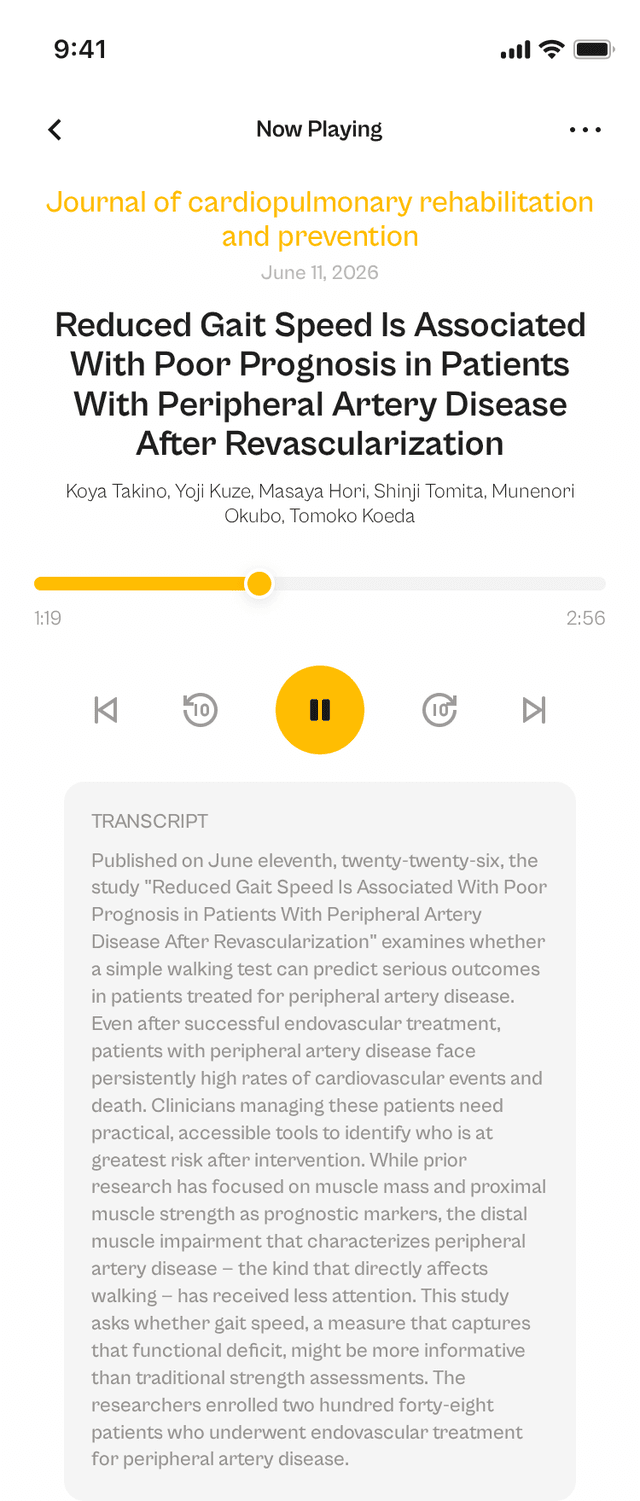
This study aimed to determine whether gait speed is a more effective prognostic indicator than systemic muscle strength measures (isometric knee extensor strength and grip strength) for predicting adverse outcomes in patients with peripheral artery disease (PAD) after endovascular treatment. The findings revealed that reduced gait speed was significantly associated with higher rates of all-cause mortality and major cardiovascular events, suggesting it may serve as a valuable risk stratification tool in this patient population. In contrast, the other muscle strength indicators did not show a significant correlation with the primary outcomes.
This is one of 33,000+ journals available on OSLR. Try it free for 14 days.
Free 14-day trial. 33,000+ journals. Cancel anytime.
More from Journal of cardiopulmonary rehabilitation and prevention
View all →Jun 11, 2026 · Journal of cardiopulmonary rehabilitation and prevention
Predicting Outpatient Cardiac Rehabilitation Enrollment: CAN STAFF MEMBERS ACCURATELY ASSESS PATIENTS FUTURE BEHAVIOR?
Jun 10, 2026 · Journal of cardiopulmonary rehabilitation and prevention
Hemodynamic Response During Different Modalities of Resistance Training in Patients With Cardiovascular Disease: A SYSTEMATIC REVIEW AND META-ANALYSIS
More in Physical Therapist
View all →Sep 22, 2026 · The American journal of sports medicine
Indications for Isolated Arthroscopic Bankart Repair in the Adolescent Shoulder May Be Limited: Bipolar Bone Loss and Low Distance to Dislocation Found Commonly in an Adolescent Population With Glenohumeral Instability
Sep 22, 2026 · The American journal of sports medicine
Autologous Platelet-Rich Plasma-Enriched Chondral Matrix Implantation Improves Cartilage Repair in an Ovine Model: A Magnetic Resonance Assessment Using the MOCART 2.0 Scoring System
Sep 22, 2026 · The American journal of sports medicine
Lateral Tibial Posterior Slope Induces Anterior Tibial Translation While Lateral-Medial Slope Difference Induces Internal Rotation: A Cadaveric Biomechanical Study
Sep 21, 2026 · British journal of sports medicine
Exercise-only interventions and exercise-based multidomain lifestyle interventions to promote cognitive function in older adults without dementia: a systematic review and meta-analysis
Sep 21, 2026 · The American journal of sports medicine
Periacetabular Osteotomy and Combined Open Femoral Head-Neck Junction Osteochondroplasty: A Concise Follow-up of a Previous Report at a Mean 10-Year Follow-up
Sep 17, 2026 · British journal of sports medicine
Prevalence and significance of anterior T-wave inversion in elite football players in the United Kingdom
"Oslr has become part of my weekly routine on my day off. The clinical relevance of the summaries is outstanding — I'd rate it 9/10. Being able to consume research hands-free is a huge advantage for busy physicians."

Dr. Jennifer Thompson
Portland, OR
Stay current without falling behind
33,000+ journals. 3-minute audio summaries. Free for 14 days.