
Symptoms and Decisions: Psychosis and Police-Led Psychiatric Crisis Intervention Outcomes
Listen to this summary
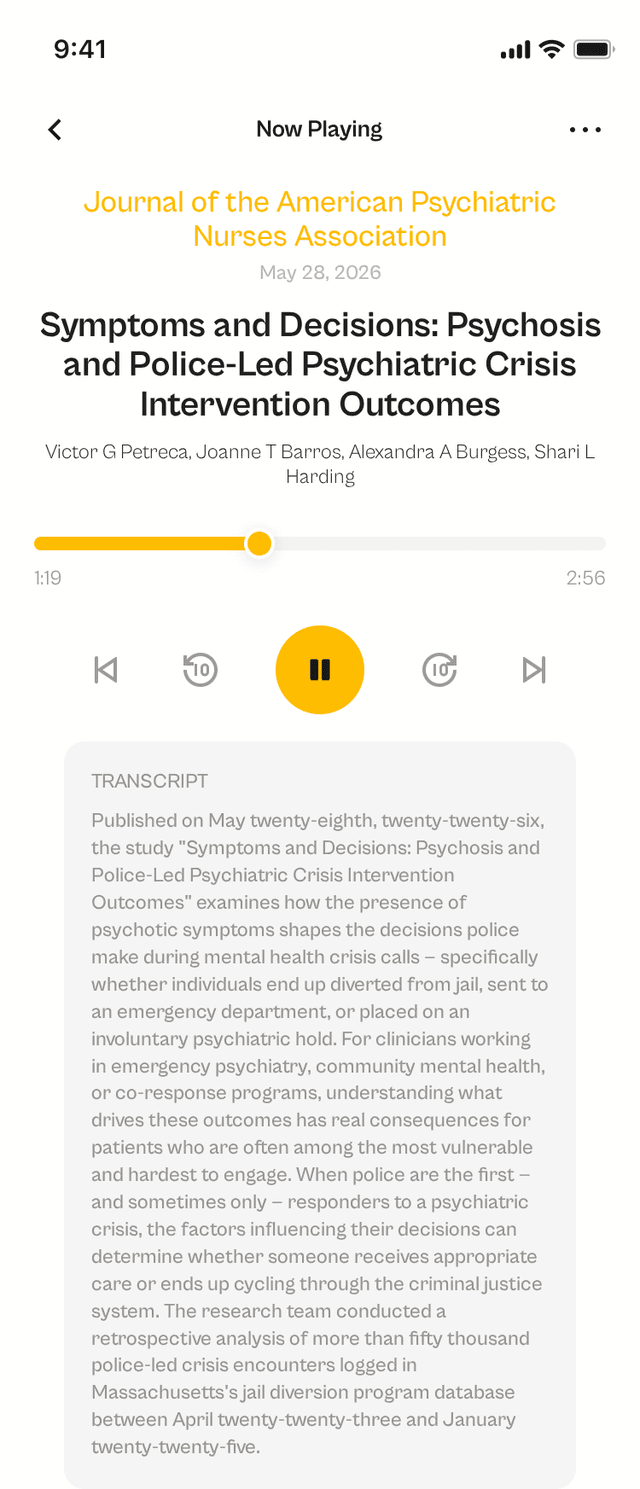
This study investigates how the presence of psychotic symptoms influences police decision-making during psychiatric crisis interventions, particularly regarding outcomes such as jail diversion, emergency department diversion, and involuntary holds. The analysis of over 50,000 crisis encounters reveals that while rates of jail and ED diversion are similar for individuals with and without psychosis, those with psychosis experience significantly higher rates of involuntary holds. The authors advocate for tailored crisis response protocols that consider clinical features and referral dynamics to improve intervention outcomes.
This is one of 33,000+ journals available on OSLR. Try it free for 14 days.
Free 14-day trial. 33,000+ journals. Cancel anytime.
More from Journal of the American Psychiatric Nurses Association
View all →Jun 4, 2026 · Journal of the American Psychiatric Nurses Association
Alcohol Withdrawal Assessment Instruments in Acute Care: An Integrative Review
May 30, 2026 · Journal of the American Psychiatric Nurses Association
The Future is Now: Scaffolding Telemental Health Skills Across the Curriculum to Ensure PMHNP Competency
More in Nurse Practitioner
View all →Sep 23, 2026 · The New England journal of medicine
Etuvetidigene Autotemcel for the Treatment of Wiskott-Aldrich Syndrome
Sep 23, 2026 · The American journal of psychiatry
Age-Associated Cognitive Deviations in Early-Onset Psychosis Patients and Their Siblings
Sep 23, 2026 · The New England journal of medicine
Phase 1 Study of Anito-cel, a d-Domain BCMA CAR T Cell for Refractory or Recurrent Myeloma
Sep 23, 2026 · JAMA
Tenecteplase Before Thrombectomy at 4.5 to 24 Hours for Basilar Artery Occlusion: The ATTENTION LATE Randomized Clinical Trial
Sep 23, 2026 · The New England journal of medicine
Effect of Screening with Multicancer Early-Detection Test on Late-Stage Cancer Diagnosis
Sep 23, 2026 · The New England journal of medicine
Clinical Uses of Common Genetic Variants Associated with Common Diseases
"Oslr has become part of my weekly routine on my day off. The clinical relevance of the summaries is outstanding — I'd rate it 9/10. Being able to consume research hands-free is a huge advantage for busy physicians."

Dr. Jennifer Thompson
Portland, OR
Stay current without falling behind
33,000+ journals. 3-minute audio summaries. Free for 14 days.