
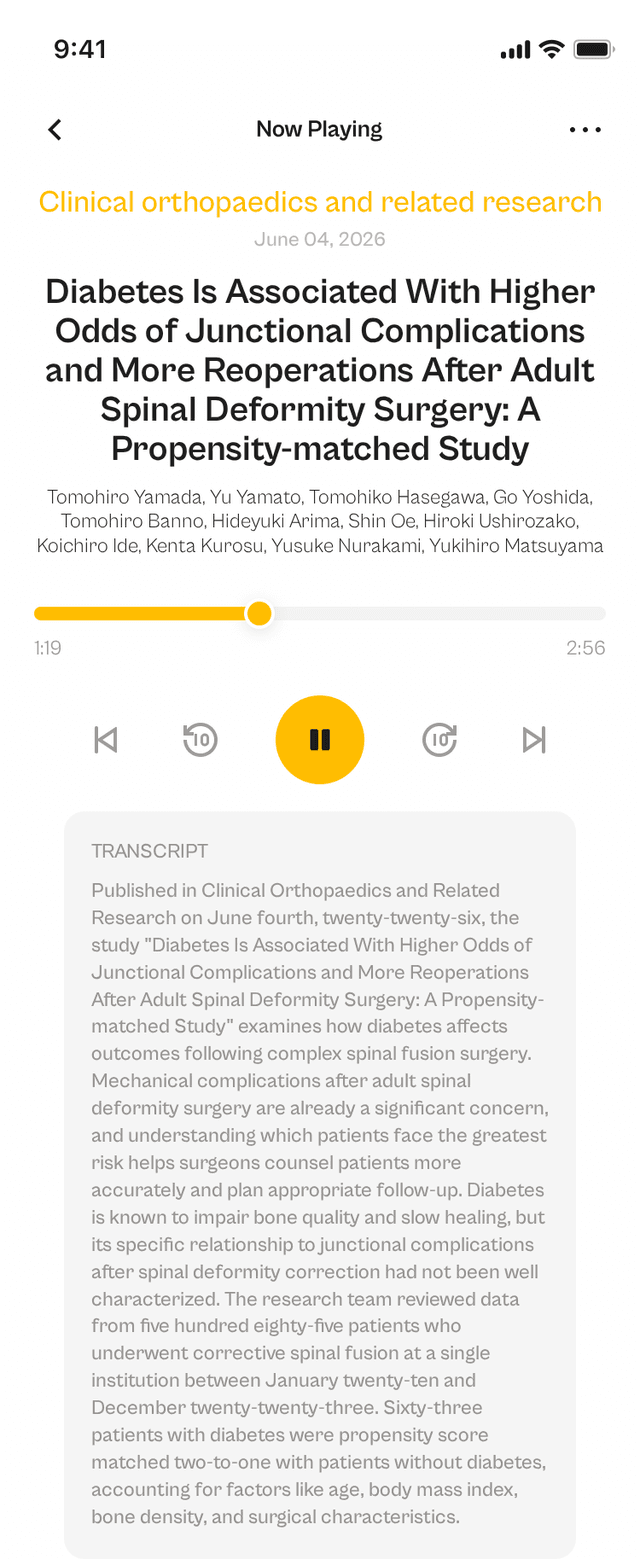
Diabetes Is Associated With Higher Odds of Junctional Complications and More Reoperations After Adult Spinal Deformity Surgery: A Propensity-matched Study
Listen to this summary
This study investigates the relationship between diabetes and mechanical complications following adult spinal deformity surgery, specifically examining the odds of proximal junctional failure, revision-free survivorship, radiographic alignment, and patient-reported outcomes. The findings indicate that patients with diabetes have a significantly higher risk of proximal junctional failure and lower revision-free survivorship compared to non-diabetic patients, although no substantial differences in radiographic alignment or patient-reported outcomes were observed. The authors suggest that increased awareness and monitoring of junctional complications in diabetic patients may be warranted.
This is one of 33,000+ journals available on OSLR. Try it free for 14 days.
Free 14-day trial. 33,000+ journals. Cancel anytime.
More from Clinical orthopaedics and related research
View all →Jun 11, 2026 · Clinical orthopaedics and related research
Is Neighborhood Socioeconomic Deprivation Associated With Outcomes Following Primary THA and TKA? A Systematic Review Utilizing the Area Deprivation Index
Jun 10, 2026 · Clinical orthopaedics and related research
Is Higher Surgeon Volume Associated With Lower Complication and Revision Risk After Distal Radius Fracture Surgery? A Population-based Cohort Study of 13,389 Patients
Jun 5, 2026 · Clinical orthopaedics and related research
Do Perineural Dexamethasone and Dexmedetomidine Improve Analgesia and Inflammatory Response After Lumbar Spine Surgery?
Jun 5, 2026 · Clinical orthopaedics and related research
Preoperative Shoulder Stiffness Was Accompanied by Distinct Supraspinatus Tendon Inflammatory Signatures but Not Inferior Long-term Outcomes After Rotator Cuff Repair
Jun 3, 2026 · Clinical orthopaedics and related research
Is Robotic-assisted THA Associated With Decreased Risk of All-cause Revision or Revision for Dislocation? An Analysis of the American Joint Replacement Registry
Jun 3, 2026 · Clinical orthopaedics and related research
Synovial Fluid Leukocyte Count and Differential Are Poor Standalone Rule-in Tests for Periprosthetic Joint Infection: Results of a Methodological Audit and Reanalysis of the 2025 Meta-analysis Underpinning the Unified Periprosthetic Joint Infection Criteria
More in Orthopaedic Surgery
View all →Nov 20, 2026 · The Journal of arthroplasty
Complications and Failures following Extensor Mechanism Reconstruction in Revision Total Knee Arthroplasty.
Nov 20, 2026 · The Journal of arthroplasty
There is a Marked Temporal Variation in the Level of Serological Markers Used for Diagnosis of Periprosthetic Joint Infection.
Nov 20, 2026 · The Journal of arthroplasty
Stratified Diagnostic Thresholds by Infection Chronicity Resolve the Controversy in Unicompartmental Knee Arthroplasty Periprosthetic Joint Infection: A Prospective Study.
Nov 20, 2026 · Journal of pediatric orthopedics
Reliability of Ultrasound-Based Metrics for Patellofemoral Instability: A Systematic Review.
Nov 19, 2026 · The Journal of arthroplasty
Association Between Quantitatively Assessed Lateral Trochlear Osteophyte Severity and Three-Year Outcomes After Medial Unicompartmental Knee Arthroplasty.
Nov 19, 2026 · The Journal of arthroplasty
Outcomes in Men versus Women After Primary Total Knee Arthroplasty: A Systematic Review.
"Oslr has become part of my weekly routine on my day off. The clinical relevance of the summaries is outstanding — I'd rate it 9/10. Being able to consume research hands-free is a huge advantage for busy physicians."

Dr. Jennifer Thompson
Portland, OR
Stay current without falling behind
33,000+ journals. 3-minute audio summaries. Free for 14 days.