
Cardiomyopathy: A Guide for Primary Care
Listen to this summary
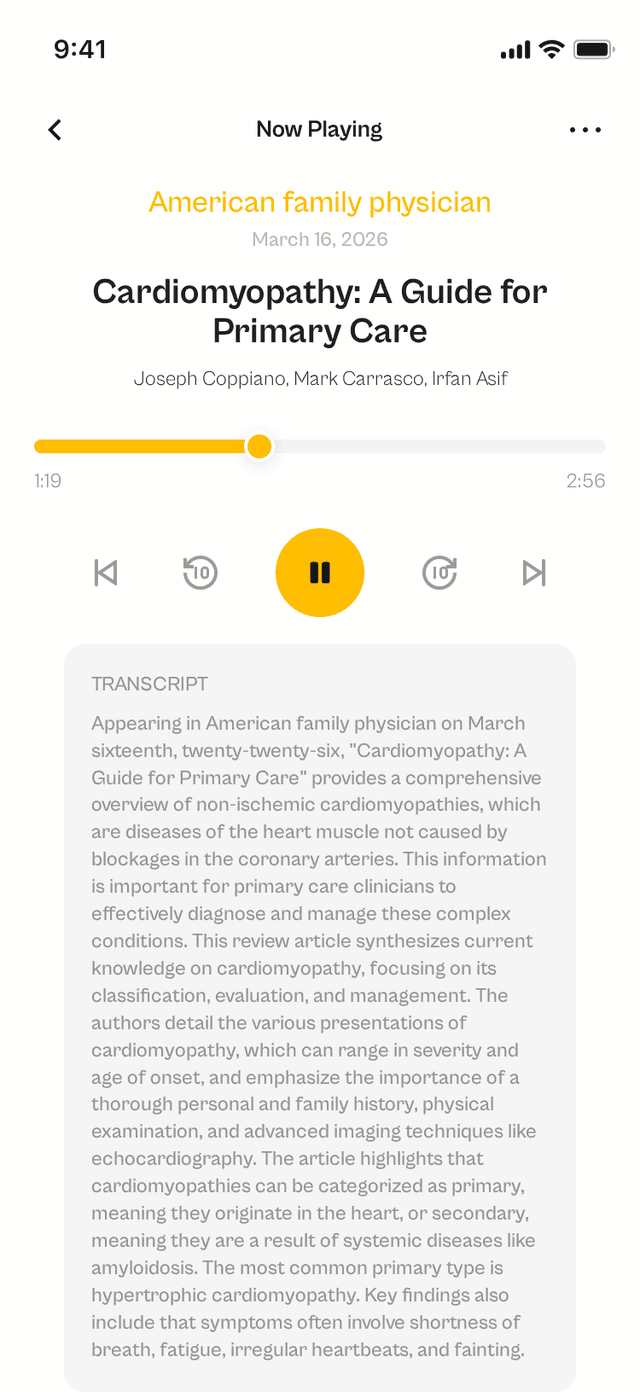
The authors aim to provide a comprehensive overview of cardiomyopathy, particularly focusing on nonischemic causes and their varying presentations. They discuss the classification of cardiomyopathies, evaluation methods, and management strategies tailored to specific types, emphasizing the importance of risk stratification and potential interventions such as heart transplantation for advanced cases.
This is one of 33,000+ journals available on OSLR. Try it free for 14 days.
Free 14-day trial. 33,000+ journals. Cancel anytime.
More from American family physician
View all →May 8, 2026 · American family physician
Thrombocytosis: Rapid Evidence Review
May 8, 2026 · American family physician
Foreign Body Ingestion in Children
May 8, 2026 · American family physician
Heat-Related Illnesses
May 8, 2026 · American family physician
Vaccine Adverse Effects: An Overview
May 8, 2026 · American family physician
Systemic Sclerosis: Evaluation and Treatment
May 8, 2026 · American family physician
Bladder Pain Syndrome: Rapid Evidence Review
More in Family Medicine
View all →May 10, 2026 · Contraception
Women's Attitudes Toward Over-the-Counter Oral Contraceptive Pills: A Cross-Sectional Survey
May 10, 2026 · JAMA
Efficacy and Safety of Digitalis Glycosides in Heart Failure: A Meta-Analysis
May 10, 2026 · JAMA
Digoxin in Patients With Symptomatic Rheumatic Heart Disease: A Randomized Clinical Trial
May 8, 2026 · Family medicine
Making the Most of CERA Studies: How to Develop Excellent Survey Research in Academic Family Medicine
May 8, 2026 · Family medicine
Introduction to Qualitative Methods: A Practical Primer for Clinicians
May 8, 2026 · Family medicine
Writing Qualitative Research and Evaluation for Clinical Audiences
"Oslr has become part of my weekly routine on my day off. The clinical relevance of the summaries is outstanding — I'd rate it 9/10. Being able to consume research hands-free is a huge advantage for busy physicians."

Dr. Jennifer Thompson
Portland, OR
Stay current without falling behind
33,000+ journals. 3-minute audio summaries. Free for 14 days.