
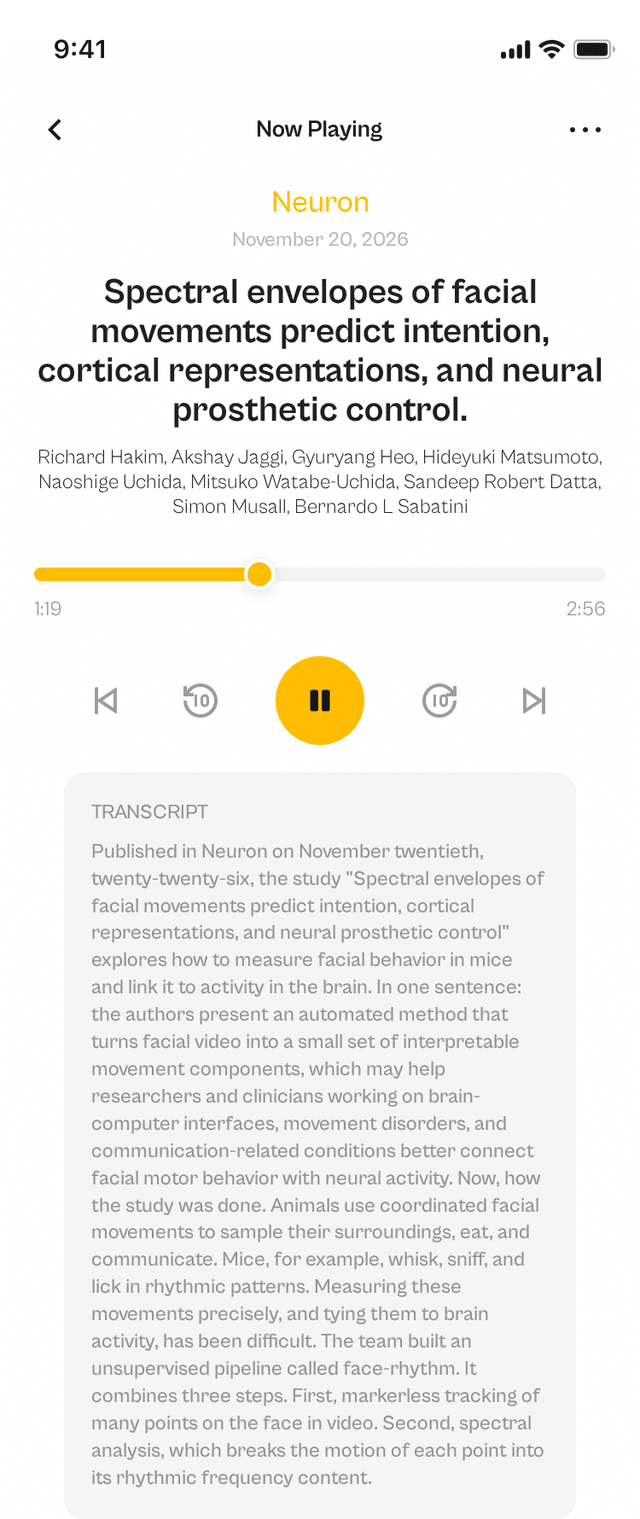
Spectral envelopes of facial movements predict intention, cortical representations, and neural prosthetic control.
Listen to this summary
Hakim and colleagues introduce face-rhythm, an unsupervised pipeline that combines markerless point tracking, spectral analysis, and non-negative tensor decomposition to reduce mouse facial videos to a small set of interpretable components. They ask whether rhythmic facial movements (whisking, sniffing, licking, and subtler motifs) can be captured in a consistent, low-dimensional form that decodes behavioral variables and explains cortical activity. They find that spectral features of movements above about 0.5 Hz are predicted well by a phase-invariant representation of facial motor cortex neurons, while slower movements retain phase-dependent structure, and the method performs competitively with deep-learning approaches while remaining interpretable.
This is one of 33,000+ journals available on OSLR. Try it free for 14 days.
Free 14-day trial. 33,000+ journals. Cancel anytime.
More from Neuron
View all →Nov 19, 2026 · Neuron
The neural mechanisms of fast versus slow decision-making.
Nov 17, 2026 · Neuron
A cell-type-resolved proteomic atlas reveals intra- and intercellular signaling in Alzheimer's disease.
Nov 16, 2026 · Neuron
Noncoding functions of FMR1 transcript in riboregulation of human neurodevelopment.
Nov 12, 2026 · Neuron
A consensus spinal cord cell-type atlas across mouse, macaque, and human.
Nov 12, 2026 · Neuron
A coronavirus protease activates sensory neurons via TRPA1 to drive sneeze, cough, and pain.
Nov 11, 2026 · Neuron
Antisense oligonucleotide silencing rescues neurodevelopmental deficits in AMPA receptor gain-of-function mice.
"Oslr has become part of my weekly routine on my day off. The clinical relevance of the summaries is outstanding — I'd rate it 9/10. Being able to consume research hands-free is a huge advantage for busy physicians."

Dr. Jennifer Thompson
Portland, OR
Stay current without falling behind
33,000+ journals. 3-minute audio summaries. Free for 14 days.