
A cell-type-resolved proteomic atlas reveals intra- and intercellular signaling in Alzheimer's disease.
Listen to this summary
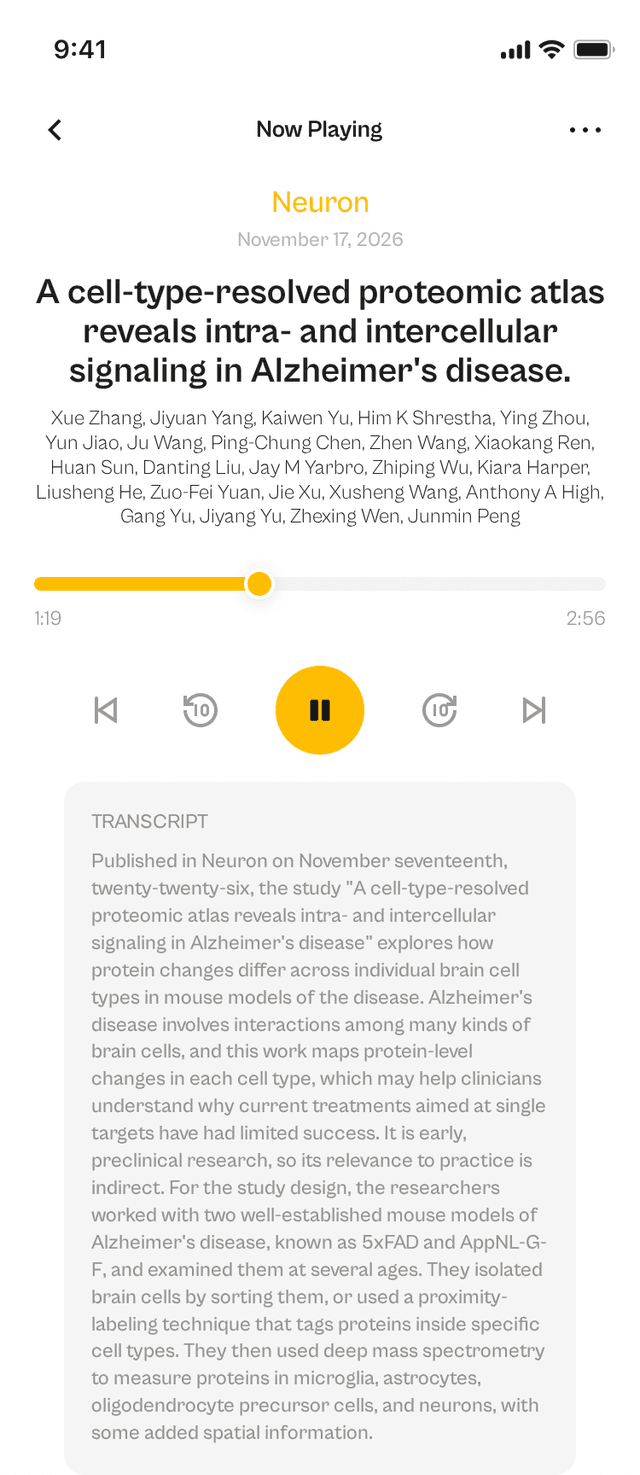
This study builds a cell-type-resolved proteomic atlas of Alzheimer's disease by profiling sorted or proximity-labeled microglia, astrocytes, oligodendrocyte precursor cells, and neurons from 5xFAD and AppNL-G-F mice across ages, quantifying over 13,000 proteins. The authors asked how proteomic changes differ across cell types, whether they reflect transcriptomic changes, and which cross-cell signaling proteins drive AD pathology. They found about 3,000 differentially abundant proteins, roughly 30% RNA-discordant, and identified pleiotrophin (PTN), which is made mainly by astrocytes but accumulates in microglia and activates human induced microglia, suggesting a novel intercellular signaling axis.
This is one of 33,000+ journals available on OSLR. Try it free for 14 days.
Free 14-day trial. 33,000+ journals. Cancel anytime.
More from Neuron
View all →Nov 20, 2026 · Neuron
Spectral envelopes of facial movements predict intention, cortical representations, and neural prosthetic control.
Nov 19, 2026 · Neuron
The neural mechanisms of fast versus slow decision-making.
Nov 16, 2026 · Neuron
Noncoding functions of FMR1 transcript in riboregulation of human neurodevelopment.
Nov 12, 2026 · Neuron
A coronavirus protease activates sensory neurons via TRPA1 to drive sneeze, cough, and pain.
Nov 12, 2026 · Neuron
A consensus spinal cord cell-type atlas across mouse, macaque, and human.
Nov 11, 2026 · Neuron
Dissociable cerebellar pathways for reach correction and learning.
"Oslr has become part of my weekly routine on my day off. The clinical relevance of the summaries is outstanding — I'd rate it 9/10. Being able to consume research hands-free is a huge advantage for busy physicians."

Dr. Jennifer Thompson
Portland, OR
Stay current without falling behind
33,000+ journals. 3-minute audio summaries. Free for 14 days.