
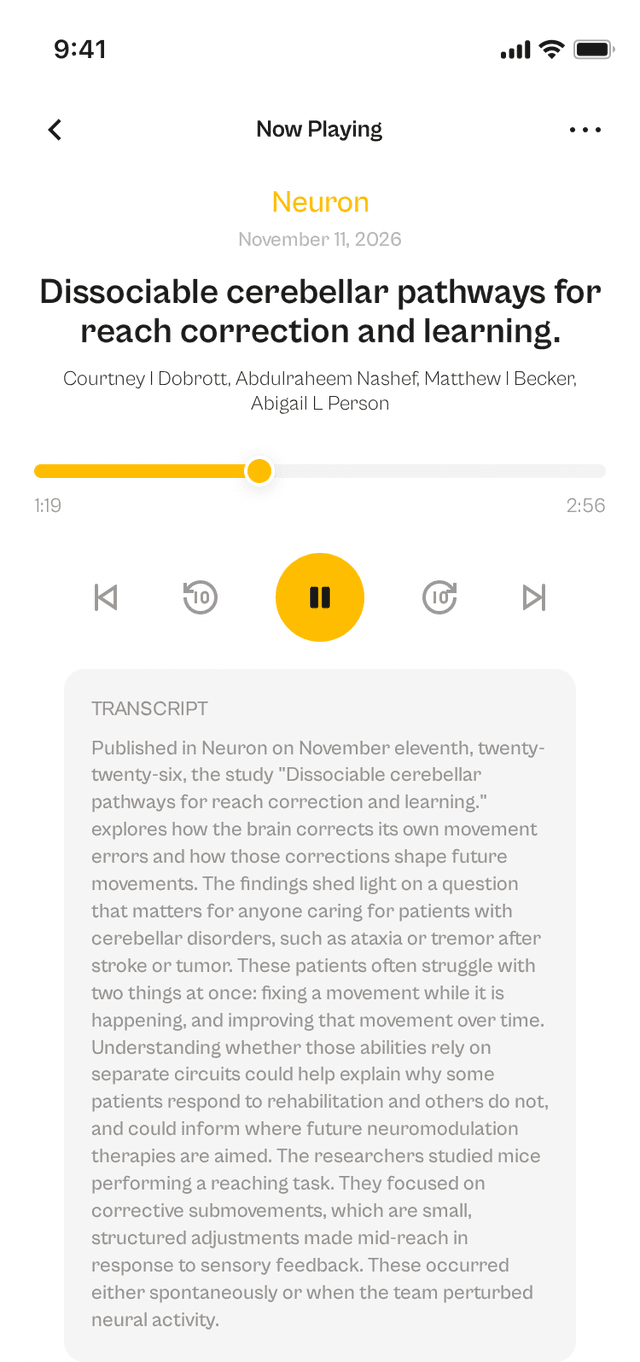
Dissociable cerebellar pathways for reach correction and learning.
Listen to this summary
This study asks how self-generated movement errors are corrected during reaching and how those corrections shape later behavior. In mice, the authors found that corrective submovements arise both spontaneously and in response to neural perturbations, with the anterior interposed cerebellar nucleus (IntA) modestly encoding them. Closed-loop perturbations of red nucleus-projecting IntA neurons were compensated for and produced learned changes in future submovement timing, whereas broader IntA perturbations were neither compensated for nor associated with learning, suggesting distinct output subsets either support or disrupt correction and learning.
This is one of 33,000+ journals available on OSLR. Try it free for 14 days.
Free 14-day trial. 33,000+ journals. Cancel anytime.
More from Neuron
View all →Nov 20, 2026 · Neuron
Spectral envelopes of facial movements predict intention, cortical representations, and neural prosthetic control.
Nov 19, 2026 · Neuron
The neural mechanisms of fast versus slow decision-making.
Nov 17, 2026 · Neuron
A cell-type-resolved proteomic atlas reveals intra- and intercellular signaling in Alzheimer's disease.
Nov 16, 2026 · Neuron
Noncoding functions of FMR1 transcript in riboregulation of human neurodevelopment.
Nov 12, 2026 · Neuron
A consensus spinal cord cell-type atlas across mouse, macaque, and human.
Nov 12, 2026 · Neuron
A coronavirus protease activates sensory neurons via TRPA1 to drive sneeze, cough, and pain.
"Oslr has become part of my weekly routine on my day off. The clinical relevance of the summaries is outstanding — I'd rate it 9/10. Being able to consume research hands-free is a huge advantage for busy physicians."

Dr. Jennifer Thompson
Portland, OR
Stay current without falling behind
33,000+ journals. 3-minute audio summaries. Free for 14 days.