
A consensus spinal cord cell-type atlas across mouse, macaque, and human.
Listen to this summary
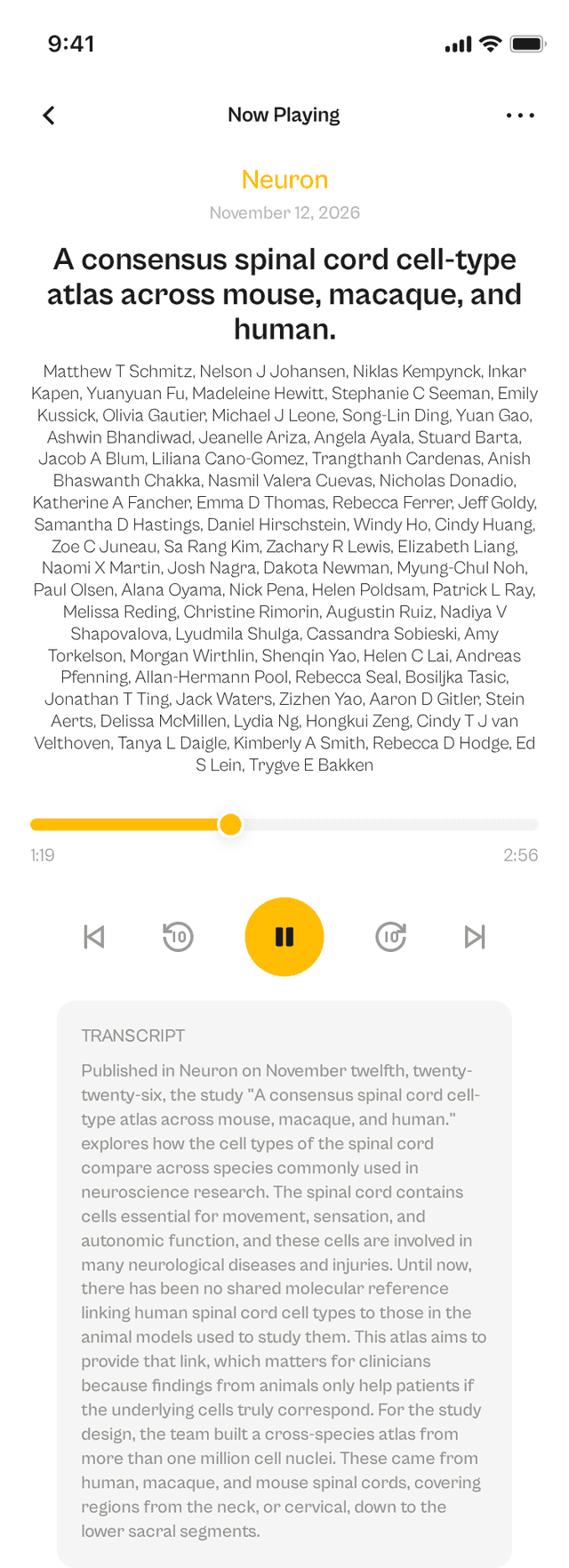
This study builds a cross-species spinal cord cell-type atlas to determine which cell types are shared between mouse, macaque, and human and how they differ. Integrating over one million nuclei from single-nucleus RNA-seq, chromatin accessibility, and spatial transcriptomics, the authors identify 111 consensus cell type groups replicable across all three species, with conserved identities and laminar organization. The main species differences are in relative abundance and gene expression, concentrated in the dorsal horn, where neurotransmitter receptor genes diverge, including a primate-specific glycine receptor subunit switch that also affects enhancer-AAV targeting.
This is one of 33,000+ journals available on OSLR. Try it free for 14 days.
Free 14-day trial. 33,000+ journals. Cancel anytime.
More from Neuron
View all →Nov 20, 2026 · Neuron
Spectral envelopes of facial movements predict intention, cortical representations, and neural prosthetic control.
Nov 19, 2026 · Neuron
The neural mechanisms of fast versus slow decision-making.
Nov 17, 2026 · Neuron
A cell-type-resolved proteomic atlas reveals intra- and intercellular signaling in Alzheimer's disease.
Nov 16, 2026 · Neuron
Noncoding functions of FMR1 transcript in riboregulation of human neurodevelopment.
Nov 12, 2026 · Neuron
A coronavirus protease activates sensory neurons via TRPA1 to drive sneeze, cough, and pain.
Nov 11, 2026 · Neuron
Slow-timescale regulation of dopamine release governs recovery of a motivational drive over days.
"Oslr has become part of my weekly routine on my day off. The clinical relevance of the summaries is outstanding — I'd rate it 9/10. Being able to consume research hands-free is a huge advantage for busy physicians."

Dr. Jennifer Thompson
Portland, OR
Stay current without falling behind
33,000+ journals. 3-minute audio summaries. Free for 14 days.