
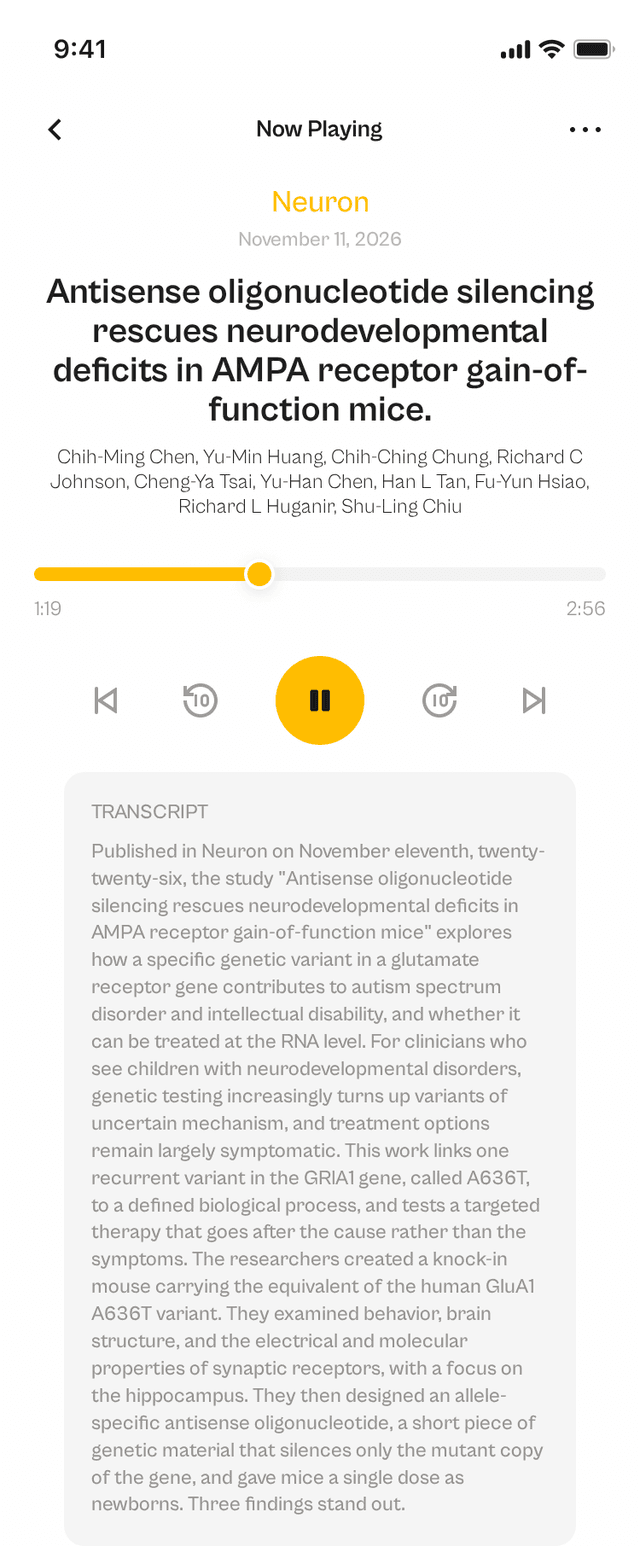
Antisense oligonucleotide silencing rescues neurodevelopmental deficits in AMPA receptor gain-of-function mice.
Listen to this summary
This study investigates how a recurrent GRIA1 variant (p.A636T), found in individuals with autism and intellectual disability, contributes to neurodevelopmental disease. Using a knock-in mouse model, the authors show that the variant causes ASD/ID-like behaviors, progressive hippocampal dendritic atrophy and neuronal loss driven by persistent calcium-permeable AMPAR-mediated excitotoxicity. They further demonstrate that a single neonatal dose of an allele-specific antisense oligonucleotide that silences the mutant transcript prevents hippocampal pathology and rescues behavioral deficits, supporting RNA-targeted therapy for AMPAR-related disorders.
This is one of 33,000+ journals available on OSLR. Try it free for 14 days.
Free 14-day trial. 33,000+ journals. Cancel anytime.
More from Neuron
View all →Nov 20, 2026 · Neuron
Spectral envelopes of facial movements predict intention, cortical representations, and neural prosthetic control.
Nov 19, 2026 · Neuron
The neural mechanisms of fast versus slow decision-making.
Nov 17, 2026 · Neuron
A cell-type-resolved proteomic atlas reveals intra- and intercellular signaling in Alzheimer's disease.
Nov 16, 2026 · Neuron
Noncoding functions of FMR1 transcript in riboregulation of human neurodevelopment.
Nov 12, 2026 · Neuron
A consensus spinal cord cell-type atlas across mouse, macaque, and human.
Nov 12, 2026 · Neuron
A coronavirus protease activates sensory neurons via TRPA1 to drive sneeze, cough, and pain.
"Oslr has become part of my weekly routine on my day off. The clinical relevance of the summaries is outstanding — I'd rate it 9/10. Being able to consume research hands-free is a huge advantage for busy physicians."

Dr. Jennifer Thompson
Portland, OR
Stay current without falling behind
33,000+ journals. 3-minute audio summaries. Free for 14 days.