
Physics-informed data augmentation to simulate low dose CT scans: Application to lung nodule detection
Listen to this summary
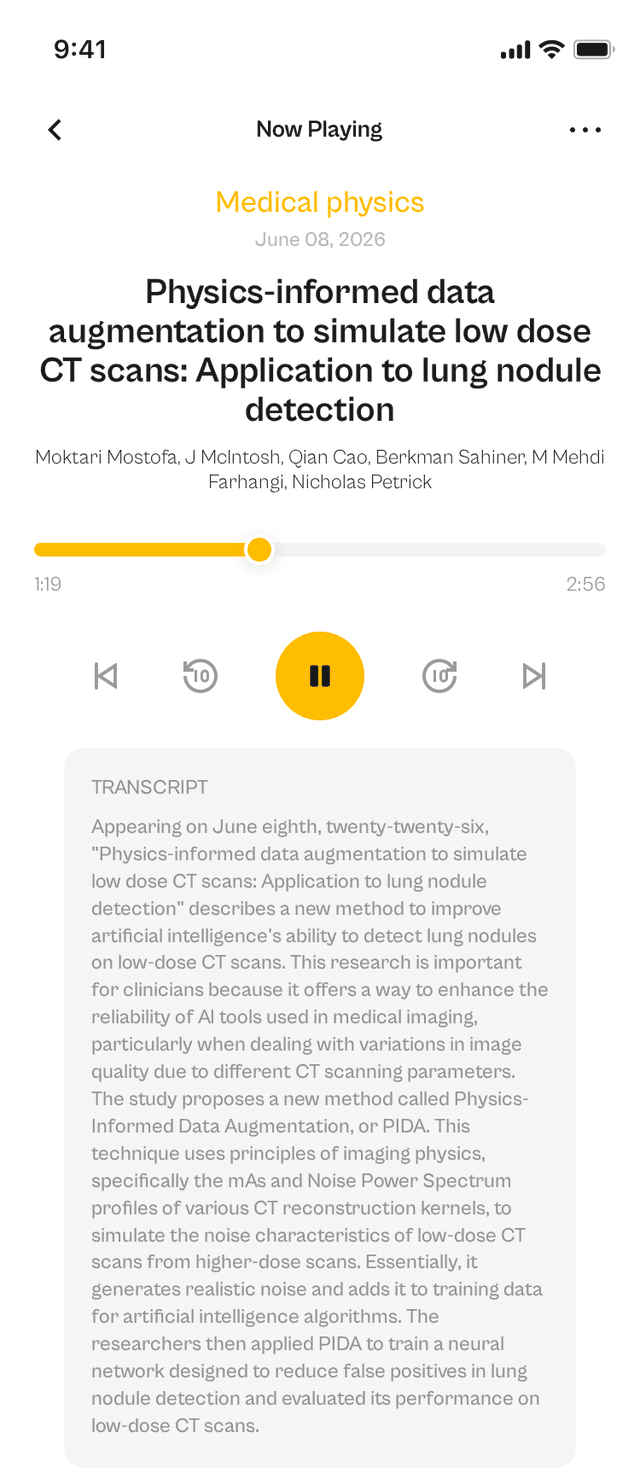
The authors investigate how to improve the performance of convolutional neural networks (CNNs) in detecting lung nodules on low-dose CT scans, which are often affected by noise characteristics from different imaging systems. They propose a Physics-Informed Data Augmentation (PIDA) method that simulates low-dose noise by leveraging data from higher-dose scans, ultimately enhancing the training dataset's variability. Their results demonstrate that incorporating PIDA significantly improves the CNN's detection performance, addressing the challenges posed by differences in training and testing data acquisition.
This is one of 33,000+ journals available on OSLR. Try it free for 14 days.
Free 14-day trial. 33,000+ journals. Cancel anytime.
More in Radiology
View all →Sep 23, 2026 · Abdominal radiology (New York)
MRI assessment of extramural venous invasion in rectal cancer: a practical pictorial review
Sep 23, 2026 · JAMA
Tenecteplase Before Thrombectomy at 4.5 to 24 Hours for Basilar Artery Occlusion: The ATTENTION LATE Randomized Clinical Trial
Sep 23, 2026 · The New England journal of medicine
Phase 1 Study of Anito-cel, a d-Domain BCMA CAR T Cell for Refractory or Recurrent Myeloma
Sep 23, 2026 · The New England journal of medicine
Effect of Screening with Multicancer Early-Detection Test on Late-Stage Cancer Diagnosis
Sep 23, 2026 · Abdominal radiology (New York)
A radiology trainee's guide to perianal fistulas
Sep 23, 2026 · The New England journal of medicine
Etuvetidigene Autotemcel for the Treatment of Wiskott-Aldrich Syndrome
"Oslr has become part of my weekly routine on my day off. The clinical relevance of the summaries is outstanding — I'd rate it 9/10. Being able to consume research hands-free is a huge advantage for busy physicians."

Dr. Jennifer Thompson
Portland, OR
Stay current without falling behind
33,000+ journals. 3-minute audio summaries. Free for 14 days.