
Inhibition of heat shock protein 90 in the mouse spinal cord enhances opioid antinociception through upregulation of PKCβ in CGRP neurons
Listen to this summary
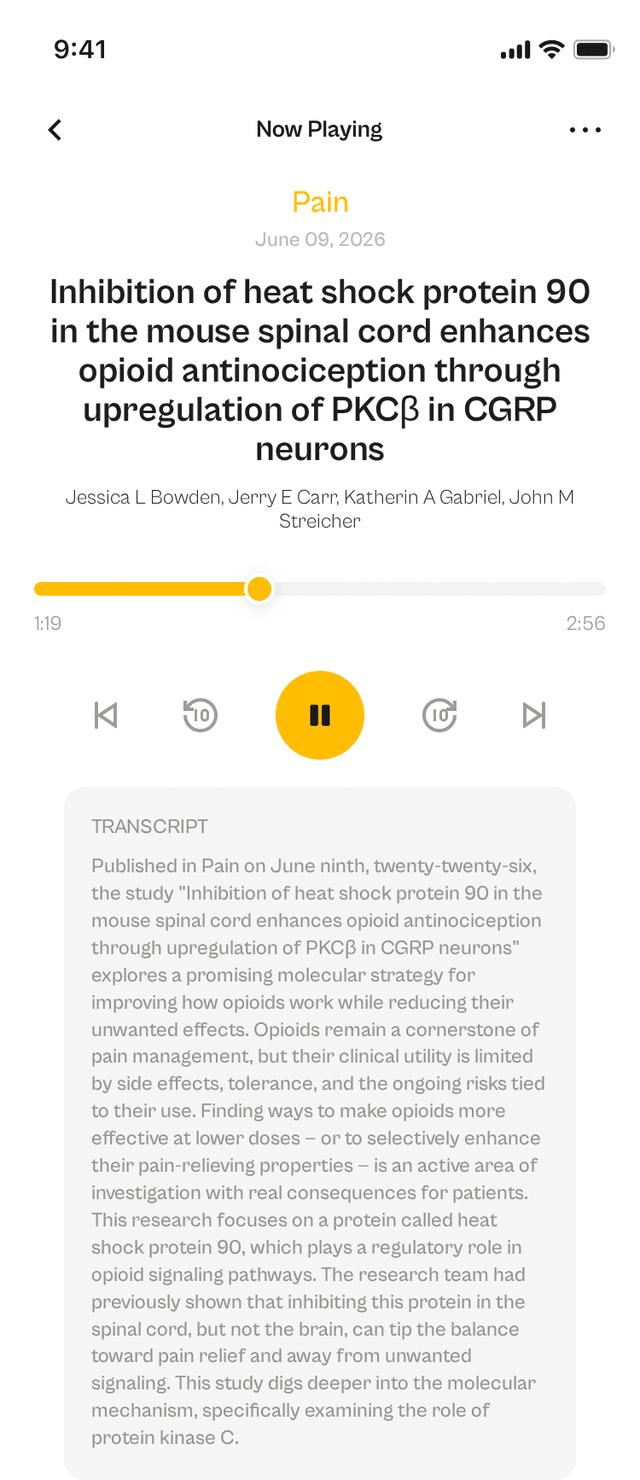
The authors investigate how the inhibition of heat shock protein 90 (Hsp90) in the spinal cord affects opioid antinociception, specifically examining the role of protein kinase C (PKC) signaling. They find that Hsp90 inhibition enhances opioid pain relief by upregulating PKCβ in calcitonin gene-related peptide (CGRP) neurons, suggesting that targeting Hsp90 could improve opioid therapy by increasing analgesic effects and reducing side effects.
This is one of 33,000+ journals available on OSLR. Try it free for 14 days.
Free 14-day trial. 33,000+ journals. Cancel anytime.
More in Anesthesiology
View all →Sep 23, 2026 · The New England journal of medicine
Etuvetidigene Autotemcel for the Treatment of Wiskott-Aldrich Syndrome
Sep 23, 2026 · The New England journal of medicine
Clinical Uses of Common Genetic Variants Associated with Common Diseases
Sep 23, 2026 · The New England journal of medicine
Phase 1 Study of Anito-cel, a d-Domain BCMA CAR T Cell for Refractory or Recurrent Myeloma
Sep 23, 2026 · The New England journal of medicine
Effect of Screening with Multicancer Early-Detection Test on Late-Stage Cancer Diagnosis
Sep 22, 2026 · Lancet (London, England)
Current advancements in the care of peripheral arterial disease: modern approaches to medical, endovascular, and surgical treatment
Sep 22, 2026 · Anesthesiology
Effect of In-line Clinical Decision Support to Improve Accuracy of American Society of Anesthesiologists Physical Status Documentation: A Two Center Evaluation of a Quality Intervention
"Oslr has become part of my weekly routine on my day off. The clinical relevance of the summaries is outstanding — I'd rate it 9/10. Being able to consume research hands-free is a huge advantage for busy physicians."

Dr. Jennifer Thompson
Portland, OR
Stay current without falling behind
33,000+ journals. 3-minute audio summaries. Free for 14 days.