
The Impact of Anticholinergic Burden on the Development of Mild Behavioral Impairment
Listen to this summary
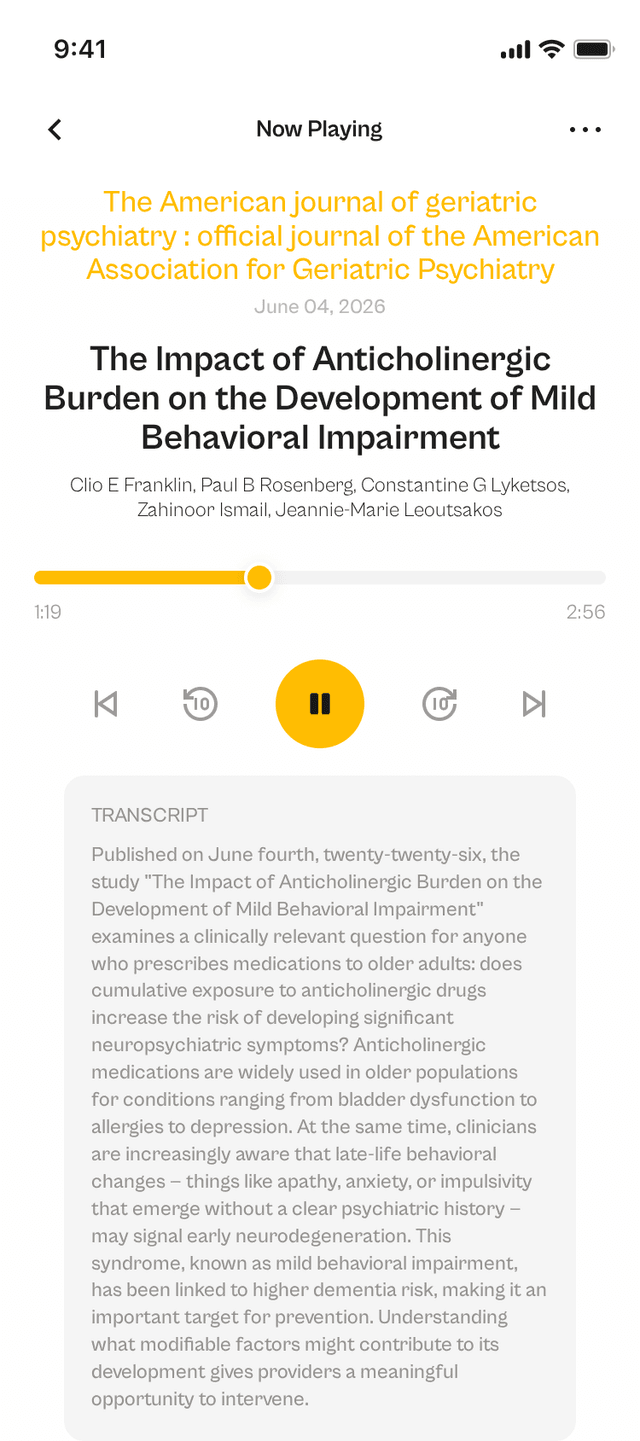
The authors aimed to investigate the relationship between anticholinergic burden (ACB) and the development of mild behavioral impairment (MBI) in cognitively unimpaired older adults. Their findings indicate that higher ACB scores are significantly associated with an increased risk of developing MBI, suggesting that careful consideration of anticholinergic medication is necessary in this population to mitigate potential neuropsychiatric risks.
This is one of 33,000+ journals available on OSLR. Try it free for 14 days.
Free 14-day trial. 33,000+ journals. Cancel anytime.
More from The American journal of geriatric psychiatry : official journal of the American Association for Geriatric Psychiatry
View all →Jun 3, 2026 · The American journal of geriatric psychiatry : official journal of the American Association for Geriatric Psychiatry
Interpersonal Predictors of Grief Among Caregivers of Persons With Dementia
May 30, 2026 · The American journal of geriatric psychiatry : official journal of the American Association for Geriatric Psychiatry
Shifting Sense of Control: State, Trait, and Scar Effects of Late-life Depression in Trajectories of Mastery
More in Psychiatry & Neurology
View all →Sep 23, 2026 · The New England journal of medicine
Etuvetidigene Autotemcel for the Treatment of Wiskott-Aldrich Syndrome
Sep 23, 2026 · The New England journal of medicine
Clinical Uses of Common Genetic Variants Associated with Common Diseases
Sep 23, 2026 · The New England journal of medicine
Phase 1 Study of Anito-cel, a d-Domain BCMA CAR T Cell for Refractory or Recurrent Myeloma
Sep 23, 2026 · The New England journal of medicine
Effect of Screening with Multicancer Early-Detection Test on Late-Stage Cancer Diagnosis
Sep 23, 2026 · The American journal of psychiatry
Age-Associated Cognitive Deviations in Early-Onset Psychosis Patients and Their Siblings
Sep 22, 2026 · The American journal of sports medicine
Lateral Tibial Posterior Slope Induces Anterior Tibial Translation While Lateral-Medial Slope Difference Induces Internal Rotation: A Cadaveric Biomechanical Study
"Oslr has become part of my weekly routine on my day off. The clinical relevance of the summaries is outstanding — I'd rate it 9/10. Being able to consume research hands-free is a huge advantage for busy physicians."

Dr. Jennifer Thompson
Portland, OR
Stay current without falling behind
33,000+ journals. 3-minute audio summaries. Free for 14 days.