
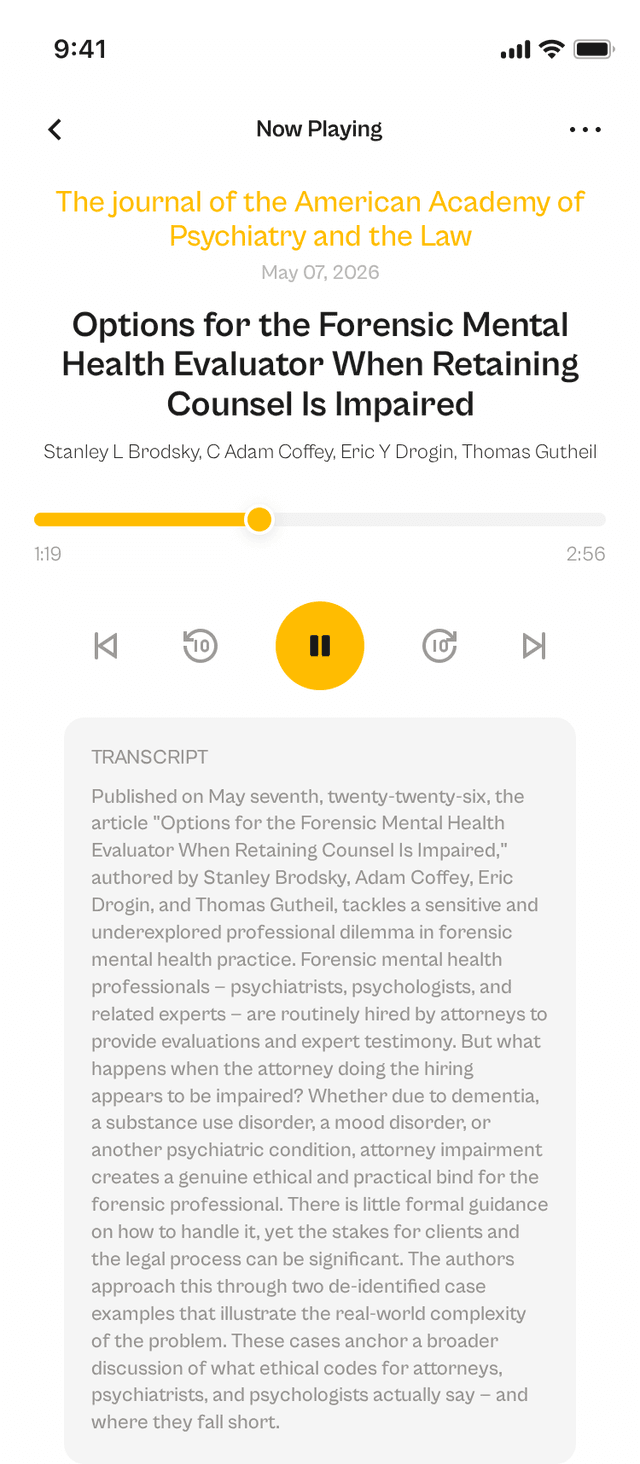
Options for the Forensic Mental Health Evaluator When Retaining Counsel Is Impaired
Listen to this summary
This paper addresses the challenges faced by forensic mental health professionals when evaluating attorneys who may be impaired due to various psychiatric conditions. The authors explore how these professionals can ethically respond to observed legal performance deficits, presenting options such as discreet inquiry, open discussion, treatment referrals, and potential withdrawal from the case. Through two de-identified case studies, the authors illustrate the complexities involved in providing expert witness and consultation services in such situations.
This is one of 33,000+ journals available on OSLR. Try it free for 14 days.
Free 14-day trial. 33,000+ journals. Cancel anytime.
More from The journal of the American Academy of Psychiatry and the Law
View all →Jun 12, 2026 · The journal of the American Academy of Psychiatry and the Law
National Survey of Undergraduate and Graduate Medical Education Exposure to Correctional Psychiatry
May 28, 2026 · The journal of the American Academy of Psychiatry and the Law
Misclassifying Ego-Syntonic Violence as Obsessive Compulsive Disorder
May 27, 2026 · The journal of the American Academy of Psychiatry and the Law
Change in Severity of Mental Disorder for Individuals in Custody in Short-Term Segregation
More in Psychiatry & Neurology
View all →Sep 23, 2026 · The New England journal of medicine
Etuvetidigene Autotemcel for the Treatment of Wiskott-Aldrich Syndrome
Sep 23, 2026 · The New England journal of medicine
Clinical Uses of Common Genetic Variants Associated with Common Diseases
Sep 23, 2026 · The New England journal of medicine
Phase 1 Study of Anito-cel, a d-Domain BCMA CAR T Cell for Refractory or Recurrent Myeloma
Sep 23, 2026 · The New England journal of medicine
Effect of Screening with Multicancer Early-Detection Test on Late-Stage Cancer Diagnosis
Sep 23, 2026 · The American journal of psychiatry
Age-Associated Cognitive Deviations in Early-Onset Psychosis Patients and Their Siblings
Sep 22, 2026 · The American journal of sports medicine
Lateral Tibial Posterior Slope Induces Anterior Tibial Translation While Lateral-Medial Slope Difference Induces Internal Rotation: A Cadaveric Biomechanical Study
"Oslr has become part of my weekly routine on my day off. The clinical relevance of the summaries is outstanding — I'd rate it 9/10. Being able to consume research hands-free is a huge advantage for busy physicians."

Dr. Jennifer Thompson
Portland, OR
Stay current without falling behind
33,000+ journals. 3-minute audio summaries. Free for 14 days.