
Risks of alcohol-energy drink co-consumption: Patterns, correlates and psychological outcomes in youth
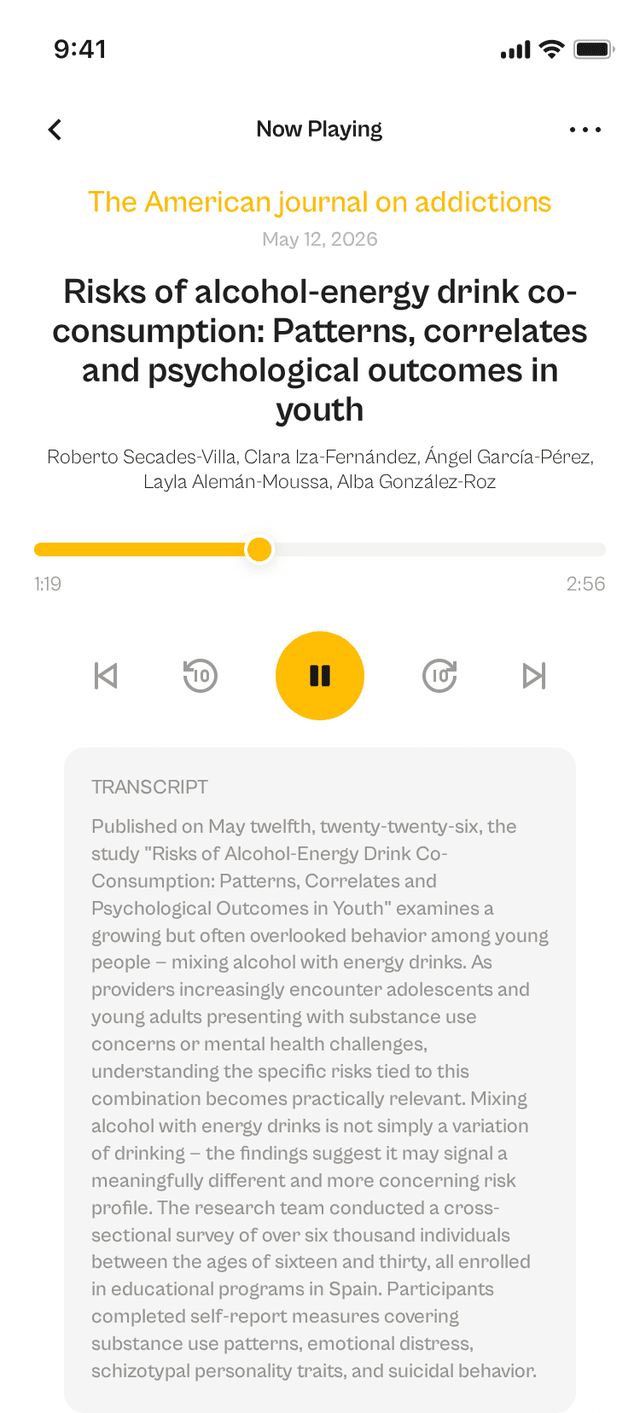
Listen to this summary
This study investigates the prevalence and risk factors associated with the co-consumption of alcohol mixed with energy drinks (AmED) among Spanish adolescents and young adults. The authors aim to compare AmED users to alcohol-only users to identify distinct risk profiles, revealing that AmED users are more likely to engage in polysubstance use and exhibit higher levels of emotional distress and suicidal behavior. The findings suggest that screening for AmED use could aid in identifying youth at greater risk for these negative outcomes, allowing for targeted prevention strategies.
This is one of 33,000+ journals available on OSLR. Try it free for 14 days.
Free 14-day trial. 33,000+ journals. Cancel anytime.
More from The American journal on addictions
View all →Jun 4, 2026 · The American journal on addictions
Do motives for and contexts of cannabis use interact to predict heavy cannabis use at the event-level?
May 10, 2026 · The American journal on addictions
Brief report: A cross-sectional survey of provider engagement with family members following patient drug overdose death
More in Psychiatry & Neurology
View all →Sep 23, 2026 · The New England journal of medicine
Etuvetidigene Autotemcel for the Treatment of Wiskott-Aldrich Syndrome
Sep 23, 2026 · The New England journal of medicine
Clinical Uses of Common Genetic Variants Associated with Common Diseases
Sep 23, 2026 · The New England journal of medicine
Phase 1 Study of Anito-cel, a d-Domain BCMA CAR T Cell for Refractory or Recurrent Myeloma
Sep 23, 2026 · The New England journal of medicine
Effect of Screening with Multicancer Early-Detection Test on Late-Stage Cancer Diagnosis
Sep 23, 2026 · The American journal of psychiatry
Age-Associated Cognitive Deviations in Early-Onset Psychosis Patients and Their Siblings
Sep 22, 2026 · The American journal of sports medicine
Lateral Tibial Posterior Slope Induces Anterior Tibial Translation While Lateral-Medial Slope Difference Induces Internal Rotation: A Cadaveric Biomechanical Study
"Oslr has become part of my weekly routine on my day off. The clinical relevance of the summaries is outstanding — I'd rate it 9/10. Being able to consume research hands-free is a huge advantage for busy physicians."

Dr. Jennifer Thompson
Portland, OR
Stay current without falling behind
33,000+ journals. 3-minute audio summaries. Free for 14 days.