
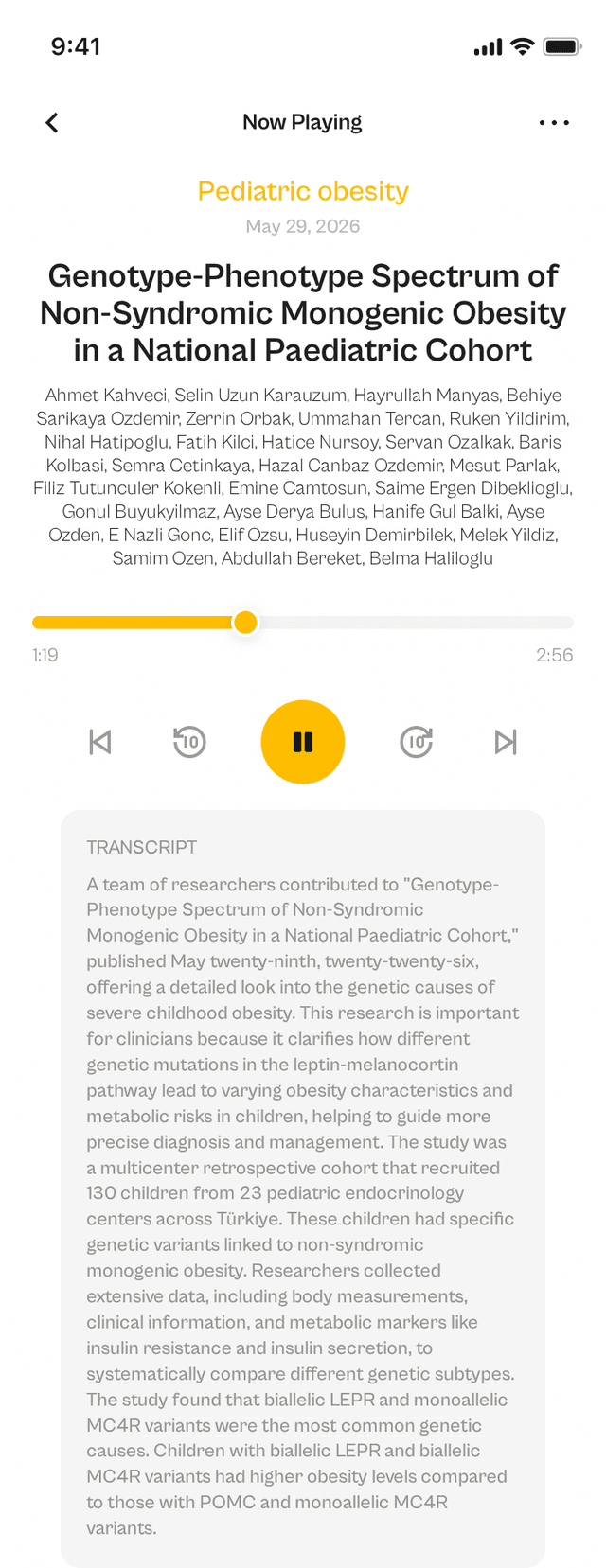
Genotype-Phenotype Spectrum of Non-Syndromic Monogenic Obesity in a National Paediatric Cohort
Listen to this summary
The authors aimed to clarify the genotype-phenotype and metabolic correlations of non-syndromic monogenic obesity caused by defects in the leptin-melanocortin pathway in a national pediatric cohort. They found that biallelic variants in LEPR and monoallelic variants in MC4R were the most common causes of severe obesity, with distinct metabolic profiles and growth impairments associated with these genotypes. The study highlights the need for early diagnosis and risk stratification based on genetic findings, particularly for those with more severe metabolic outcomes.
This is one of 33,000+ journals available on OSLR. Try it free for 14 days.
Free 14-day trial. 33,000+ journals. Cancel anytime.
More from Pediatric obesity
View all →Jun 1, 2026 · Pediatric obesity
Combining GLP-1 Receptor Agonists and Health-Behaviour and Lifestyle Therapy Yields Higher Adherence and Reduces Session Needs for Successful Weight Management in Adolescence: An Observational Real-World Single-Center Study
May 28, 2026 · Pediatric obesity
Long-Term Effectiveness of a School- and Community-Based Intervention for the Prevention of Childhood Obesity in High-Risk Families Across Europe: The Feel4Diabetes Study
More in Pediatrics
View all →Sep 23, 2026 · The New England journal of medicine
Phase 1 Study of Anito-cel, a d-Domain BCMA CAR T Cell for Refractory or Recurrent Myeloma
Sep 23, 2026 · American journal of respiratory and critical care medicine
Combined results of the TETON-1 and TETON-2 Trials of Inhaled Treprostinil for Idiopathic Pulmonary Fibrosis
Sep 23, 2026 · American journal of respiratory and critical care medicine
Biologic outcomes in severe asthma patients by smoking status: evidence from SHARP
Sep 23, 2026 · The New England journal of medicine
Effect of Screening with Multicancer Early-Detection Test on Late-Stage Cancer Diagnosis
Sep 23, 2026 · Journal of clinical oncology : official journal of the American Society of Clinical Oncology
Five-Year Follow-Up of the Phase III ASCOT Trial of Adjuvant S-1 After Resection for Biliary Tract Cancer
Sep 23, 2026 · Pediatric nephrology (Berlin, Germany)
IPNA clinical practice recommendations for the management of aHUS and secondary TMA in children
"Oslr has become part of my weekly routine on my day off. The clinical relevance of the summaries is outstanding — I'd rate it 9/10. Being able to consume research hands-free is a huge advantage for busy physicians."

Dr. Jennifer Thompson
Portland, OR
Stay current without falling behind
33,000+ journals. 3-minute audio summaries. Free for 14 days.