
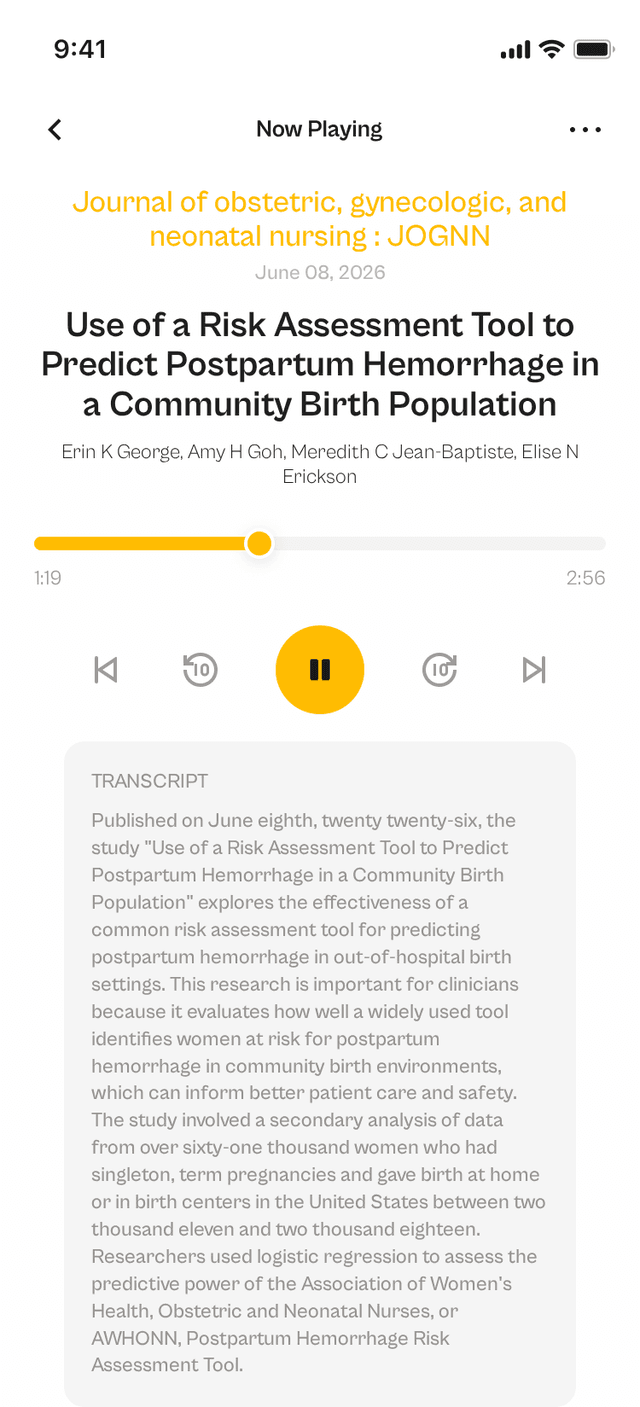
Use of a Risk Assessment Tool to Predict Postpartum Hemorrhage in a Community Birth Population
Listen to this summary
The authors aimed to evaluate the effectiveness of the AWHONN Postpartum Hemorrhage Risk Assessment Tool in predicting postpartum hemorrhage (PPH) outcomes within a community birth population. Their analysis of data from over 61,000 women revealed that the tool had a low predictive power (AUC of 0.53), which improved slightly to 0.59 when incorporating additional risk factors such as nulliparity. The findings suggest that the current risk assessment tool may require modifications to enhance its accuracy in predicting PPH.
This is one of 33,000+ journals available on OSLR. Try it free for 14 days.
Free 14-day trial. 33,000+ journals. Cancel anytime.
More from Journal of obstetric, gynecologic, and neonatal nursing : JOGNN
View all →Jun 10, 2026 · Journal of obstetric, gynecologic, and neonatal nursing : JOGNN
Cluster Randomized Controlled Trial of a Breathing and Relaxation Training Included in Antenatal Education
Jun 8, 2026 · Journal of obstetric, gynecologic, and neonatal nursing : JOGNN
Earning Trust by Establishing a Middle Ground in Maternity Care
More in Nurse Practitioner
View all →Sep 23, 2026 · The New England journal of medicine
Etuvetidigene Autotemcel for the Treatment of Wiskott-Aldrich Syndrome
Sep 23, 2026 · The American journal of psychiatry
Age-Associated Cognitive Deviations in Early-Onset Psychosis Patients and Their Siblings
Sep 23, 2026 · The New England journal of medicine
Phase 1 Study of Anito-cel, a d-Domain BCMA CAR T Cell for Refractory or Recurrent Myeloma
Sep 23, 2026 · JAMA
Tenecteplase Before Thrombectomy at 4.5 to 24 Hours for Basilar Artery Occlusion: The ATTENTION LATE Randomized Clinical Trial
Sep 23, 2026 · The New England journal of medicine
Effect of Screening with Multicancer Early-Detection Test on Late-Stage Cancer Diagnosis
Sep 23, 2026 · The New England journal of medicine
Clinical Uses of Common Genetic Variants Associated with Common Diseases
"Oslr has become part of my weekly routine on my day off. The clinical relevance of the summaries is outstanding — I'd rate it 9/10. Being able to consume research hands-free is a huge advantage for busy physicians."

Dr. Jennifer Thompson
Portland, OR
Stay current without falling behind
33,000+ journals. 3-minute audio summaries. Free for 14 days.