
Recognizing repeat expansion disorders in clinical practice
Listen to this summary
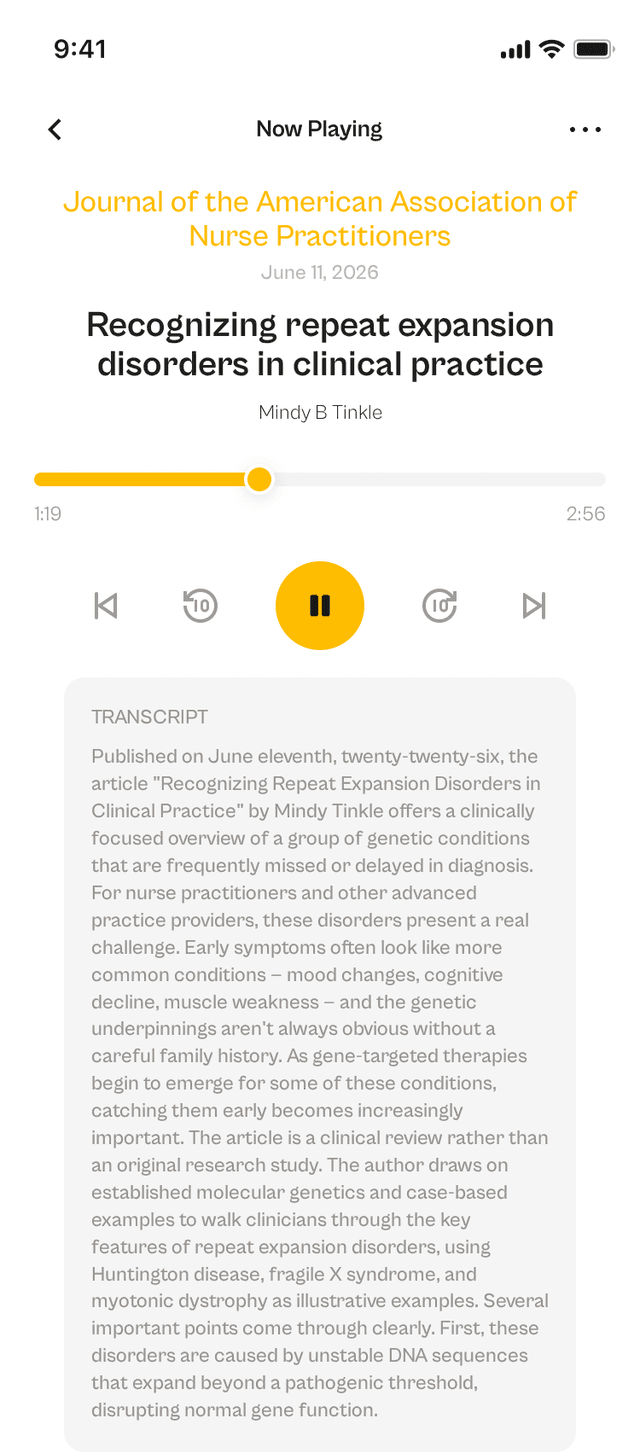
The authors aim to highlight the importance of recognizing repeat expansion disorders in clinical practice, emphasizing the role of healthcare providers in identifying early symptoms and making timely referrals for genetic evaluation. They discuss the variability in clinical presentations and the molecular characteristics that influence disease severity, underscoring the need for awareness of these conditions to facilitate early intervention and support for affected families. The paper also notes the potential for emerging gene-targeted therapies to modify disease progression.
This is one of 33,000+ journals available on OSLR. Try it free for 14 days.
Free 14-day trial. 33,000+ journals. Cancel anytime.
More from Journal of the American Association of Nurse Practitioners
View all →Jun 10, 2026 · Journal of the American Association of Nurse Practitioners
Comparing prescribing practices of nurse practitioners and physicians in the United States: A scoping review
Jun 6, 2026 · Journal of the American Association of Nurse Practitioners
Use of second-generation incretin analogs (GLP-1 and GIP receptor agonists) in type 1 diabetes and latent autoimmune diabetes in adults: A systematic review
More in Nurse Practitioner
View all →Sep 23, 2026 · The New England journal of medicine
Etuvetidigene Autotemcel for the Treatment of Wiskott-Aldrich Syndrome
Sep 23, 2026 · The American journal of psychiatry
Age-Associated Cognitive Deviations in Early-Onset Psychosis Patients and Their Siblings
Sep 23, 2026 · The New England journal of medicine
Phase 1 Study of Anito-cel, a d-Domain BCMA CAR T Cell for Refractory or Recurrent Myeloma
Sep 23, 2026 · JAMA
Tenecteplase Before Thrombectomy at 4.5 to 24 Hours for Basilar Artery Occlusion: The ATTENTION LATE Randomized Clinical Trial
Sep 23, 2026 · The New England journal of medicine
Effect of Screening with Multicancer Early-Detection Test on Late-Stage Cancer Diagnosis
Sep 23, 2026 · The New England journal of medicine
Clinical Uses of Common Genetic Variants Associated with Common Diseases
"Oslr has become part of my weekly routine on my day off. The clinical relevance of the summaries is outstanding — I'd rate it 9/10. Being able to consume research hands-free is a huge advantage for busy physicians."

Dr. Jennifer Thompson
Portland, OR
Stay current without falling behind
33,000+ journals. 3-minute audio summaries. Free for 14 days.