
Subtypes of Hypertension 2 to 7 Years After First Pregnancy
Listen to this summary
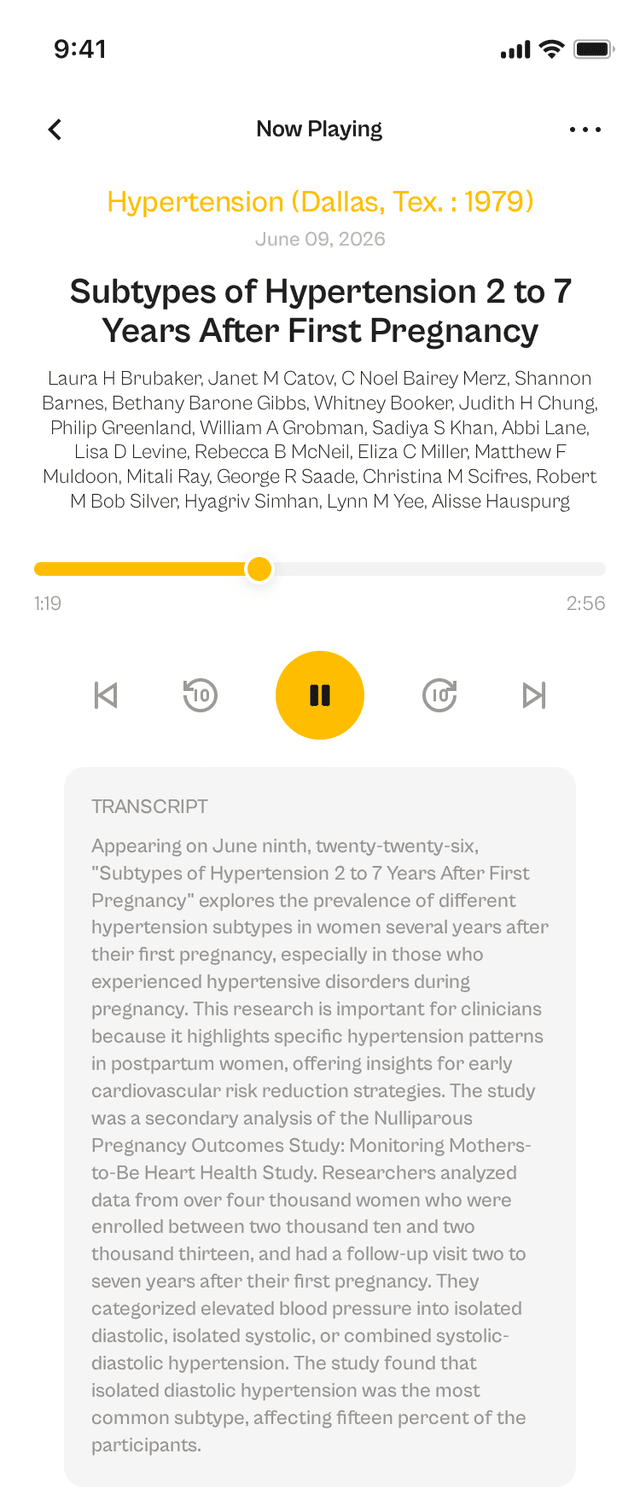
The authors aimed to investigate the prevalence of different hypertensive subtypes (isolated diastolic, isolated systolic, and combined systolic-diastolic hypertension) in women 2 to 7 years after their first pregnancy, particularly in relation to prior hypertensive disorders of pregnancy. They found that isolated diastolic hypertension was the most common subtype, and women with a history of hypertensive disorders during pregnancy had a significantly higher risk of both combined systolic-diastolic and isolated diastolic hypertension. This highlights the potential for targeted cardiovascular risk reduction in postpartum women, especially those with a history of pregnancy-related hypertension.
This is one of 33,000+ journals available on OSLR. Try it free for 14 days.
Free 14-day trial. 33,000+ journals. Cancel anytime.
More in Internal Medicine
View all →Sep 23, 2026 · JACC. Clinical electrophysiology
Programmed Ventricular Stimulation for Risk Stratification in Nonischemic Cardiomyopathy With Preserved or Mildly Reduced LVEF
Sep 23, 2026 · Journal of clinical oncology : official journal of the American Society of Clinical Oncology
Five-Year Follow-Up of the Phase III ASCOT Trial of Adjuvant S-1 After Resection for Biliary Tract Cancer
Sep 23, 2026 · American journal of respiratory and critical care medicine
Biologic outcomes in severe asthma patients by smoking status: evidence from SHARP
Sep 23, 2026 · The New England journal of medicine
Effect of Screening with Multicancer Early-Detection Test on Late-Stage Cancer Diagnosis
Sep 23, 2026 · The New England journal of medicine
Phase 1 Study of Anito-cel, a d-Domain BCMA CAR T Cell for Refractory or Recurrent Myeloma
Sep 23, 2026 · American journal of respiratory and critical care medicine
Combined results of the TETON-1 and TETON-2 Trials of Inhaled Treprostinil for Idiopathic Pulmonary Fibrosis
"Oslr has become part of my weekly routine on my day off. The clinical relevance of the summaries is outstanding — I'd rate it 9/10. Being able to consume research hands-free is a huge advantage for busy physicians."

Dr. Jennifer Thompson
Portland, OR
Stay current without falling behind
33,000+ journals. 3-minute audio summaries. Free for 14 days.