
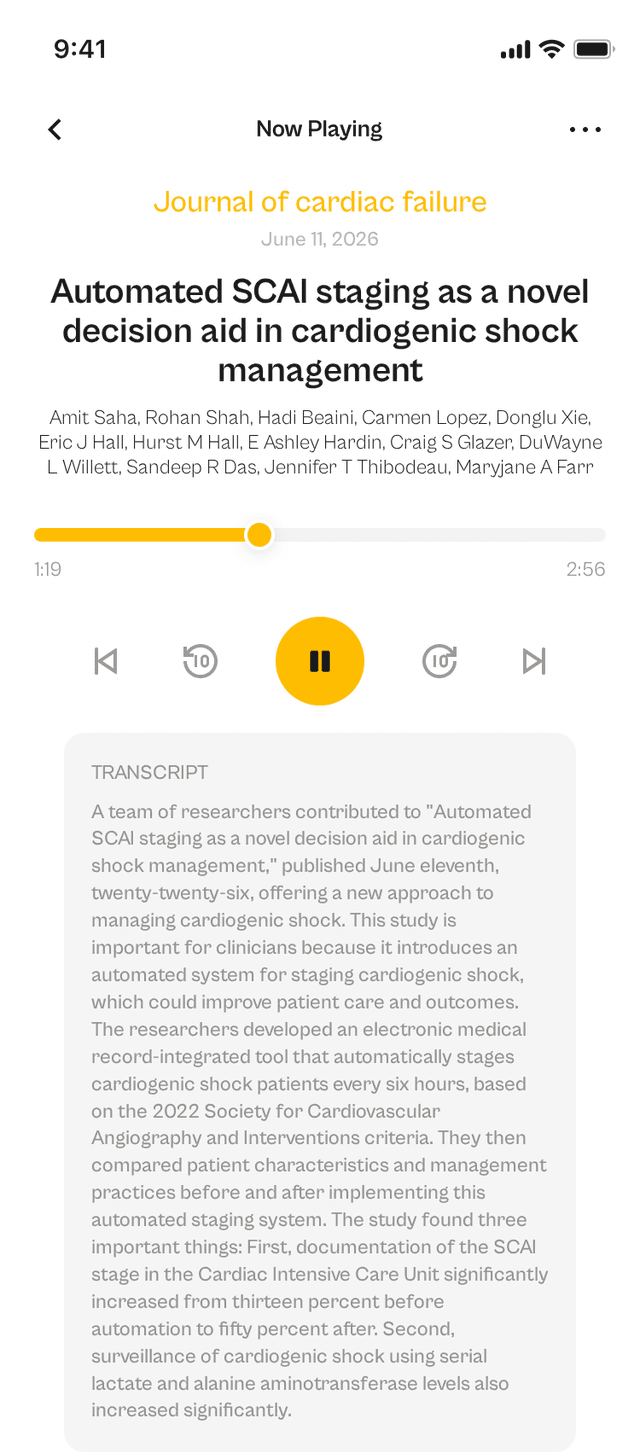
Automated SCAI staging as a novel decision aid in cardiogenic shock management
Listen to this summary
The authors aimed to develop and assess the utility of an automated, electronic medical record-integrated staging tool for cardiogenic shock (CS) using the Society for Cardiovascular Angiography and Interventions (SCAI) criteria. Their findings indicate that the implementation of this automated staging significantly improved documentation of SCAI stages and enhanced surveillance practices, suggesting that early, serial automated staging may offer prognostic value in managing CS.
This is one of 33,000+ journals available on OSLR. Try it free for 14 days.
Free 14-day trial. 33,000+ journals. Cancel anytime.
More from Journal of cardiac failure
View all →Jun 11, 2026 · Journal of cardiac failure
A Novel Model to Predict Progression to Death After Withdrawal of Care in Potential Donation-After-Circulatory-Death Heart Donors
Jun 7, 2026 · Journal of cardiac failure
Impact of Mavacamten on Disease-Related Symptoms in Patients With Obstructive Hypertrophic Cardiomyopathy: HCMSQ Outcomes in EXPLORER-HCM
More in Internal Medicine
View all →Jun 25, 2026 · Blood
Combining Quizartinib with intensive chemotherapy in older patients with newly diagnosed AML: results of the UK NCRI AML18 Trial
Jun 25, 2026 · Blood
Translational Regulation of Sf1 Integrates Alternative Splicing and Hematopoietic Stem Cell Fate
Jun 25, 2026 · Blood
Galectin-1 Fuels Monocyte Hyperinflammation and Represents a Novel Therapeutic Target in Myeloproliferative Neoplasms
Jun 25, 2026 · The American journal of sports medicine
Association of Central Acetabular Osteophytes With Microinstability and Increased Combined Anteversion in Borderline Dysplasia Hips
Jun 25, 2026 · Blood
NG2-ITGA4 axis regulates Rho GTPases and leukemic aggressiveness in KMT2A-r B-ALL and is targetable with natalizumab
Jun 24, 2026 · Lancet (London, England)
Safety, pharmacokinetics, and exploratory efficacy of the oral ghrelin receptor agonist AC01 in heart failure with reduced ejection fraction (GOAL-HF1): a randomised, double-blind, placebo-controlled, phase 1b/2a study
"Oslr has become part of my weekly routine on my day off. The clinical relevance of the summaries is outstanding — I'd rate it 9/10. Being able to consume research hands-free is a huge advantage for busy physicians."

Dr. Jennifer Thompson
Portland, OR
Stay current without falling behind
33,000+ journals. 3-minute audio summaries. Free for 14 days.