
In-hospital cardiac arrest in non-ST-segment elevation myocardial infarction: characteristics and association of early intervention with risk -findings from the CCC-ACS project
Listen to this summary
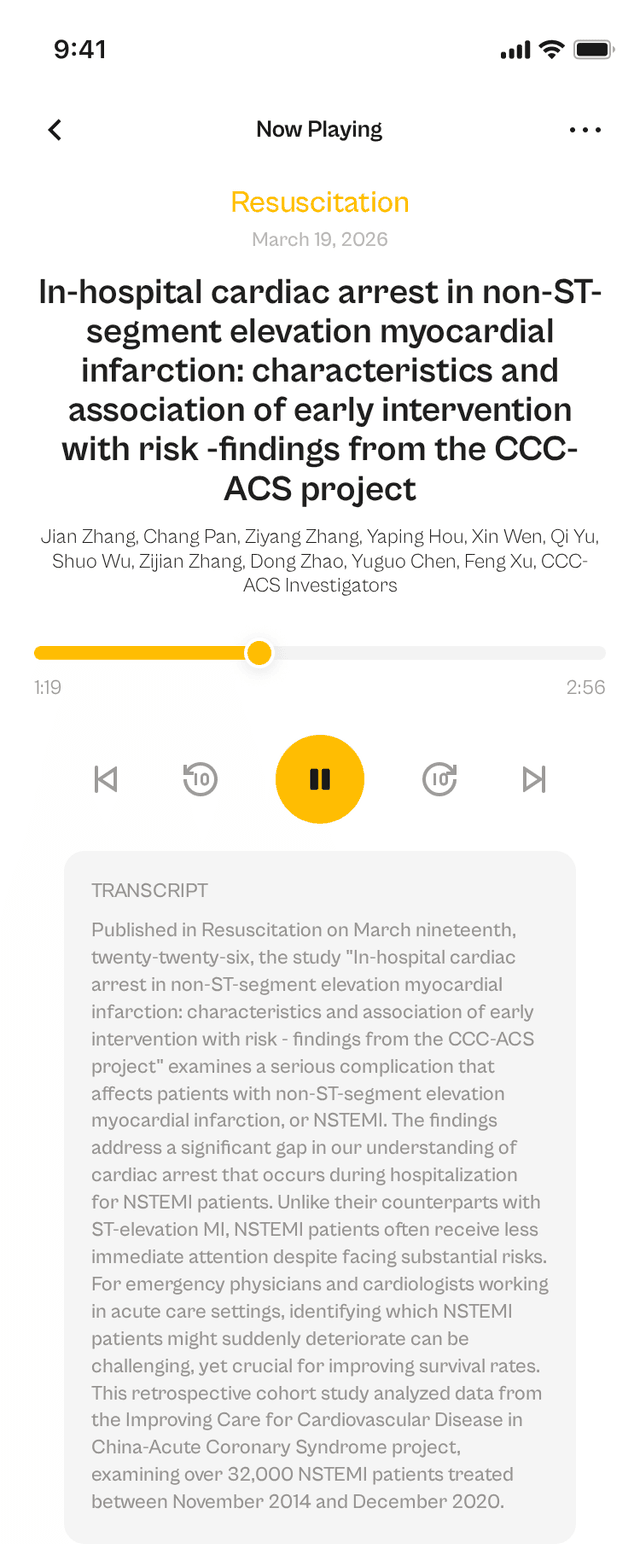
The authors aimed to investigate the characteristics and risk factors associated with in-hospital cardiac arrest (IHCA) in patients with non-ST-segment elevation myocardial infarction (NSTEMI) and to assess the impact of early intervention on outcomes. Their study found that IHCA occurred in 1.24% of NSTEMI patients, with a high in-hospital mortality rate, and identified several risk factors, including advanced age and elevated troponin levels, while early coronary angiography emerged as a significant protective factor. The findings highlight the importance of recognizing high-risk patients and implementing timely interventions to potentially reduce IHCA incidence.
This is one of 33,000+ journals available on OSLR. Try it free for 14 days.
Free 14-day trial. 33,000+ journals. Cancel anytime.
More from Resuscitation
View all →Mar 19, 2026 · Resuscitation
Impact of tidal volume during cardiopulmonary resuscitation: an experimental pilot porcine study
Mar 19, 2026 · Resuscitation
POST-CARDIAC ARREST BRAIN INJURY MODEL: NEUROBIOMARKER KINETICS FOLLOWING GLOBAL CEREBRAL HYPOPERFUSION-REPERFUSION
Mar 19, 2026 · Resuscitation
The impact of defibrillation current and pad position on return of spontaneous circulation during refractory ventricular fibrillation
Mar 19, 2026 · Resuscitation
Does the initial description of an out-of-hospital cardiac arrest given by callers contacting Emergency Medical Services contain key indicator words which can be used to support appropriate resource deployment?
Mar 16, 2026 · Resuscitation
Multiplying Flow and Pressure: Detecting Respiratory Phases in Intra-Arrest Ventilation
Mar 12, 2026 · Resuscitation
Effect of prehospital respiratory interventions on pediatric drowning outcomes
More in Emergency Medicine
View all →Mar 25, 2026 · Academic emergency medicine : official journal of the Society for Academic Emergency Medicine
A Scoping Review of Teamwork, Patient Safety, and Clinician Well-Being in the Emergency Department
Mar 25, 2026 · Academic emergency medicine : official journal of the Society for Academic Emergency Medicine
Co-Design of a Sleep Improvement Intervention for Persons Living With Dementia Boarding in the Emergency Department
Mar 25, 2026 · The American journal of emergency medicine
Midline and central line catheters usage and blood stream infection: Trends and insights from 2016 to 2024
Mar 25, 2026 · Prehospital emergency care
Health and Medical Preparedness and Response to the 2024 Republican National Convention
Mar 24, 2026 · Academic emergency medicine : official journal of the Society for Academic Emergency Medicine
A Multidimensional Approach to Acute Traumatic Brain Injury: What the NIH-NINDS CBI-M Framework Means for Emergency Medicine
Mar 24, 2026 · Annals of emergency medicine
Urgent Care and Emergency Department Visitors: A Latent Class Analysis
"Oslr has become part of my weekly routine on my day off. The clinical relevance of the summaries is outstanding — I'd rate it 9/10. Being able to consume research hands-free is a huge advantage for busy physicians."

Dr. Jennifer Thompson
Portland, OR
Stay current without falling behind
33,000+ journals. 3-minute audio summaries. Free for 14 days.