
Tailored psychotherapy and AI-enhanced contingency management for co-occurring disorders in cannabis use disorder: a systematic review
Listen to this summary
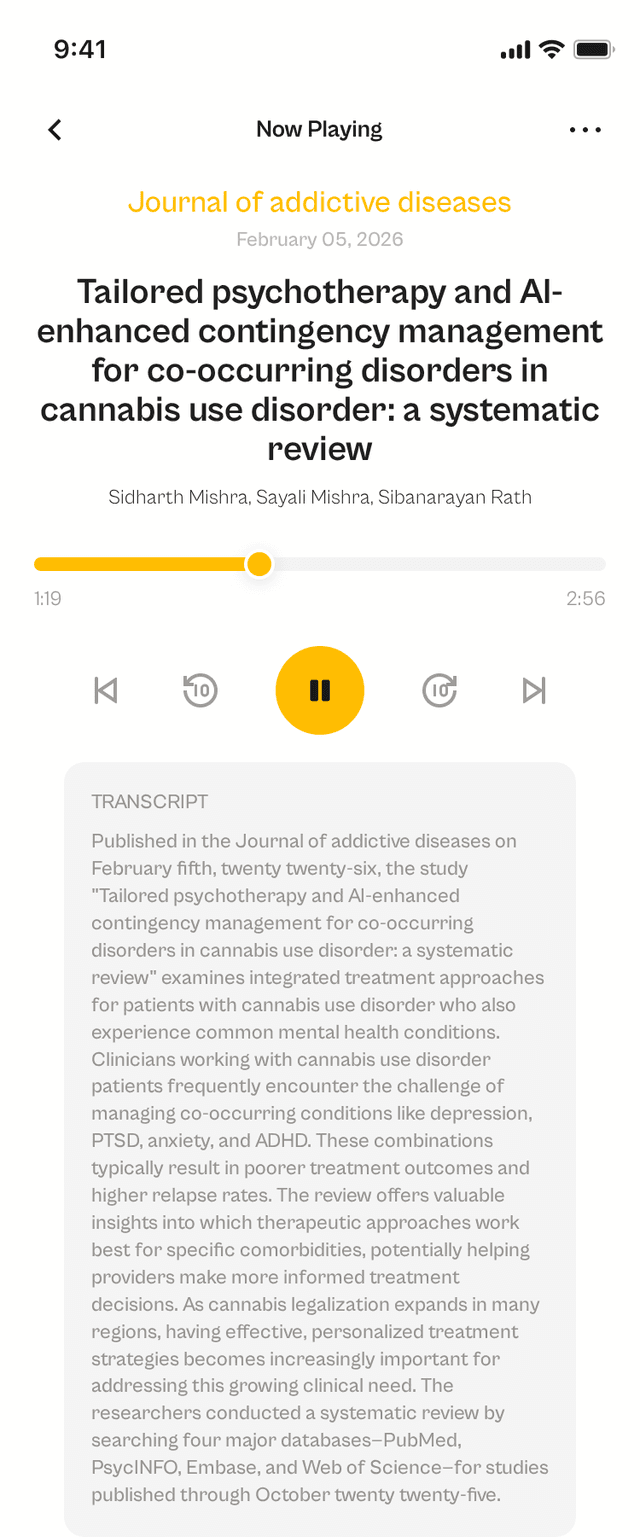
This systematic review investigates the effectiveness of tailored interventions for cannabis use disorder (CUD) in individuals with co-occurring disorders such as depression, PTSD, anxiety, and ADHD, while also exploring the potential of AI-enhanced contingency management (CM) to improve treatment outcomes. The findings indicate that integrated cognitive-behavioral therapies and AI applications can significantly reduce cannabis use and improve psychiatric symptoms, suggesting that combining personalized psychotherapy with technology-assisted reinforcement may enhance treatment efficacy for this population.
This is one of 33,000+ journals available on OSLR. Try it free for 14 days.
Free 14-day trial. 33,000+ journals. Cancel anytime.
More from Journal of addictive diseases
View all →Mar 23, 2026 · Journal of addictive diseases
Quality of life in people who inject drugs correlate with discharge outcomes and medication therapy initiation
Mar 6, 2026 · Journal of addictive diseases
Assessing the clinical competence of large language models for tobacco use disorder: A multi-domain expert evaluation
Mar 4, 2026 · Journal of addictive diseases
Network meta-analysis of non-pharmacological interventions for psychiatric symptoms among individuals with substance use disorders
Mar 3, 2026 · Journal of addictive diseases
Why brief interventions fail in substance use-and how to fix them
Mar 3, 2026 · Journal of addictive diseases
Balancing transition and readmission: a comparative study of low-dose vs standard buprenorphine initiation for medically managed opioid withdrawal
Feb 26, 2026 · Journal of addictive diseases
A random forest analysis identifying important predictors and risk factors among those who reported use of methamphetamine during their last alcohol use: a national analysis between 2021-2023
More in Psychiatry & Neurology
View all →Mar 25, 2026 · The American journal of sports medicine
Tibiofemoral Load Sharing and Lateral Meniscal Function Are Restored in Tibia- and Capsular-Based Repair of Type 3 Lateral Meniscal Oblique Radial Tears
Mar 25, 2026 · The American journal of sports medicine
Lateral Extra-articular Tenodesis Restores Knee Rotational and Translational Stability Regardless of Fixation Type: A Matched-Pair Cadaveric Study
Mar 25, 2026 · The American journal of sports medicine
Clinical Outcomes of Unipolar Versus Bipolar Patellofemoral Fresh Osteochondral Allograft Transplantation
Mar 25, 2026 · British journal of sports medicine
Injury risk and its relationship with biological maturation among 100 junior tennis athletes: a 15-year retrospective analysis
Mar 25, 2026 · The American journal of sports medicine
Deltoid Osteomuscular Transfer Suppresses Humeral Head Translation Caused by Massive Irreparable Rotator Cuff Tears: A Cadaveric Biomechanical Study
Mar 25, 2026 · The New England journal of medicine
A Placebo-Controlled Trial of the Oral PCSK9 Inhibitor Enlicitide
"Oslr has become part of my weekly routine on my day off. The clinical relevance of the summaries is outstanding — I'd rate it 9/10. Being able to consume research hands-free is a huge advantage for busy physicians."

Dr. Jennifer Thompson
Portland, OR
Stay current without falling behind
33,000+ journals. 3-minute audio summaries. Free for 14 days.