
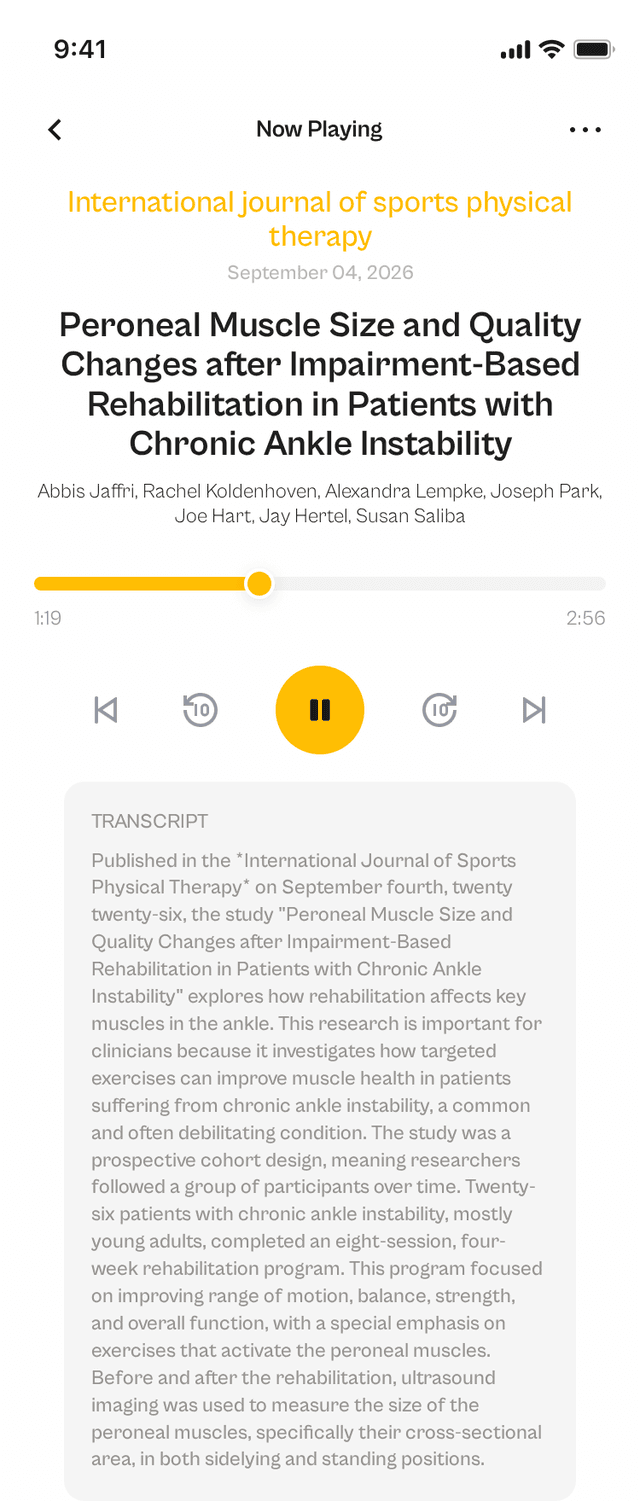
Peroneal Muscle Size and Quality Changes after Impairment-Based Rehabilitation in Patients with Chronic Ankle Instability
Listen to this summary
The authors aimed to investigate changes in peroneal muscle size and quality following an impairment-based rehabilitation program in patients with chronic ankle instability (CAI). Their findings revealed significant increases in peroneal muscle cross-sectional area and improved muscle quality in the trained limb, with cross-education effects noted in the untrained limb, highlighting the effectiveness of targeted rehabilitation in managing CAI.
This is one of 33,000+ journals available on OSLR. Try it free for 14 days.
Free 14-day trial. 33,000+ journals. Cancel anytime.
More from International journal of sports physical therapy
View all →Sep 4, 2026 · International journal of sports physical therapy
Isokinetic Quadriceps and Hamstring Peak Torque in Athletes Aged 10-50+: Preoperative Uninvolved Limb Reference Values for ACL Reconstruction
Sep 4, 2026 · International journal of sports physical therapy
Standard Versus Arm-Length-Normalized Conditions for Assessment of the Closed Kinetic Chain Upper Extremity Stability Test in Healthy Youth Athletes
Sep 4, 2026 · International journal of sports physical therapy
Acute Effects of Contract-Relax PNF With and Without Neuromuscular Electrical Stimulation on Hamstring Flexibility and Jump Performance in Adolescent Soccer Players: A Randomized Controlled Trial
Sep 4, 2026 · International journal of sports physical therapy
Patients' Mental Barriers in Rehabilitation after ACL Reconstruction: A Qualitative Interview Study
Sep 4, 2026 · International journal of sports physical therapy
Utilization of the Functional Lower Extremity Evaluation (FLEE) in Return-to-Sport Rehabilitation Protocol Following Hip Arthroscopy in Collegiate Athletes: A Case Series
Sep 4, 2026 · International journal of sports physical therapy
Return to Golf Rehabilitation Progression after Anterior Cruciate Ligament Reconstruction Using an Evidence-Based Foundation
More in Physical Therapist
View all →Sep 22, 2026 · The American journal of sports medicine
Autologous Platelet-Rich Plasma-Enriched Chondral Matrix Implantation Improves Cartilage Repair in an Ovine Model: A Magnetic Resonance Assessment Using the MOCART 2.0 Scoring System
Sep 22, 2026 · The American journal of sports medicine
Indications for Isolated Arthroscopic Bankart Repair in the Adolescent Shoulder May Be Limited: Bipolar Bone Loss and Low Distance to Dislocation Found Commonly in an Adolescent Population With Glenohumeral Instability
Sep 22, 2026 · The American journal of sports medicine
Lateral Tibial Posterior Slope Induces Anterior Tibial Translation While Lateral-Medial Slope Difference Induces Internal Rotation: A Cadaveric Biomechanical Study
Sep 21, 2026 · British journal of sports medicine
Exercise-only interventions and exercise-based multidomain lifestyle interventions to promote cognitive function in older adults without dementia: a systematic review and meta-analysis
Sep 21, 2026 · The American journal of sports medicine
Periacetabular Osteotomy and Combined Open Femoral Head-Neck Junction Osteochondroplasty: A Concise Follow-up of a Previous Report at a Mean 10-Year Follow-up
Sep 17, 2026 · British journal of sports medicine
Prevalence and significance of anterior T-wave inversion in elite football players in the United Kingdom
"Oslr has become part of my weekly routine on my day off. The clinical relevance of the summaries is outstanding — I'd rate it 9/10. Being able to consume research hands-free is a huge advantage for busy physicians."

Dr. Jennifer Thompson
Portland, OR
Stay current without falling behind
33,000+ journals. 3-minute audio summaries. Free for 14 days.