
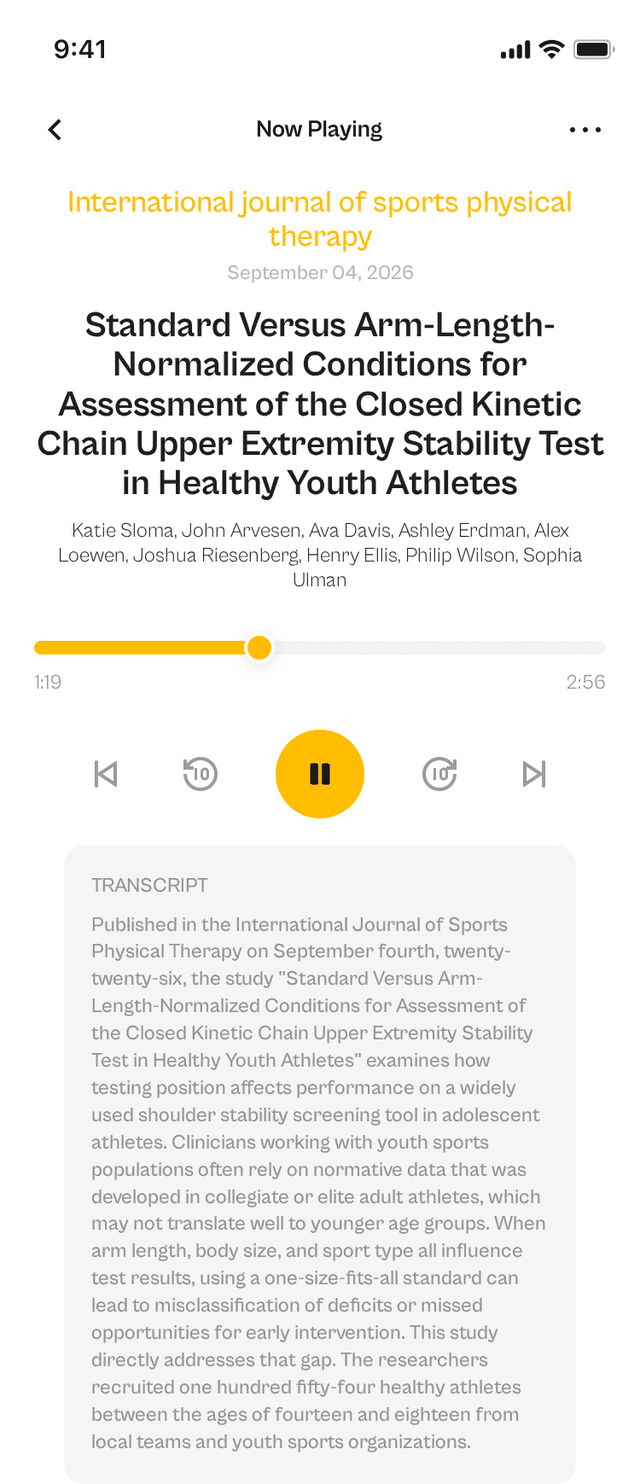
Standard Versus Arm-Length-Normalized Conditions for Assessment of the Closed Kinetic Chain Upper Extremity Stability Test in Healthy Youth Athletes
Listen to this summary
The authors aimed to compare performance and establish agreement between standard and arm-length-normalized conditions of the Closed Kinetic Chain Upper Extremity Stability Test (CKCUEST) in healthy adolescent athletes. They found that performance was significantly better in the arm-length-normalized condition, suggesting it may be a more appropriate assessment method, particularly given the influence of arm length, body mass, and sport type on results. The study highlights the need for population-specific reference values in evaluating shoulder stability.
This is one of 33,000+ journals available on OSLR. Try it free for 14 days.
Free 14-day trial. 33,000+ journals. Cancel anytime.
More from International journal of sports physical therapy
View all →Sep 4, 2026 · International journal of sports physical therapy
Peroneal Muscle Size and Quality Changes after Impairment-Based Rehabilitation in Patients with Chronic Ankle Instability
Sep 4, 2026 · International journal of sports physical therapy
Isokinetic Quadriceps and Hamstring Peak Torque in Athletes Aged 10-50+: Preoperative Uninvolved Limb Reference Values for ACL Reconstruction
Sep 4, 2026 · International journal of sports physical therapy
Acute Effects of Contract-Relax PNF With and Without Neuromuscular Electrical Stimulation on Hamstring Flexibility and Jump Performance in Adolescent Soccer Players: A Randomized Controlled Trial
Sep 4, 2026 · International journal of sports physical therapy
Patients' Mental Barriers in Rehabilitation after ACL Reconstruction: A Qualitative Interview Study
Sep 4, 2026 · International journal of sports physical therapy
Utilization of the Functional Lower Extremity Evaluation (FLEE) in Return-to-Sport Rehabilitation Protocol Following Hip Arthroscopy in Collegiate Athletes: A Case Series
Sep 4, 2026 · International journal of sports physical therapy
Return to Golf Rehabilitation Progression after Anterior Cruciate Ligament Reconstruction Using an Evidence-Based Foundation
More in Physical Therapist
View all →Sep 22, 2026 · The American journal of sports medicine
Autologous Platelet-Rich Plasma-Enriched Chondral Matrix Implantation Improves Cartilage Repair in an Ovine Model: A Magnetic Resonance Assessment Using the MOCART 2.0 Scoring System
Sep 22, 2026 · The American journal of sports medicine
Indications for Isolated Arthroscopic Bankart Repair in the Adolescent Shoulder May Be Limited: Bipolar Bone Loss and Low Distance to Dislocation Found Commonly in an Adolescent Population With Glenohumeral Instability
Sep 22, 2026 · The American journal of sports medicine
Lateral Tibial Posterior Slope Induces Anterior Tibial Translation While Lateral-Medial Slope Difference Induces Internal Rotation: A Cadaveric Biomechanical Study
Sep 21, 2026 · British journal of sports medicine
Exercise-only interventions and exercise-based multidomain lifestyle interventions to promote cognitive function in older adults without dementia: a systematic review and meta-analysis
Sep 21, 2026 · The American journal of sports medicine
Periacetabular Osteotomy and Combined Open Femoral Head-Neck Junction Osteochondroplasty: A Concise Follow-up of a Previous Report at a Mean 10-Year Follow-up
Sep 17, 2026 · British journal of sports medicine
Prevalence and significance of anterior T-wave inversion in elite football players in the United Kingdom
"Oslr has become part of my weekly routine on my day off. The clinical relevance of the summaries is outstanding — I'd rate it 9/10. Being able to consume research hands-free is a huge advantage for busy physicians."

Dr. Jennifer Thompson
Portland, OR
Stay current without falling behind
33,000+ journals. 3-minute audio summaries. Free for 14 days.