
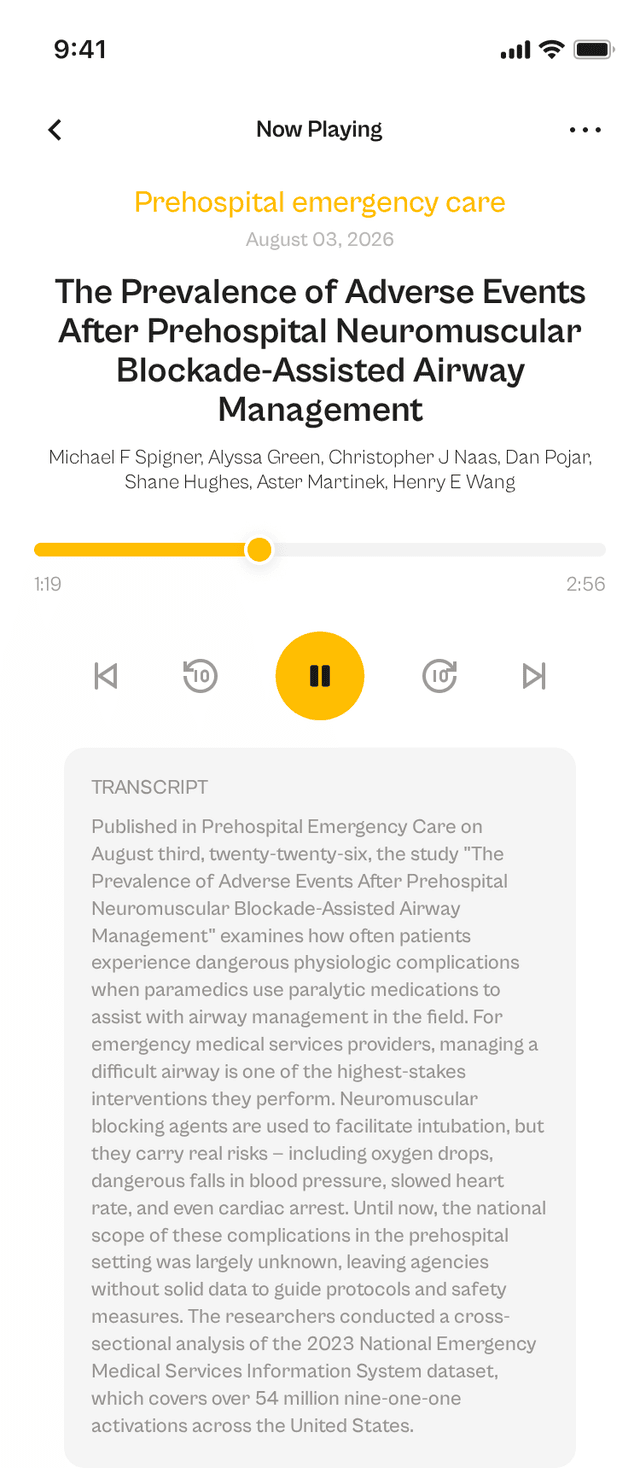
The Prevalence of Adverse Events After Prehospital Neuromuscular Blockade-Assisted Airway Management
Listen to this summary
The authors aimed to estimate the prevalence of adverse events associated with prehospital neuromuscular blockade-assisted airway management in the United States. Their study found that 27.5% of patients experienced at least one adverse event, with hypoxemia being the most common at 25%, highlighting the need for emergency medical services to implement measures to mitigate these risks.
This is one of 33,000+ journals available on OSLR. Try it free for 14 days.
Free 14-day trial. 33,000+ journals. Cancel anytime.
More from Prehospital emergency care
View all →Jul 30, 2026 · Prehospital emergency care
Prehospital resuscitative endovascular balloon occlusion of the aorta (REBOA) in patients with major trauma and cardiac arrest: a systematic review
Jul 30, 2026 · Prehospital emergency care
National Characteristics of Emergency Medical Services in Rural and Frontier Areas: A 2024 Update on Rural-Urban Differences in EMS Care
Jul 29, 2026 · Prehospital emergency care
Determinants of Timely Prehospital Thrombolysis Administration within a Pharmacoinvasive STEMI Network in Victoria, Australia
Jul 29, 2026 · Prehospital emergency care
The estimated prevalence of multiple record encounters in the National Emergency Medical Services Information System
Jul 21, 2026 · Prehospital emergency care
Signs of Life During Out-of-Hospital Cardiac Arrest: A Retrospective Cohort Study
Jul 17, 2026 · Prehospital emergency care
Differential association of prehospital physician presence with outcomes in out-of-hospital cardiac arrest: Secondary analysis of a nationwide registry
More in Emergency Medicine
View all →Aug 8, 2026 · The American journal of emergency medicine
Clinical selection of point-of-care EEG for seizure or altered mental status in a pediatric emergency department
Aug 8, 2026 · The American journal of emergency medicine
Paramedic perspectives on prehospital buprenorphine: A qualitative case study of implementation in emergency medical services
Aug 7, 2026 · The American journal of emergency medicine
When dyspnea replaces chest pain: Age-dependent symptom profiles in ACS and non-ACS patients undergoing coronary angiography
Aug 6, 2026 · The American journal of emergency medicine
Non-A, non-B aortic arch dissection with atypical presentation, ambiguous CTA findings, and therapeutic dilemma
Aug 6, 2026 · The American journal of emergency medicine
Concurrent cardiocerebral infarction in the emergency department: A case series from a tertiary care centre in South India
Aug 6, 2026 · The American journal of emergency medicine
Successful dispatcher-assisted CPR and outcomes after out-of-hospital cardiac arrest: an age-specific nationwide study
"Oslr has become part of my weekly routine on my day off. The clinical relevance of the summaries is outstanding — I'd rate it 9/10. Being able to consume research hands-free is a huge advantage for busy physicians."

Dr. Jennifer Thompson
Portland, OR
Stay current without falling behind
33,000+ journals. 3-minute audio summaries. Free for 14 days.