
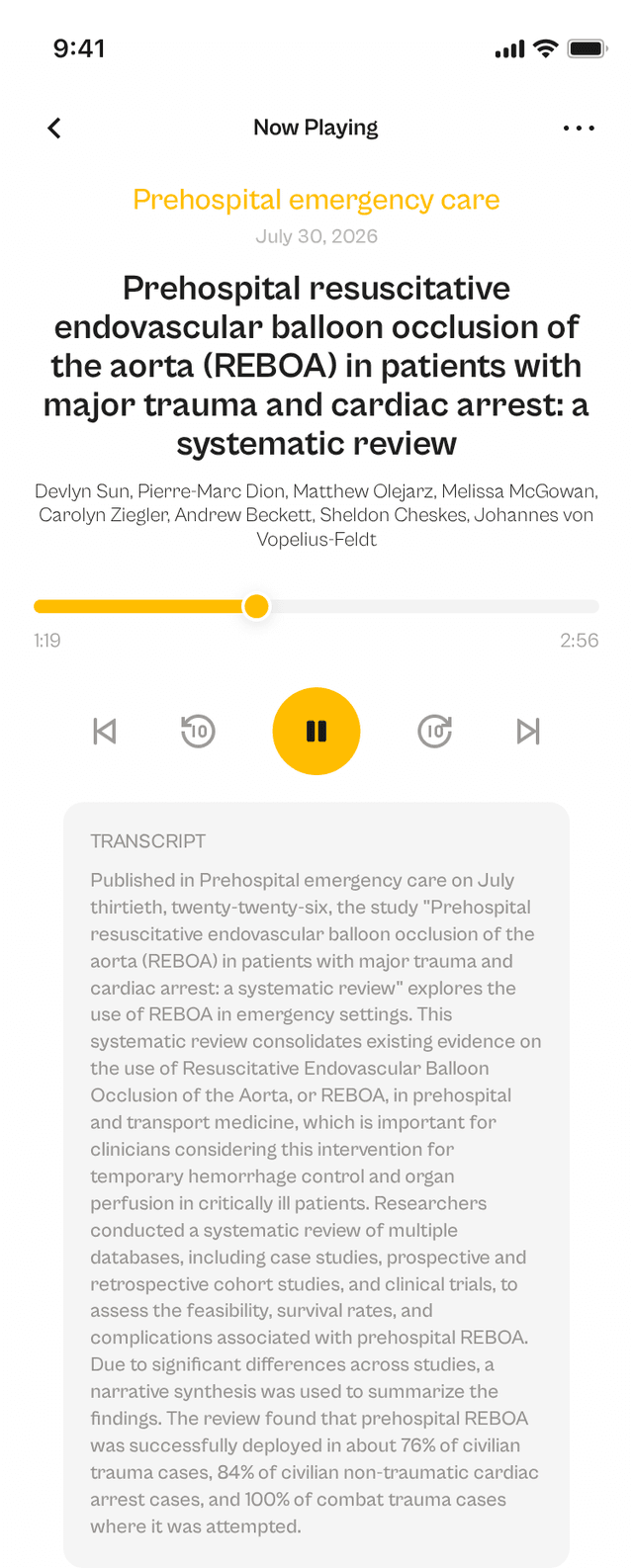
Prehospital resuscitative endovascular balloon occlusion of the aorta (REBOA) in patients with major trauma and cardiac arrest: a systematic review
Listen to this summary
This systematic review aims to evaluate the feasibility and effectiveness of prehospital resuscitative endovascular balloon occlusion of the aorta (REBOA) in patients experiencing major trauma and cardiac arrest. The findings indicate that while REBOA can be successfully deployed in a majority of cases, survival rates and complications vary significantly, highlighting the need for more robust studies to better understand its impact on patient outcomes in prehospital settings. Overall, the evidence remains limited due to methodological limitations and a lack of comprehensive data on survival rates.
This is one of 33,000+ journals available on OSLR. Try it free for 14 days.
Free 14-day trial. 33,000+ journals. Cancel anytime.
More from Prehospital emergency care
View all →Aug 3, 2026 · Prehospital emergency care
The Prevalence of Adverse Events After Prehospital Neuromuscular Blockade-Assisted Airway Management
Jul 30, 2026 · Prehospital emergency care
National Characteristics of Emergency Medical Services in Rural and Frontier Areas: A 2024 Update on Rural-Urban Differences in EMS Care
Jul 29, 2026 · Prehospital emergency care
The estimated prevalence of multiple record encounters in the National Emergency Medical Services Information System
Jul 29, 2026 · Prehospital emergency care
Determinants of Timely Prehospital Thrombolysis Administration within a Pharmacoinvasive STEMI Network in Victoria, Australia
Jul 21, 2026 · Prehospital emergency care
Signs of Life During Out-of-Hospital Cardiac Arrest: A Retrospective Cohort Study
Jul 17, 2026 · Prehospital emergency care
Differential association of prehospital physician presence with outcomes in out-of-hospital cardiac arrest: Secondary analysis of a nationwide registry
More in Emergency Medicine
View all →Aug 8, 2026 · The American journal of emergency medicine
Clinical selection of point-of-care EEG for seizure or altered mental status in a pediatric emergency department
Aug 8, 2026 · The American journal of emergency medicine
Paramedic perspectives on prehospital buprenorphine: A qualitative case study of implementation in emergency medical services
Aug 7, 2026 · The American journal of emergency medicine
When dyspnea replaces chest pain: Age-dependent symptom profiles in ACS and non-ACS patients undergoing coronary angiography
Aug 6, 2026 · The American journal of emergency medicine
Non-A, non-B aortic arch dissection with atypical presentation, ambiguous CTA findings, and therapeutic dilemma
Aug 6, 2026 · The American journal of emergency medicine
Concurrent cardiocerebral infarction in the emergency department: A case series from a tertiary care centre in South India
Aug 6, 2026 · The American journal of emergency medicine
Successful dispatcher-assisted CPR and outcomes after out-of-hospital cardiac arrest: an age-specific nationwide study
"Oslr has become part of my weekly routine on my day off. The clinical relevance of the summaries is outstanding — I'd rate it 9/10. Being able to consume research hands-free is a huge advantage for busy physicians."

Dr. Jennifer Thompson
Portland, OR
Stay current without falling behind
33,000+ journals. 3-minute audio summaries. Free for 14 days.