
Is non-supine positioning preferable in patients requiring intubation in the emergency department?
Listen to this summary
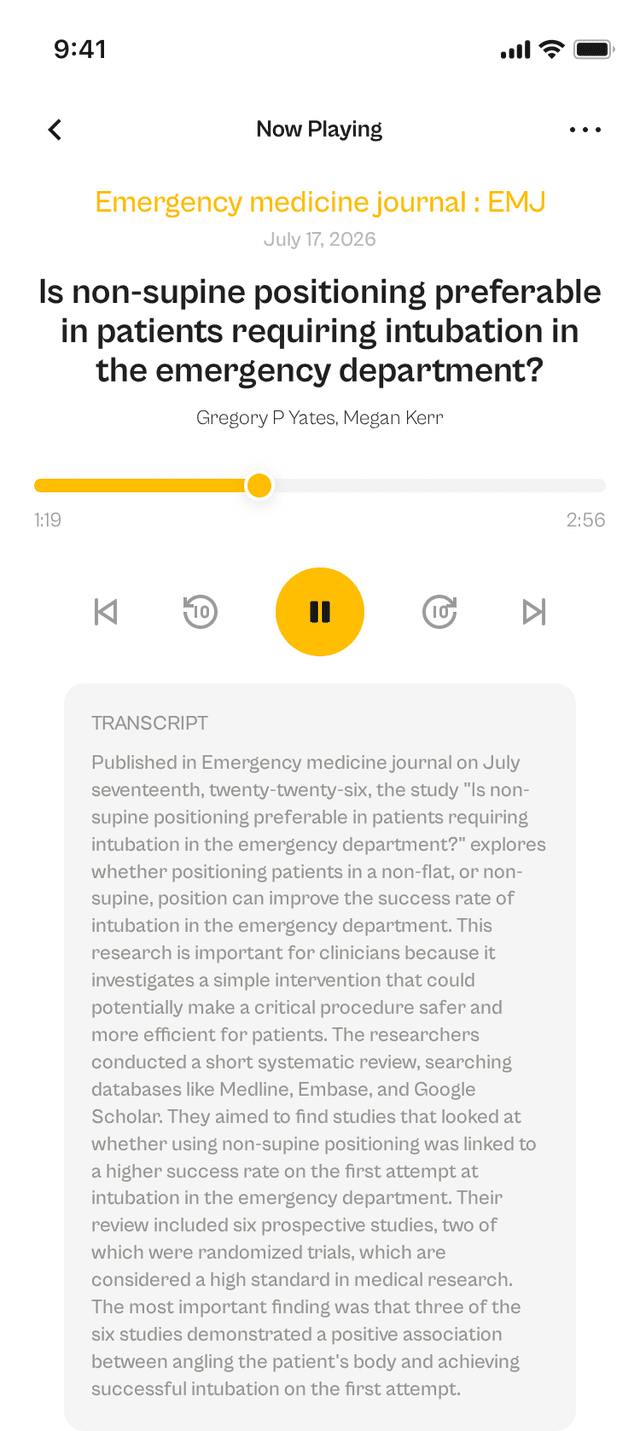
The authors aimed to determine whether non-supine positioning during intubation in the emergency department improves first-pass success rates. Their systematic review of six prospective studies, including two randomized trials, found a positive correlation between patient angulation and first-pass success in three of the studies, suggesting that inclined positioning may be beneficial for ED intubation protocols.
This is one of 33,000+ journals available on OSLR. Try it free for 14 days.
Free 14-day trial. 33,000+ journals. Cancel anytime.
More from Emergency medicine journal : EMJ
View all →Aug 3, 2026 · Emergency medicine journal : EMJ
Cross-sectional associations between neurodiversity and violence-related attendances in Welsh Emergency Departments and the role of Hospital-based Violence Intervention Programmes
Jul 30, 2026 · Emergency medicine journal : EMJ
In children presenting to the paediatric emergency department (PED) with acute gastroenteritis, does the use of probiotics lead to a shorter duration of diarrhoeal symptoms?
Jul 30, 2026 · Emergency medicine journal : EMJ
Black-white implicit bias among healthcare workers in UK emergency departments: findings from the multicentred BiasED Study
Jul 28, 2026 · Emergency medicine journal : EMJ
Non-communicable disease prevalence among asylum seekers and Swiss nationals: a comparative cross-sectional study in emergency care
Jul 28, 2026 · Emergency medicine journal : EMJ
A socioeconomic equity measured by Indices of Multiple Deprivation for HEMS-attended major trauma in South East England: heterogenous effects in severe traumatic brain injury
Jul 24, 2026 · Emergency medicine journal : EMJ
Alcohol-related minor injuries in an emergency room setting (ARMIERo): a case-crossover study on alcohol consumption and alcohol attributable fraction of minor injuries
More in Emergency Medicine
View all →Aug 8, 2026 · The American journal of emergency medicine
Clinical selection of point-of-care EEG for seizure or altered mental status in a pediatric emergency department
Aug 8, 2026 · The American journal of emergency medicine
Paramedic perspectives on prehospital buprenorphine: A qualitative case study of implementation in emergency medical services
Aug 7, 2026 · The American journal of emergency medicine
When dyspnea replaces chest pain: Age-dependent symptom profiles in ACS and non-ACS patients undergoing coronary angiography
Aug 6, 2026 · The American journal of emergency medicine
Non-A, non-B aortic arch dissection with atypical presentation, ambiguous CTA findings, and therapeutic dilemma
Aug 6, 2026 · The American journal of emergency medicine
Concurrent cardiocerebral infarction in the emergency department: A case series from a tertiary care centre in South India
Aug 6, 2026 · The American journal of emergency medicine
Successful dispatcher-assisted CPR and outcomes after out-of-hospital cardiac arrest: an age-specific nationwide study
"Oslr has become part of my weekly routine on my day off. The clinical relevance of the summaries is outstanding — I'd rate it 9/10. Being able to consume research hands-free is a huge advantage for busy physicians."

Dr. Jennifer Thompson
Portland, OR
Stay current without falling behind
33,000+ journals. 3-minute audio summaries. Free for 14 days.