
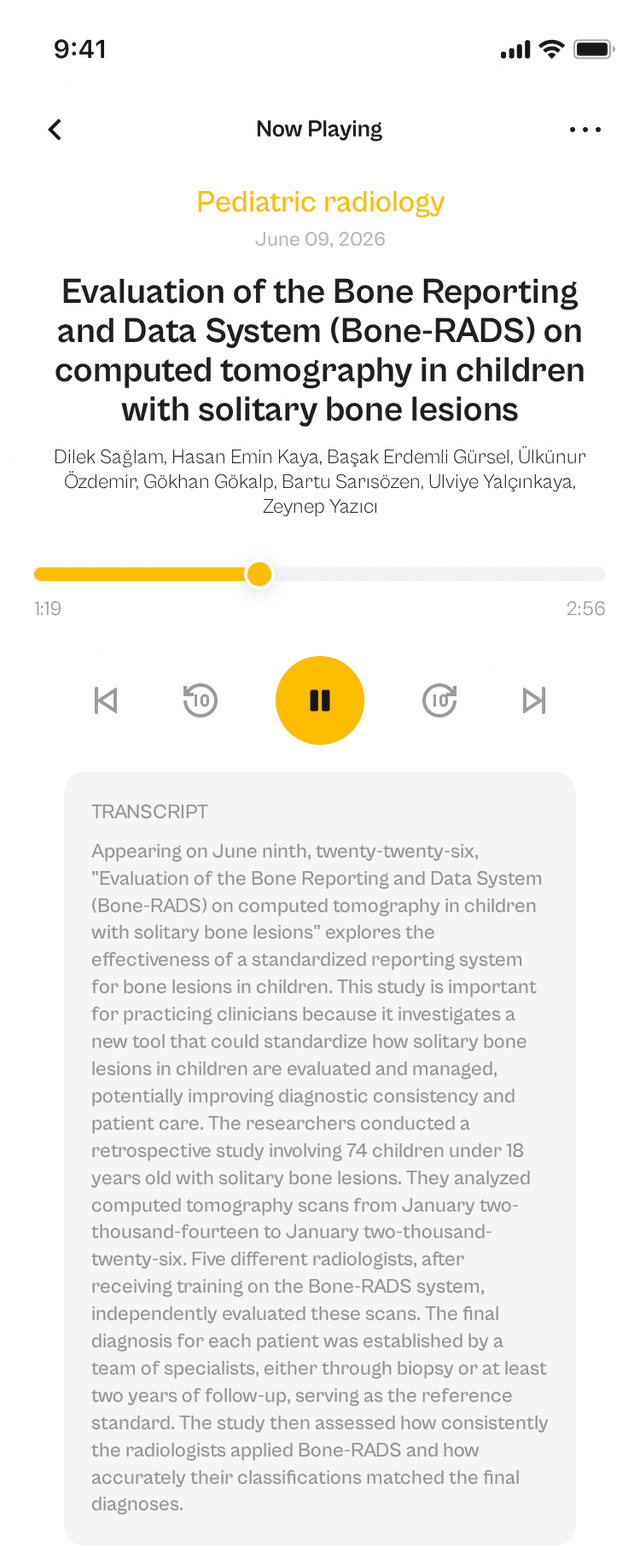
Evaluation of the Bone Reporting and Data System (Bone-RADS) on computed tomography in children with solitary bone lesions
Listen to this summary
This study evaluates the interrater agreement and diagnostic performance of the Bone Reporting and Data System (Bone-RADS) for solitary bone lesions in children using computed tomography (CT). The authors found that Bone-RADS demonstrated almost perfect interrater agreement and high diagnostic accuracy, suggesting its potential utility in managing solitary bone lesions in pediatric patients.
This is one of 33,000+ journals available on OSLR. Try it free for 14 days.
Free 14-day trial. 33,000+ journals. Cancel anytime.
More from Pediatric radiology
View all →Jun 11, 2026 · Pediatric radiology
Integrating artificial intelligence into paediatric interventional radiology: a review of emerging applications and future directions
Jun 10, 2026 · Pediatric radiology
Pediatric magnetic resonance urography from patient preparation to post-processing: basics and controversies
More in Radiology
View all →Sep 23, 2026 · Abdominal radiology (New York)
MRI assessment of extramural venous invasion in rectal cancer: a practical pictorial review
Sep 23, 2026 · JAMA
Tenecteplase Before Thrombectomy at 4.5 to 24 Hours for Basilar Artery Occlusion: The ATTENTION LATE Randomized Clinical Trial
Sep 23, 2026 · The New England journal of medicine
Phase 1 Study of Anito-cel, a d-Domain BCMA CAR T Cell for Refractory or Recurrent Myeloma
Sep 23, 2026 · The New England journal of medicine
Effect of Screening with Multicancer Early-Detection Test on Late-Stage Cancer Diagnosis
Sep 23, 2026 · Abdominal radiology (New York)
A radiology trainee's guide to perianal fistulas
Sep 23, 2026 · The New England journal of medicine
Etuvetidigene Autotemcel for the Treatment of Wiskott-Aldrich Syndrome
"Oslr has become part of my weekly routine on my day off. The clinical relevance of the summaries is outstanding — I'd rate it 9/10. Being able to consume research hands-free is a huge advantage for busy physicians."

Dr. Jennifer Thompson
Portland, OR
Stay current without falling behind
33,000+ journals. 3-minute audio summaries. Free for 14 days.