
Large Language Model Authorship in Ophthalmic Publications
Listen to this summary
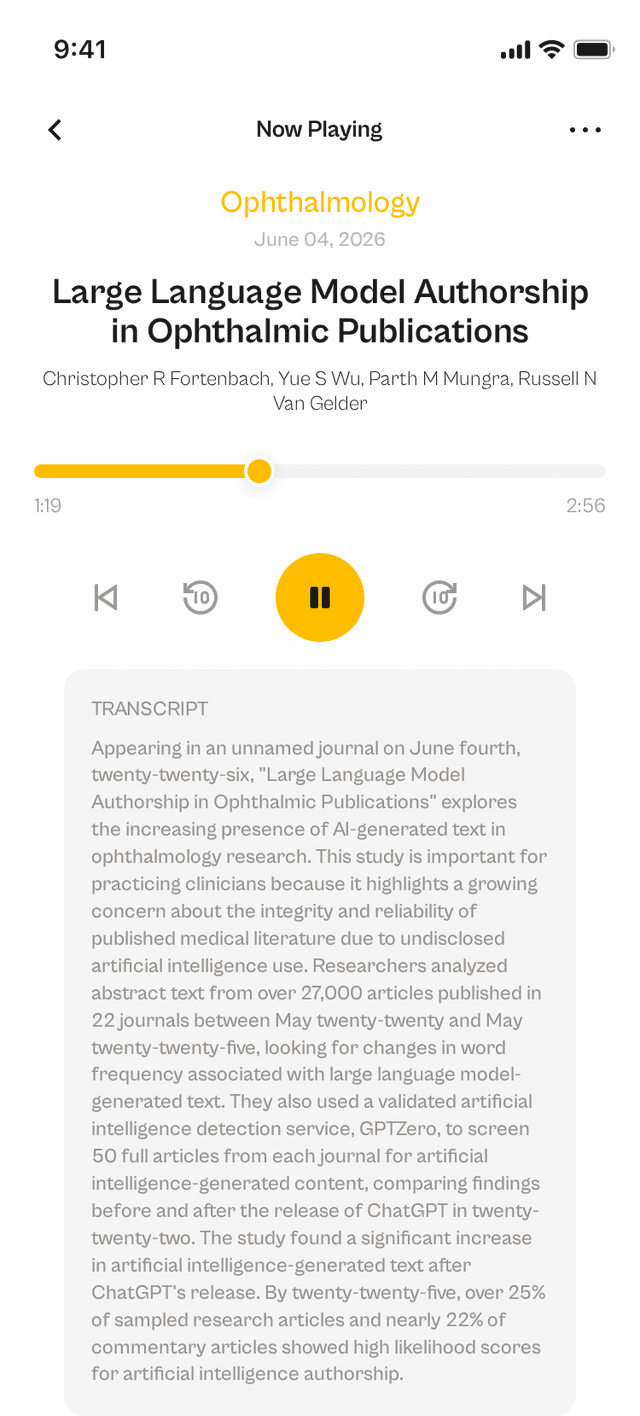
The authors aimed to investigate the prevalence of AI-generated text in ophthalmology publications following the release of ChatGPT in 2022. Their analysis revealed a significant increase in stylistic word usage associated with AI-generated content, with 25.7% of research articles and 21.6% of commentary articles showing high likelihoods of AI authorship, often without disclosure. The findings highlight the need for transparency and editorial oversight regarding the use of AI in scientific writing to maintain authorship integrity.
This is one of 33,000+ journals available on OSLR. Try it free for 14 days.
Free 14-day trial. 33,000+ journals. Cancel anytime.
More in Ophthalmology
View all →Sep 23, 2026 · The New England journal of medicine
Etuvetidigene Autotemcel for the Treatment of Wiskott-Aldrich Syndrome
Sep 23, 2026 · The New England journal of medicine
Clinical Uses of Common Genetic Variants Associated with Common Diseases
Sep 23, 2026 · The New England journal of medicine
Phase 1 Study of Anito-cel, a d-Domain BCMA CAR T Cell for Refractory or Recurrent Myeloma
Sep 23, 2026 · The New England journal of medicine
Effect of Screening with Multicancer Early-Detection Test on Late-Stage Cancer Diagnosis
Sep 22, 2026 · American journal of ophthalmology
Incidence of De Novo Glaucoma and Ocular Hypertension After DMEK vs DSAEK: A Systematic Review and Meta-Analysis
Sep 22, 2026 · Lancet (London, England)
Peripheral arterial disease: adverse impacts, disparities in outcomes, and the path ahead
"Oslr has become part of my weekly routine on my day off. The clinical relevance of the summaries is outstanding — I'd rate it 9/10. Being able to consume research hands-free is a huge advantage for busy physicians."

Dr. Jennifer Thompson
Portland, OR
Stay current without falling behind
33,000+ journals. 3-minute audio summaries. Free for 14 days.