
Interpreting ultra-processed food trial evidence: evidentiary limits, reporting practices, and policy relevance
Listen to this summary
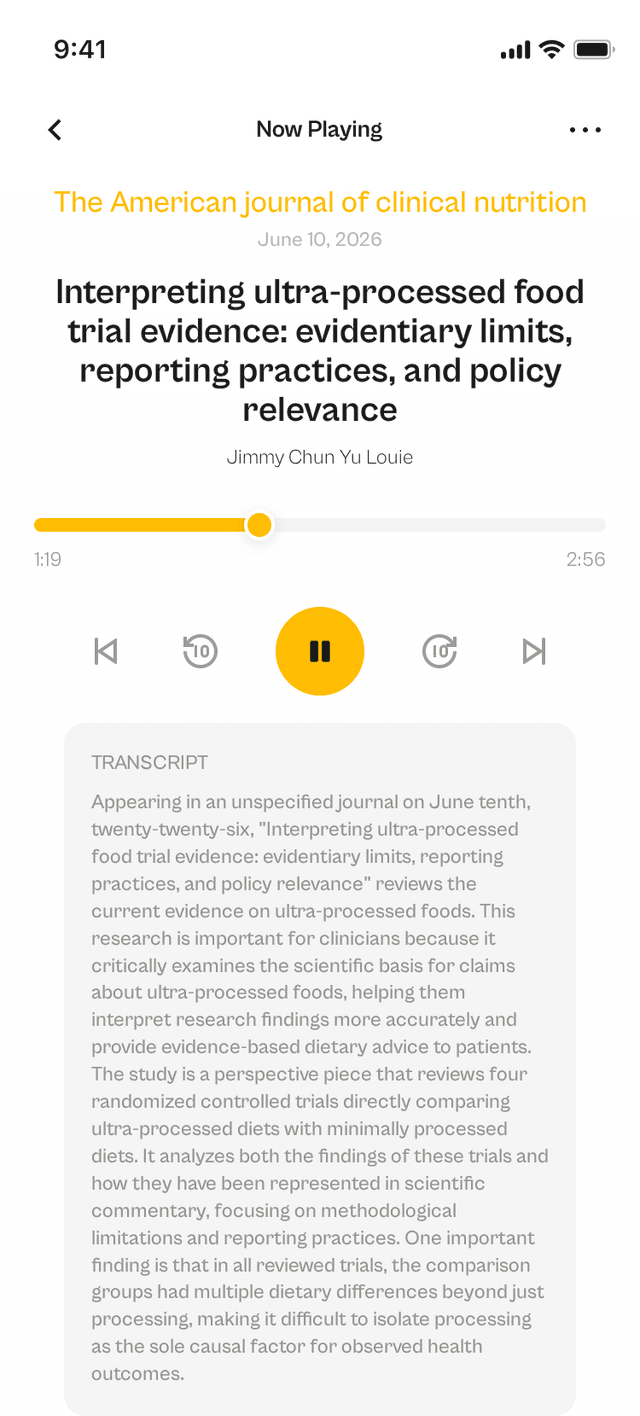
The authors examine the interpretation of randomized controlled trials comparing ultra-processed foods (UPF) to minimally processed diets, questioning whether the evidence truly supports causal claims about the health impacts of UPF. They highlight methodological limitations and biases in reporting that may overstate the negative effects of UPF while downplaying neutral or positive outcomes. The paper concludes with recommendations for improving trial design and reporting to ensure more accurate interpretations that inform public health policy.
This is one of 33,000+ journals available on OSLR. Try it free for 14 days.
Free 14-day trial. 33,000+ journals. Cancel anytime.
More from The American journal of clinical nutrition
View all →Jun 10, 2026 · The American journal of clinical nutrition
Circulating palmitoleic acid is associated with cerebral glucose metabolism in healthy middle-aged individuals: results from the PESA prospective cohort study
Jun 9, 2026 · The American journal of clinical nutrition
Enteral Iron Dose Effect on Iron Storage, Intestinal Barrier, and Gut Microbiome in Preterm Infants: A Randomized Clinical Trial
More in Family Medicine
View all →Sep 23, 2026 · JAMA
Tenecteplase Before Thrombectomy at 4.5 to 24 Hours for Basilar Artery Occlusion: The ATTENTION LATE Randomized Clinical Trial
Sep 23, 2026 · The New England journal of medicine
Clinical Uses of Common Genetic Variants Associated with Common Diseases
Sep 23, 2026 · The New England journal of medicine
Effect of Screening with Multicancer Early-Detection Test on Late-Stage Cancer Diagnosis
Sep 23, 2026 · The New England journal of medicine
Phase 1 Study of Anito-cel, a d-Domain BCMA CAR T Cell for Refractory or Recurrent Myeloma
Sep 23, 2026 · The New England journal of medicine
Etuvetidigene Autotemcel for the Treatment of Wiskott-Aldrich Syndrome
Sep 22, 2026 · The American journal of sports medicine
Lateral Tibial Posterior Slope Induces Anterior Tibial Translation While Lateral-Medial Slope Difference Induces Internal Rotation: A Cadaveric Biomechanical Study
"Oslr has become part of my weekly routine on my day off. The clinical relevance of the summaries is outstanding — I'd rate it 9/10. Being able to consume research hands-free is a huge advantage for busy physicians."

Dr. Jennifer Thompson
Portland, OR
Stay current without falling behind
33,000+ journals. 3-minute audio summaries. Free for 14 days.