
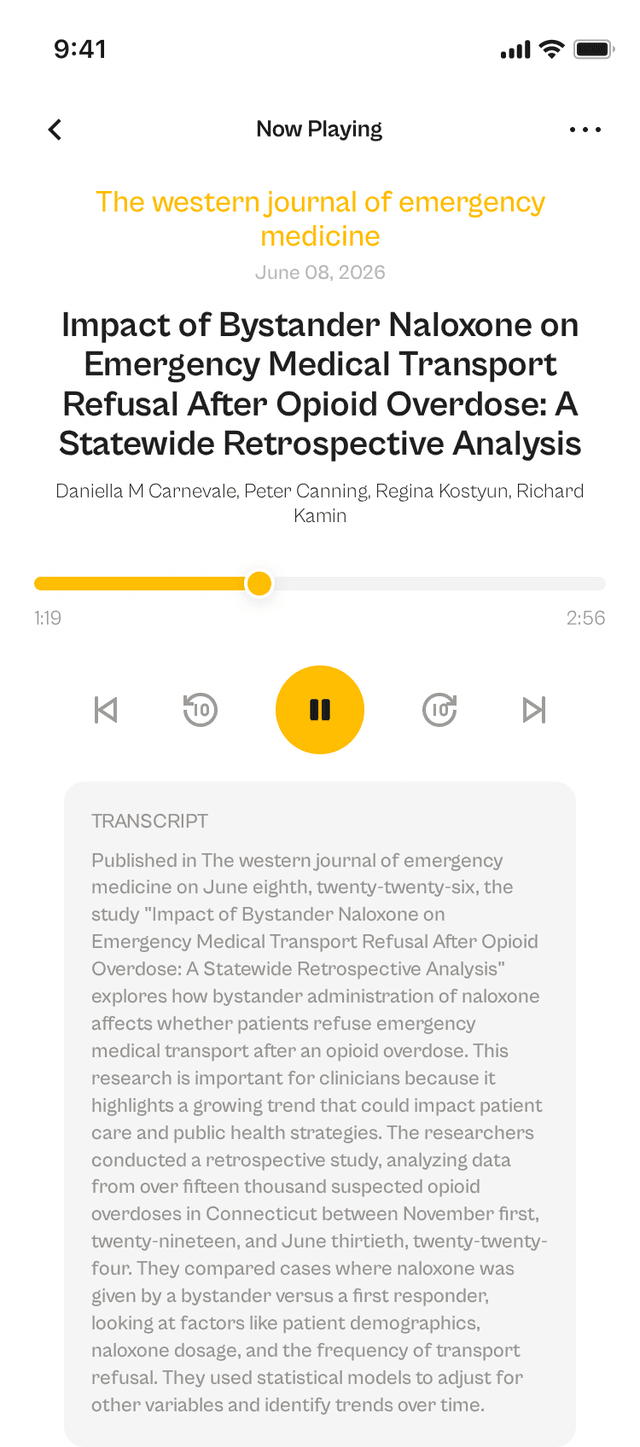
Impact of Bystander Naloxone on Emergency Medical Transport Refusal After Opioid Overdose: A Statewide Retrospective Analysis
Listen to this summary
This study investigates how bystander administration of naloxone impacts the likelihood of patients refusing emergency medical transport after an opioid overdose. The authors found that transport refusal was significantly higher when naloxone was administered by bystanders compared to first responders, with bystander administration increasing over time. The findings suggest that while refusal may not always lead to negative outcomes, it presents missed opportunities for critical follow-up care and interventions for opioid use disorder.
This is one of 33,000+ journals available on OSLR. Try it free for 14 days.
Free 14-day trial. 33,000+ journals. Cancel anytime.
More from The western journal of emergency medicine
View all →Jun 8, 2026 · The western journal of emergency medicine
Mechanisms and Intervention Strategies for Heat Stroke-Associated Myocardial Dysfunction: A Narrative Review
Jun 8, 2026 · The western journal of emergency medicine
Pilot Simulation Task Trainer for Prehospital Management of Neck Hemorrhage
Jun 8, 2026 · The western journal of emergency medicine
Emergency Department Boarding for Psychiatric Hospitalization in Older Adults: Placement Challenges and Associated Risks
Jun 8, 2026 · The western journal of emergency medicine
Clinician-documented Firearm Access and Safety Interventions for Veterans Receiving Suicide Risk Evaluation in VA Emergency Care Settings
Jun 8, 2026 · The western journal of emergency medicine
Contraception in the ED: Understanding Education and Opportunities for Clinicians to Advise Patients
Jun 8, 2026 · The western journal of emergency medicine
Changes in THC Positivity Rates in Adolescents Corresponding to Legalization of Recreational Marijuana in Illinois
More in Emergency Medicine
View all →Jun 23, 2026 · The American journal of emergency medicine
Status epilepticus in patients with known epilepsy presenting to the emergency department: Predictors and mortality risk
Jun 23, 2026 · Emergency medicine journal : EMJ
Concordance between an artificial intelligence self-triage programme and physical triage
Jun 22, 2026 · Prehospital emergency care
Prehospital Assessment and Treatment of Infants and Toddlers in Respiratory Distress: A Retrospective Analysis
Jun 22, 2026 · The American journal of emergency medicine
Vascular Eagle syndrome presenting with expanding cervical hematoma and acute ischemic stroke causing impending airway compromise
Jun 22, 2026 · The American journal of emergency medicine
Acute urinary retention presenting as inferior pseudo-STEMI: A case report
Jun 22, 2026 · Resuscitation
Diastolic blood pressure and end-tidal carbon dioxide during adult ICU cardiopulmonary resuscitation: association with return of spontaneous circulation
"Oslr has become part of my weekly routine on my day off. The clinical relevance of the summaries is outstanding — I'd rate it 9/10. Being able to consume research hands-free is a huge advantage for busy physicians."

Dr. Jennifer Thompson
Portland, OR
Stay current without falling behind
33,000+ journals. 3-minute audio summaries. Free for 14 days.