
Temperature Control After In-Hospital Cardiac Arrest: Outcomes From the Discover In-Hospital Cardiac Arrest Cohort
Listen to this summary
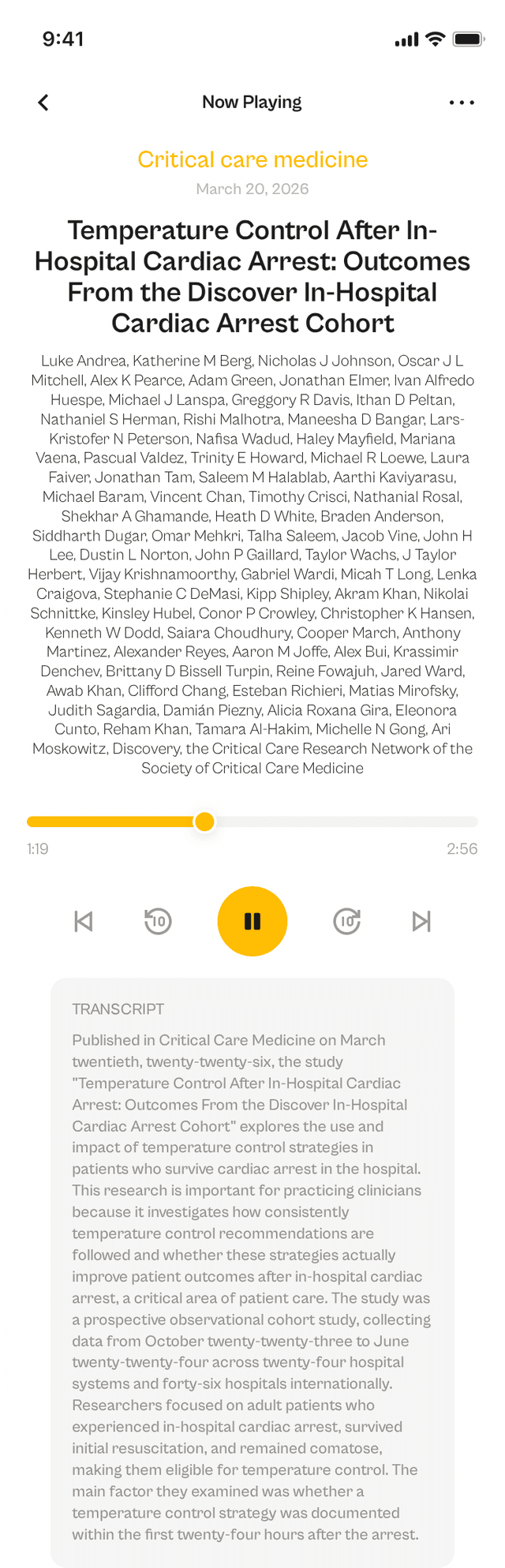
The authors aimed to investigate the adherence to temperature control strategies for comatose survivors of in-hospital cardiac arrest (IHCA) and its association with patient outcomes. They found that while a documented temperature control strategy was linked to a higher likelihood of receiving temperature therapy and a lower incidence of fever, it did not significantly affect survival or functional and neurologic outcomes. Notably, over half of the eligible patients did not have a documented strategy, highlighting variability in practice across hospital systems.
This is one of 33,000+ journals available on OSLR. Try it free for 14 days.
Free 14-day trial. 33,000+ journals. Cancel anytime.
More from Critical care medicine
View all →Mar 25, 2026 · Critical care medicine
Economic and Regional Disparities in Critical Care Ultrasound Training, Equipment Access, and Implementation Barriers in China: A Nationwide Cross-Sectional Survey
Mar 24, 2026 · Critical care medicine
Clinical Criteria for the Definition of Refractory Septic Shock: A Joint Delphi Consensus from the Society of Critical Care Medicine (SCCM) and European Society of Intensive Care Medicine (ESICM)
Mar 23, 2026 · Critical care medicine
Sepsis and Subsequent Psychiatric Morbidity: A Nationwide Population-Based Matched Cohort Study, 2008-2019
Mar 23, 2026 · Critical care medicine
Ready for Donation, Not for Death: A Qualitative Study of Families' Experience With Controlled Donation After Circulatory Determination of Death in Intensive Care
Mar 23, 2026 · Critical care medicine
Effects of a Combined Lifestyle Intervention on Recovery of ICU Survivors: A Randomized Controlled Trial
Mar 20, 2026 · Critical care medicine
Gaps and Strategies for Management of Sepsis in Low-Resource Settings: Expert Consensus Statements Using a Delphi Method
More in Internal Medicine
View all →Mar 25, 2026 · The American journal of sports medicine
Clinical Outcomes of Unipolar Versus Bipolar Patellofemoral Fresh Osteochondral Allograft Transplantation
Mar 25, 2026 · The American journal of sports medicine
Tibiofemoral Load Sharing and Lateral Meniscal Function Are Restored in Tibia- and Capsular-Based Repair of Type 3 Lateral Meniscal Oblique Radial Tears
Mar 25, 2026 · Gastroenterology
From Autoimmunity to Intestinal Tissue Damage: Insights From Potential Celiac Disease as a Paradigm of Disease Progression
Mar 25, 2026 · The American journal of sports medicine
Deltoid Osteomuscular Transfer Suppresses Humeral Head Translation Caused by Massive Irreparable Rotator Cuff Tears: A Cadaveric Biomechanical Study
Mar 25, 2026 · British journal of sports medicine
Injury risk and its relationship with biological maturation among 100 junior tennis athletes: a 15-year retrospective analysis
Mar 25, 2026 · Blood
FLT3-ITD scaffolds PKCι-STAT1 to drive noncanonical S727 phosphorylation and CD276-driven CD8+ T-cell exhaustion in AML
"Oslr has become part of my weekly routine on my day off. The clinical relevance of the summaries is outstanding — I'd rate it 9/10. Being able to consume research hands-free is a huge advantage for busy physicians."

Dr. Jennifer Thompson
Portland, OR
Stay current without falling behind
33,000+ journals. 3-minute audio summaries. Free for 14 days.