
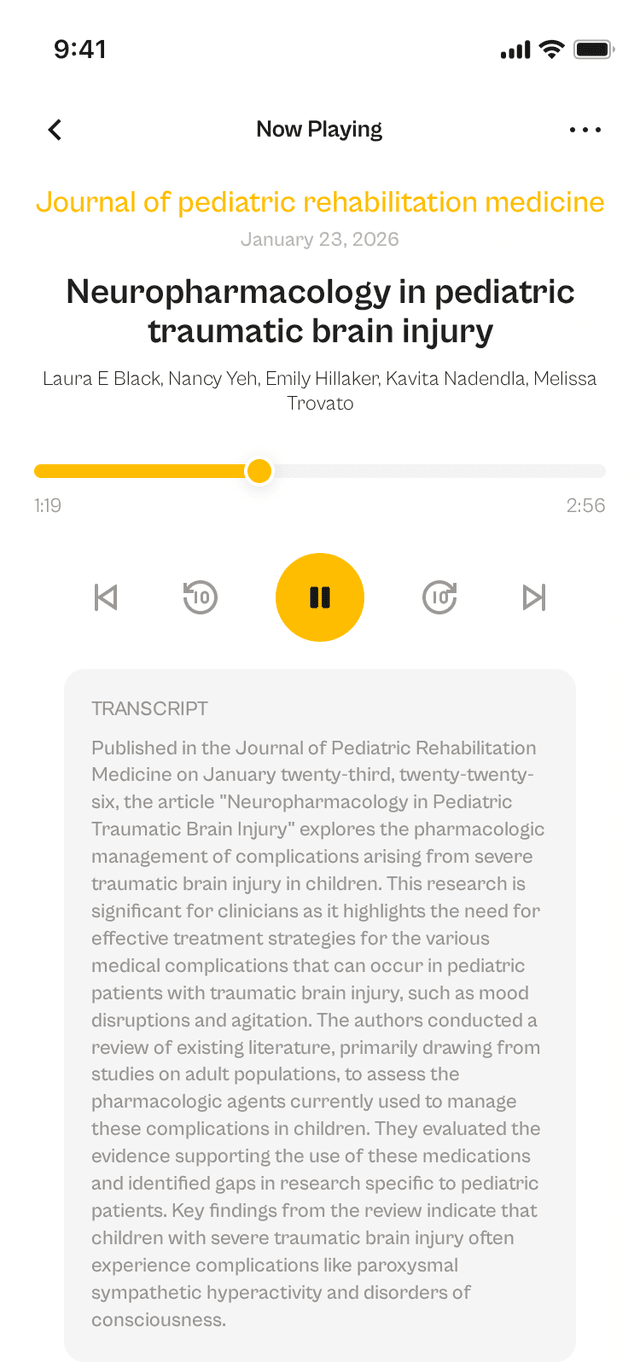
Neuropharmacology in pediatric traumatic brain injury
Listen to this summary
This review article investigates the pharmacologic agents utilized in managing complications associated with severe traumatic brain injury (TBI) in children, such as paroxysmal sympathetic hyperactivity and mood disruptions. The authors highlight the reliance on adult literature for evidence supporting these medications and emphasize the need for further research to assess their effectiveness specifically in pediatric populations.
This is one of 33,000+ journals available on OSLR. Try it free for 14 days.
Free 14-day trial. 33,000+ journals. Cancel anytime.
More from Journal of pediatric rehabilitation medicine
View all →Mar 20, 2026 · Journal of pediatric rehabilitation medicine
Pediatrician reported experiences of transitioning adolescents with disabilities
Mar 11, 2026 · Journal of pediatric rehabilitation medicine
Psychometric Evaluation of Sexual Knowledge and Self-Efficacy Components of the SPARKS Survey for Adults with Spina Bifida
Mar 3, 2026 · Journal of pediatric rehabilitation medicine
Coping experiences in child and adolescent rehabilitation through a novel device: A multi-method feasibility study
Mar 3, 2026 · Journal of pediatric rehabilitation medicine
Acute effect of hippotherapy applied on different sitting surfaces in children with special needs
Feb 10, 2026 · Journal of pediatric rehabilitation medicine
Effects of diaphragmatic breathing and manual diaphragm relaxation on respiratory muscle strength, chest expansion, pulmonary function, and sitting ability in children with diplegic cerebral palsy: A randomized controlled trial
Dec 23, 2025 · Journal of pediatric rehabilitation medicine
Convergent validity of physical and neurological examination of subtle signs (PANESS) gaits and stations with performance-based and self-reported balance measures
More in Physical Therapist
View all →Mar 25, 2026 · The American journal of sports medicine
Lateral Extra-articular Tenodesis Restores Knee Rotational and Translational Stability Regardless of Fixation Type: A Matched-Pair Cadaveric Study
Mar 25, 2026 · The American journal of sports medicine
Deltoid Osteomuscular Transfer Suppresses Humeral Head Translation Caused by Massive Irreparable Rotator Cuff Tears: A Cadaveric Biomechanical Study
Mar 25, 2026 · The American journal of sports medicine
Tibiofemoral Load Sharing and Lateral Meniscal Function Are Restored in Tibia- and Capsular-Based Repair of Type 3 Lateral Meniscal Oblique Radial Tears
Mar 25, 2026 · The American journal of sports medicine
Clinical Outcomes of Unipolar Versus Bipolar Patellofemoral Fresh Osteochondral Allograft Transplantation
Mar 25, 2026 · British journal of sports medicine
Injury risk and its relationship with biological maturation among 100 junior tennis athletes: a 15-year retrospective analysis
Mar 24, 2026 · British journal of sports medicine
Impact of physical activity patterns on major adverse cardiovascular events in adults with hypertension
"Oslr has become part of my weekly routine on my day off. The clinical relevance of the summaries is outstanding — I'd rate it 9/10. Being able to consume research hands-free is a huge advantage for busy physicians."

Dr. Jennifer Thompson
Portland, OR
Stay current without falling behind
33,000+ journals. 3-minute audio summaries. Free for 14 days.