
Trends in Temperature Control after Cardiac Arrest in Cardiac Intensive Care Units: An Analysis from the Critical Care Cardiology Trials Network.
Listen to this summary
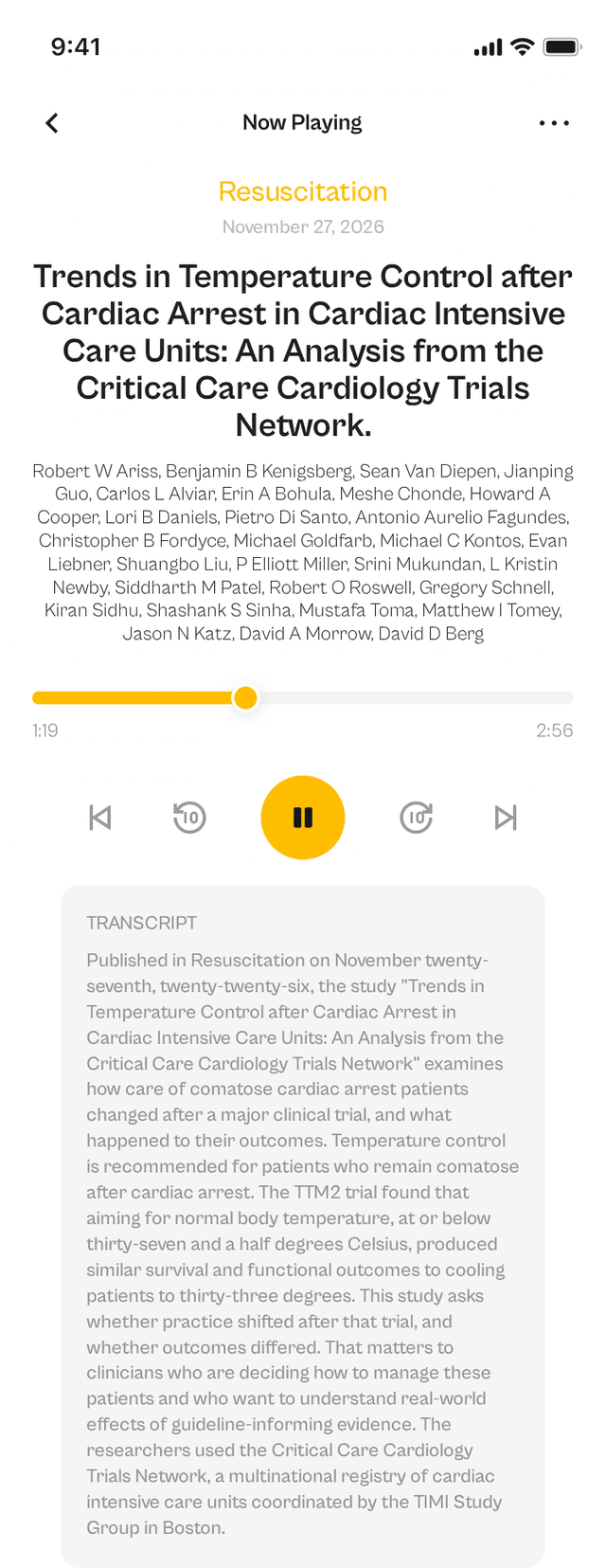
This study examined whether clinicians in cardiac intensive care units changed how they use temperature control after cardiac arrest following the TTM2 trial, which found targeted normothermia to be comparable to hypothermia. Across 1,706 comatose patients from 2018-2024, overall temperature control use stayed stable (74% pre- vs. 78% post-TTM2), but target temperatures shifted markedly toward normothermia. In-hospital mortality was higher after TTM2 among patients with initial shockable rhythms (50% vs. 42%, aOR 1.48), a difference the authors suggest may reflect secular changes in patient populations rather than the treatment shift itself.
This is one of 33,000+ journals available on OSLR. Try it free for 14 days.
Free 14-day trial. 33,000+ journals. Cancel anytime.
More from Resuscitation
View all →Nov 27, 2026 · Resuscitation
Psychological outcomes of spouses of out-of-hospital cardiac arrest survivors according to witnessing and cardiopulmonary resuscitation performance: Results from the cross-sectional DANCAS study.
Nov 27, 2026 · Resuscitation
Sex Differences in Neurological Outcomes After Out-of-Hospital Cardiac Arrest: Sequential Adjusted Analysis from the JAAM Registry.
Nov 27, 2026 · Resuscitation
Prevalence and Patterns of Acute Cerebral Infarctions in Comatose Survivors of Cardiac Arrest.
Nov 27, 2026 · Resuscitation
Coronary artery disease severity in patients with refractory out-of-hospital cardiac arrest: a secondary analysis of the INCEPTION trial.
Nov 26, 2026 · Resuscitation
Reversed airflow during asynchronous volume controlled mechanical ventilation in Out-of-Hospital Cardiac Arrest: a physiological observational study.
Nov 26, 2026 · Resuscitation
Improvement in Peak Oxygen Consumption Following Cardiac Rehabilitation in Out-of-Hospital Cardiac Arrest (OHCA) Survivors: A Comparative Study with ST-elevation Myocardial Infarction (STEMI) Patients.
More in Emergency Medicine
View all →Nov 27, 2026 · The American journal of emergency medicine
Complication rates of emergency physician-performed regional anesthesia in emergency department and inpatient settings: a retrospective cohort study.
Nov 27, 2026 · Journal of pain and symptom management
Voluntarily Stopping Eating and Drinking: a cross-sectional mixed-methods study among relatives in the Netherlands.
Nov 27, 2026 · Journal of pain and symptom management
Impact of voluntary assisted dying on health professionals: A systematic review.
Nov 27, 2026 · Journal of pain and symptom management
Healthcare Utilisation in Patients with Advanced Non-Cancer Conditions: A Propensity Matched Study.
Nov 27, 2026 · The American journal of emergency medicine
Sepsis response team architecture in the emergency department: A systematic review of process reliability and patient outcomes.
Nov 27, 2026 · The American journal of emergency medicine
Modified Cunningham technique compared with the standard Cunningham technique for acute anterior shoulder dislocation: a prospective randomized study.
"Oslr has become part of my weekly routine on my day off. The clinical relevance of the summaries is outstanding — I'd rate it 9/10. Being able to consume research hands-free is a huge advantage for busy physicians."

Dr. Jennifer Thompson
Portland, OR
Stay current without falling behind
33,000+ journals. 3-minute audio summaries. Free for 14 days.